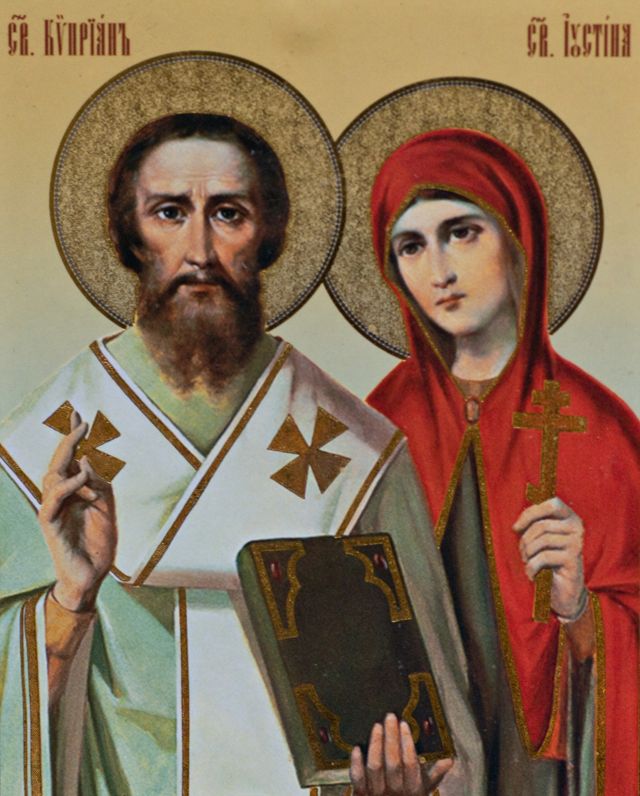
HE only ancient writer who mentions S. Justina of Padua is Venantius Fortunatus, an Italian by birth, but Bishop of Poictiers, in the sixth century. Twice does he mention the name in connection with Padua, but gives no particulars concerning her. Two sermons on S. Justina are attributed to S. Maximus, but they are generally admitted to be much later, the composition of a monk. The Acts of S. Justina are one of those audacious forgeries, more common in the East than in the West, pretending to have been written by an eye-witness of what he describes. The writer of the Acts of S. Justina would have himself regarded as Prosdochimus, disciple of S. Peter, and first bishop of Padua. Some time in the Middle Ages Padua was ambitious to know something about her early bishops and martyrs, and a writer, more zealous than honest, composed S. Justina.
a set of Acts to supply the deficiency. First he wrote the Acts of S. Prosdochimus, as if by S. Maximus, his successor in the see, and inserted therein the words, “ This same man, S. Prosdochimus, wrote the passion of Justina, and committed it to us (/>. Maximus), to be retained in our memory.” The Acts conclude: “ After his death, I, Maximus, his successor, being chosen by all the clergy and people, and consecrated by the Roman bishop, wrote down all that I saw and that I heard of him.” The same hand wrote next the Acts of S. Justina, introducing them with this audacious falsehood: “ I beg of you, whosoever shall piously and religiously hear or read this, to remember in your prayers me, a sinner, who was present, in the Lord’s name, at this martyrdom.” These forgeries are as clumsy as they are wicked. The writer was profoundly ignorant of history. He made Nero succeed Maximian [Diocletian’s co-emperor in the West, 286–305]. For Justina is martyred by Maximian (a.d. 286-305)^ and Prosdochimus, who writes her passion, is a martyr under Nero (a.d. 54-68), and disciple of S. Peter. Vitalianus, father of Justina, is, moreover, king of Padua !
After having stated this, it would seem useless to narrate the incidents of the passion of S. Justina; but inasmuch as it is possible that the pseudo- Prosdochimus may have worked ancient material into his otherwise valueless composition, the account of her martyrdom shall be briefly summarized. Justina, daughter of Vitalianus and Prsepedigna, noble parents at Padua, believing in Christ, was left an orphan at the age of sixteen. As she was returning from her villa in the country to Padua one day, she was stopped by the soldiers of Maximian on the bridge over the Po, and obliged to descend from her chariot and follow them to the court of justice. She knelt on the stones, and prayed God to preserve her innocence, though in the hands of brutal soldiers. The impression of her knees on the stones is shown at this day on the bridge. When brought before Maximian, she showed the utmost courage, and he ordered her to be stabbed to the heart with a sword. In 1 1 77, Gerard, Bishop of Padua, determined to find the body of S. Justina, and having found a skeleton under the altar in the church of her dedication, placed it in a shrine, and exhibited it to the veneration of the people. This is probably the date of the composition of the Acts.
S. Justina is represented with a palm-branch, and her side transfixed by a sword.