Baring-Gould’s sources: Irish Martyrologies. Authority A life in Irish, less extravagant in marvels than most other lives of Irish saints, but yet late; and mention in the Annals of the Four Masters.] S. Ceallach or Kellach, was the son of Eoghan Beul, son of Ceallach, son of Oilioll Molt His brother's name was Muireadhach or Cuchongilt. The family was that of Hy-Fiach. Fiach had two sons, Daud, king of Ireland, 22 Lives of ' the Saints. [Mayi.
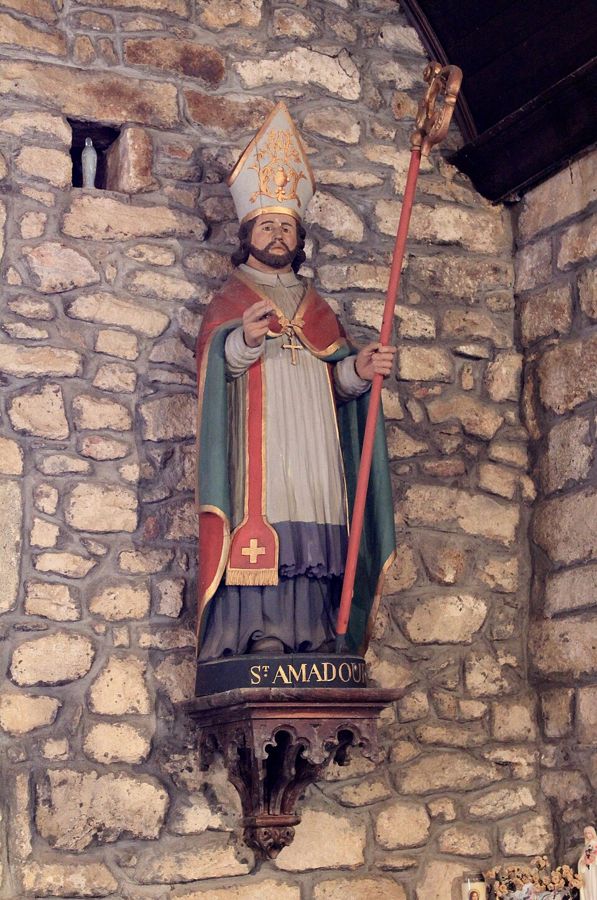
Land Amalgad, king of Connaught. The father of Daud (Dathias) was the famous Niall of the Nine Hostages (d. 404.) Fergus and Donald, descendants of Niall by another son, attacked Eoghan the Fair, and in' a battle on the banks of the Moy, he was grievously wounded, and died three days after. Eoghan left two sons, Ceallach, a monk at Clonmacnois, his eldest, and Cuchongilt, then a child. The chiefs of Connaught went to Clonmacnois, and invited Kellach to ascend the throne. He accepted the invitation, greatly to the disapproval of S. Kieran his abbot. But wearied speedily with the dissensions among his nobles, and their intrigues with the enemy, he deserted his throne, and took refuge in a forest, where he remained concealed for a whole year. He then returned to Clonmacnois, and was received by S. Kieran as a returning prodigal. After a few years he was ordained priest, and then bishop of Killala. Being on a visit to his diocese, he was invited by Guaire, king of Connaught (d. 662) to visit him. Guaire was the son of Colman, of the Neill family, and he had assumed the throne on its being vacated by Kellach. The messenger sent to invite Kellach received as answer that the bishop would visit the king after he had said mass on Sunday, but he could not come before. The messenger instead of giving the exact answer, said that Kellach had refused to accompany him. Thereupon Guaire was angry, and sent orders that Kellach should be expelled his diocese. The saintly bishop retired to the islet of Edghair, in Lough Conn, and there remained with four of his disciples. Guaire, who was jealous and fearful of the bishop, whose throne he had usurped, determined to rid himself of Kellach. He therefore bribed his four disciples, who were also his foster-brothers, and they brought the bishop to the mainland, and murdered him in a wood. Guaire granted the territory of Tirawley to the four murderers as a reward May i.] •S1. Kellach.
for their services, and they thereupon erected a fort at DunFine. Soon after the perpetration of the deed, Muireadhach or Cuchongilt, the brother of Kellach, came to visit his brother in his hermitage, but not finding him there, and hearing of what Guaire had done for the four fosterbrothers, he at once suspected that his brother had been murdered. After some enquiries and searches, he found the body in the hollow trunk of an oak, tom by ravens, scald-crows, and wolves. Cuchongilt carried the mangled body to the church of Turloch for interment, but the clergy dreading the vengeance of king Guaire, would not permit it to be buried there; upon which it was taken to the church of Eiscreacha, where it was interred with due honour. Cuchongilt, after having chanted a short dirge over the grave of his brother, in which he vowed vengeance against the murderers, assembled an armed band of three hundred of his relatives and adherents, with whom, after having lived one year in Hy-Many, and some time in Meath, where he married Aifi, the daughter of Blathmac, king of Ireland, he at length returned to Tirawley, his own Fleasc lamha, or patrimonial inheritance, where, by the assistance of a swineherd, he procured admittance to the fort of Dun-Fine, in which the murderers of his brother were banqueting. He remained at the banquet in the disguise of a swine-herd, until he observed that the four murderers and all their guests and attendants were stupid with intoxication, upon which he sent his friend, the swine-herd, for his armed baud, who were concealed in the neighbourhood, and they rushing into the fort, slew all the guards and attendants, and seized upon the four murderers of Bishop Ceallach. The guests, by no means recovered from their intoxication, on learning that it was Cuchongilt, the second son of king Eoghan Bel, and the brother of the murdered bishop, had thus disturbed their festivities, instead of [May i.
grieving at the occurrence, thought it suitable to hmsn their potations in honour of the rightful heir. On the next day Cuchongilt carried the four murderer's in chains, southwards, through the territory from DunFine to a place called Durlus Muaidhe, and across Lee Durluis, until he arrived at a place near the river Moy, since called Ard-na-riadh (now Ardnarea), i.e., the hill of executions, where he executed the four, cutting off all their limbs while they were living.
After this Cuchongilt obtained the hostages of Tir Fiachract and Tir Amhalgaidh, and compelled Guaire to live in Tir Fiachrach Aidhne, in the south of the province.