L

A shepherd who stayed with his people through hard times.

Read the essentials →
February 27 · Bishop

St. Leander of Hispala

St. Leander of Hispala

A shepherd who stayed with his people through hard times.

Traditional feast

February 27
1914 / pre-1969 calendar, per Baring-Gould (1897)

Current feast

Not verified yet

Represents

Bishop

Their story

Adapted in modern English from the Catholic Encyclopedia (1913) · original text below · little is known

Leander was born at Carthage about 534 to a Roman family that moved to Seville. His brothers Isidore and Fulgentius also became bishops, and his sister Florentina a nun and abbess. A monk, he became Bishop of Seville in 579 and founded a celebrated school.

He helped convert Prince Hermenegild and was exiled to Constantinople by the Arian (followers of Arius's teaching that the Son is a created being, not fully God) king Leovigild, where he wrote against Arianism and became a friend of the future Gregory the Great. Later he had a share in King Reccared's conversion and preached the closing sermon at the Third Council of Toledo, where Visigothic (of the Germanic kingdom ruling Spain) Spain renounced Arianism. He died at Seville in 600 or 601.

Early life

Selected sentences from the original account, unaltered.

This illustrious friend of the great S. Gregory, this apostle of the Visigoths, was of illustrious birth. His father, Severian duke of Carthagena, and mother, Turtura, of royal Ostrogoth blood, had three sons and two daughters. He retired, when young, from the world, and took the religious habit in a monastery of Seville, where he gained so great a reputation that, on the archiepiscopal see becoming vacant, he was elected to it by the unanimous voice of clergy and people.

What they represent

How they teach us to live

Drawn from themes in the original account

Stay faithful when it costs you. This account is about holding firm under pressure.

Feed your mind with Scripture and good books. Learning and the Scriptures matter in this life.

Learn from the kind of life it was. A shepherd who stayed with his people through hard times.

From the Catholic Encyclopedia

1913 · 605 words

Leander of Seville, Saint, bishop of that city, b. at Carthage about 534, of a Roman family established in that city; d. at Seville, 13 March, 600 or 601. Some historians claim that his father Severian was duke or governor of Carthage, but St. Isidore simply states that he was a citizen of that city. The family emigrated from Carthage about 554 and went to Seville. The eminent worth of the children of Severian would seem to indicate that they were reared in distinguished surroundings. Severian had three sons, Leander Isidore, and Fulgentius and one daughter, Florentina. St. Leander and St. Isidore both became bishops of Seville; St. Fulgentius, Bishop of Carthagena, and St. Florentina, a nun, who directed forty convents and one thousand nuns. It has been also believed, but wrongly, that Theodosia, another daughter of Severian, became the wife of the Visigothic king, Leovigild. Leander became at first a Benedictine [monks following the Rule of St. Benedict] monk, and then in 579 Bishop of Seville. In the meantime be founded a celebrated school, which soon became a centre of learning and orthodoxy. He assisted the Princess Ingunthis to convert her husband Hermenegild, the eldest son of Leovigild, and defended the convert against his father's cruel reprisals. In endeavoring to save his country fromn Arianism [followers of Arius, who taught that the Son is a created being, not fully God], Leander showed himself an orthodox Christian and a far-sighted patriot. Exiled by Leovigild, he withdrew to Byzantium from 579 to 582. It is possible, but not proved, that he sought to rouse the Emperor Tiberius to take up arms against the Arian king: in any case the attempt was without result. He profited, however, by his stay at Byzantium to compose important works against Arianism, and there became acquainted with the future Gregory the Great, then legate [an official representative sent by the pope] of Pelagius II at the Byzantine court. A close friendship thenceforth united the two men, and the correspondence of St. Gregory with St. Leander remains one of the latter's greatest titles to honour. It is not known exactly when Leander returned from exile. Leovigild put to death his son Hermenegild in 585, and himself died in 589.

In this decisive hour for the future of Spain, Leander did most to ensure the religious unity, the fervent faith, and the broad culture on which was based its later greatness. He had a share in the conversion of Reccared, and never ceased to exercise over him a deep and beneficial influence. At the Third Council of Toledo, where Visigothic Spain abjured Arianism, Leander delivered the closing sermon. On his return from this council, Leander convened an important synod in his metropolitan [the archbishop who heads a group of dioceses] city of Seville (Conc. Hisp., I), and never afterwards ceased his efforts to consolidate the work, in which his brother and successor St. Isidore was to follow him. Leander received the pallium [a woolen band the pope gives to archbishops as a sign of their authority] in August, 599. There remmain unfortunately of this writer, superior to his brother Isidore, only two works: De institutione virginum et contemptu mundi, a monastic rule composed for his sister, and Homilia de triumpho ecclesiæ ob conversionem Gothorum (P.L., LXXII). St. Isidore wrote of his brother: "This man of suave eloquence and eminent talent shone as brightly by his virtues as by his doctrine. By his faith and zeal the Gothic people have been converted from Arianism to the Catholic faith" (De script. eccles., xxviii).

Acta S.S., 13 March: Mabillon, Acta S.S. O.S B., sæc. I; Aguirre, Collectio max. conc. hisp., Flores, España Sagrada, IX; Bourret, L'école chrétienne de Séville sous la monarchie des Visigoths (Paris, 1855); Montalembert, Les Moines d'Occident, II; Gams, Die Kirchengesch. von Spanien, II (2nd ed., 1874); Görres, Leander, Bischof von Sevilla u. Metropolit der Kirchenprov. Bätica in Zeitsch. fur wissenschaftl. Theol., III (1885).

Read more

The full original · 623 words

Read Baring-Gould’s full account

Baring-Gould’s sources: Roman Martyrology, and those of Usuardus, Notker, Ado, and Bede; but by the Spanish Church and Mozarabic Kalendar, followed by the Bollandists, on March 13th. Authorities:—His own writings, the letters of S. Gregory the Great, and early Spanish histories.

This illustrious friend of the great S. Gregory, this apostle of the Visigoths, was of illustrious birth. His father, Severian duke of Carthagena, and mother, Turtura, of royal Ostrogoth blood, had three sons and two daughters. The sons were, S. Leander, S. Fulgentius, B. of Ecija, and S. Isidore, who succeeded Leander as archbishop of Seville. The daughters were S. Florentina, abbess of fifty convents, and the princess Theodosia, married to king Leovigild, who became the mother of the illustrious martyr, S. Hermenigild.

From his boyhood, Leander was regarded as endowed with singular eloquence and power of fascinating others. He retired, when young, from the world, and took the religious habit in a monastery of Seville, where he gained so great a reputation that, on the archiepiscopal see becoming vacant, he was elected to it by the unanimous voice of clergy and people.

Leovigild, his brother-in-law, then reigned over the Visigoth kingdom, in Spain, and openly professed Arianism [followers of Arius, who taught that the Son is a created being, not fully God]. This caused great embarrassment to Leander, who used every effort to confirm the Catholics in their faith, and to oppose the heretics at every point. He was sent on an embassy from the Catholics to the emperor Tiberius, at Constantinople, where he made the acquaintance of S. Gregory the Great, then cardinal-deacon of Pope Pelagius II., who had sent him at this time on the affairs of the church, to the imperial court. The warmest attachment sprang up between these two great men, and it was at the instance of S. Leander, that S. Gregory wrote his famous "Morals of the Book of Job." When their business was concluded, both saints returned to their country, S. Gregory to Italy, and S. Leander to Spain, where he succeeded in converting prince Hermenigild, his nephew, the eldest son of king Leovigild. This placed the Catholics in great danger. The king, in an explosion of rage, executed his son on Easter-day, 586, and began a furious persecution of the Church. S. Leander and his brother, S. Fulgentius, together with several other bishops, were exiled, and the king seized on the property and revenues of the Church, and, adding cruelty to robbery, put several nobles to death, and confiscated their lands.

S. Leander, though exiled, warred with his pen against the Arian heresy, and wrote two works confuting the errors of Arianism, and a third book answering objections which had been raised against his arguments.

The persecution did not last long, for in the following year, 587, Leovigild, finding himself about to die, recalled the Catholic bishops, and commended his son, Recared, to the care of S. Leander. Thus, to use the words of S. Gregory, Recared, following not the perfidy of his father, an Arian, but the faith of his martyred brother, was brought himself, and the whole nation of the Visigoths, to the true faith.

In the third council of Toledo, 589, the archbishop of Seville presiding, a solemn declaration of the consubstantiality of the Divine Persons was drawn up, and signed by the king, Recared, and his queen, Badda, daughter of king Arthur, of Britain. Next year another synod was held at Seville, in which he presided, to establish the complete conversion of the nation from Arianism to the true faith.

S. Leander died in 596, on March 13th, and his body was laid in the church of SS. Justus and Rufina. His relics [the bodily remains of a saint, or objects they used, kept with honor] are now preserved in a chapel of the Cathedral church.

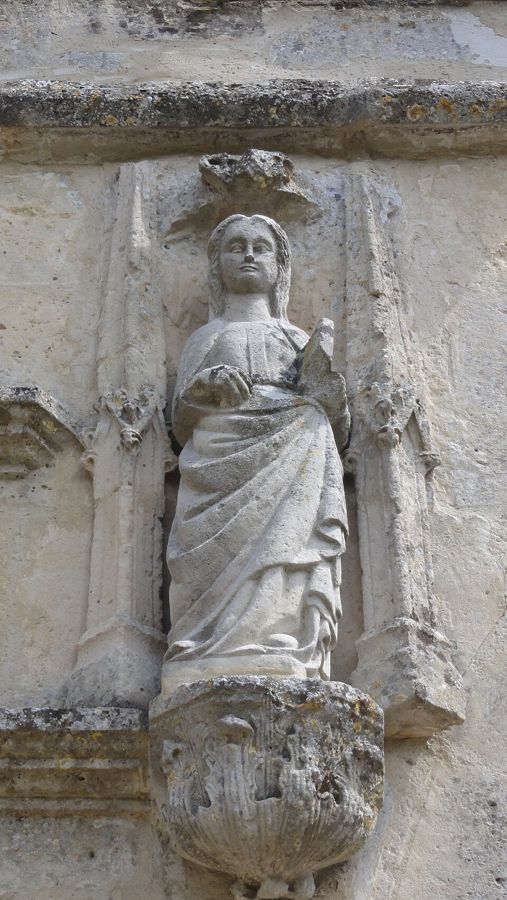
In art, S. Leander appears with (1) a flaming heart in his hand, to represent his zeal for the conversion of the Visigoths, but this is a symbol used for a multitude of other saints; or with (2) a pen; or (3) with Recared or Hermenigild as a boy at his side.
Feast days

Feast: February 27

Nine days · Free

Pray the novena
with us.

One short email a day for nine days. The day's prayer, a line from St. Leander of Hispala's story, and a nudge to keep going.

Also on February 27
Sts. Julian, Chronion and Besas

Sts. Julian

February 27 · Martyrs
G

St. Gelasius

February 27 · Martyr
St. Honorina

St. Honorina

February 27 · Virgin, Martyr
← All 1726 saints in the library
Sources & notes

Feast-day sources

Story sources

Sources

Credits

From Sabine Baring-Gould, The Lives of the Saints, new edition in 16 vols. (London: John C. Nimmo, 1897), digitized text from Project Gutenberg. Public domain.

From “Catholic Encyclopedia (1913)/St. Leander of Seville,” The Catholic Encyclopedia (New York: Robert Appleton Company, 1907–1914), via Wikisource. Public domain. Matched by name and feast date; text unedited except for our bracketed notes in grey.

From Sabine Baring-Gould, The Lives of the Saints, new edition in 16 vols. (London: John C. Nimmo, 1897), digitized text from Project Gutenberg. Public domain in the United States. Reproduced unedited, except for short bracketed notes in grey that we added to explain names and terms (“S.” is the old abbreviation for Saint). Some history and judgments reflect 19th-century scholarship.