Read Baring-Gould’s full account
Baring-Gould’s sources: Roman Martyrology. Canonized by Pope Innocent VIII. in 1484. Authority: — Oratio de S. Leopoldi Austrise march ionis, vita et moribus auctore Jo. Francisco Pacinio, habita, ann. 1484/' in Surius and Pez, Ser. rer. Austr. i. pp. 577-93, with a summary of the canonization and the bull of Innocent VIII. The “ Breve excerptum e chron. Rikardi canon. Neuenburg, de S. Leopoldo,” brought out by Leopoldus Campilitiensis, is a forgery by the editor.] Unfortunately there is not sufficient contemporary evidence as to the life of S. Leopold for a biographer to be able to give a full and satisfactory account of it, and though historians of three hundred years after his death have done their utmost by the exercise of their imaginations, and by giving expression to their conjectures under the guise of historic statements, to cover this deficiency of material, still such testimony is of no value whatever to the serious historian, though it may profit the religious romancer. Leopold IV., margrave of Austria, was the son of Leopold III. and his wife Idda, daughter of the emperor Henry III. His father died in 1096, when he was about nineteen years old, and ten years after he married Agnes, daughter of the emperor Henry IV., widow of Frederick of Saxony, and she became the mother of Conrad, afterwards emperor, and of Frederick, the father of Barbarossa.1 In 1 127 the pious couple built the Cistercian monastery of Holy Cross, near Kahlenberg, where Leopold had his court. They also founded the noble monastery of Neubuig, near Vienna, and endowed it with princely possessions. They also enriched the abbey of Molk, and began the building of the beautiful Freisingen.
5. Leopold \ church at Maria-Zell in Styria. The peace of the county was troubled by an invasion by the Hungarians under Stephen II. Leopold marched to the defence of his frontiers, and defeated the invaders. A few years later the Hungarians again attacked Austria, and Leopold again defeated them, this time with such crushing effect as almost to destroy the whole army, and to reduce the king to sue humbly for peace.
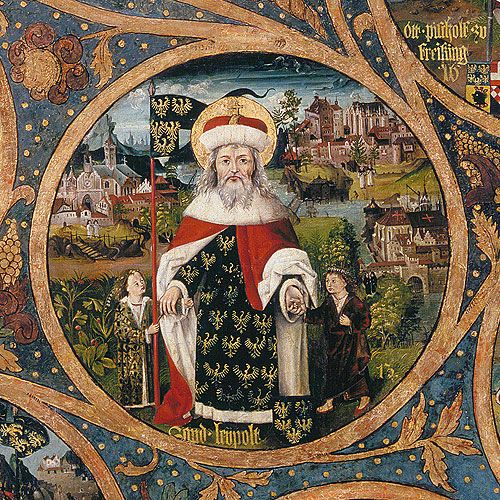
When Henry V. died, in 11*5, the Bavarians endeavoured to obtain the imperial crown for Leopold, but failed, and the Saxons obtained it for Lothair. Perhaps the most signal testimony to the merits of Leopold and his love of peace is, that in the stirring times of Henry V., when Germany was convulsed with civil wars, and in the reign of Lothair, when the empire was in like manner tom by faction, Leopold is not mentioned by the chroniclers. He took no part in these disputes, he neither sided with the Pope against the emperor, nor with Henry V. against the Pope, and he remained firm in his allegiance to Lothair against the interests of his stepson Conrad.1 He died, the beloved of his Neuburg. His skeleton, the head crowned with an archducal coronet, resting on a red satin pillow, is exhibited above an altar in the church at Neuburg. He is represented in margrave's or archduke's apparel, holding a church.
1 When Henry IV. was excommunicated, and his son Henry incited to take up arms against him by Paschal II., Leopold took part with the son in his unnatural rebellion against his lather, but he afterwards did penance to expiate what he felt, in spite of the Papal benediction and sanction, was wrong.