St. Lucian of Antioch

Lucian was born at Samosata in Syria.

Read the essentials →
January 7 · Priest, Martyr

St. Lucian of Antioch

St. Lucian of Antioch

Lucian was born at Samosata in Syria.

Traditional feast

January 7
1914 / pre-1969 calendar, per Baring-Gould (1914)

Current feast

January 7 (also listed: October 15)
Secondary source · Wikipedia

Represents

Priest
Martyr

Their story

Adapted in modern English from Baring-Gould (1914) · original text below

Lucian was born at Samosata in Syria. Baring-Gould says he was orphaned at twelve, gave his inheritance to the poor, and studied Scripture at Edessa under a teacher named Macarius. As a priest he opened a school at Antioch. There he worked on a corrected text of the Greek Bible by comparing manuscripts with the Hebrew. His edition was widely used in the East, and Jerome (the scholar who made the Latin Vulgate Bible) knew it. Some of his students later became leading Arians (followers of Arius's teaching that the Son is a created being, not fully God), and Lucian's own orthodoxy has been debated. He died, however, in communion with the Church.

In the last phase of the Great Persecution (the empire's final attempt to wipe out Christianity, 303–313), under Emperor Maximinus Daia (whom Baring-Gould calls Maximian), Lucian hid. A Sabellian (a group that denied that Father, Son and Spirit are distinct persons) priest betrayed him, and he was taken to Nicomedia, the eastern capital. On the way he is said to have brought back forty Christian soldiers who had given in. In prison he was racked, laid on broken pottery, and starved.

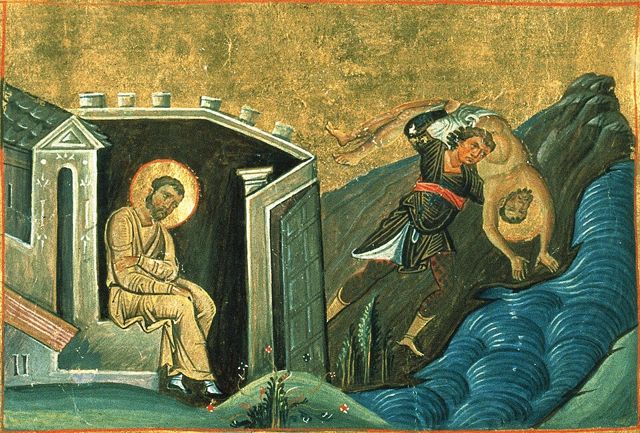
After fourteen days, as Epiphany (the feast of Christ's manifestation, January 6) approached, his disciples wanted to receive the Eucharist from him once more. There was no way to bring an altar into the prison. So, as the old account says, he told them: 'This breast of mine shall be the table, and you shall be a holy temple standing round me.' They stood in a close ring to hide him from the guards, and he celebrated with the bread and wine resting on his chest. The next day, when officers came to see if he was alive, he said three times, 'I am a Christian,' and died, on January 7, 312. His body was thrown into the sea and recovered fifteen days later; a legend says a dolphin brought it ashore.

Early life

Selected sentences from the original account, unaltered.

Saint Lucian was born at Samosata, in Syria; his parents were Christians, and sought above all things to educate their son in the fear of God.

What they represent

How they teach us to live

Drawn from themes in the original account

Stay faithful when it costs you. This account is about holding firm under pressure.

Pray a little every day. Prayer runs all through this account.

Feed your mind with Scripture and good books. Learning and the Scriptures matter in this life.

Read more

The full original · 616 words

Read Baring-Gould’s full account

Baring-Gould’s sources: Commemorated on this day by the Latins, on the 15th October by the Greeks. This S. Lucian is not to be confused with S. Lucian of Beauvais, commemorated on Jan. 8th. He is spoken of by S. Jerome and Theodoret. S. Chrysostom has a homily on S. Lucian. Information concerning him is also obtained from the Greek Menæa, and from the Acts of his martyrdom in Metaphrastes.

Saint Lucian was born at Samosata, in Syria; his parents were Christians, and sought above all things to educate their son in the fear of God. Both died and left him an orphan at the age of twelve, and the boy, in his desolation, distributed his goods to the poor, and took refuge with Macarius at Edessa, who taught out of Holy Scripture the things concerning eternal life. Arrived at man's estate, he was ordained priest, and opened a school at Antioch, and diligently laboured at procuring a correct version of the Holy Scriptures, by comparing together the different Hebrew copies. His version of the sacred writings was used by S. Jerome [translator of the Bible into Latin (d. 420)], and proved of much assistance to him in his work of writing the Vulgate.

When Maximian [Diocletian’s co-emperor in the West, 286–305] persecuted the Church, S. Lucian concealed himself, but was betrayed by a Sabellian priest into the hands of the persecutors; he was taken to Nicomedia, and brought before Maximian. On his way he was the means of recovering forty Christian soldiers, who had lapsed. In Nicomedia he was subjected to torture. His feet were placed in the stocks, which were distended, so as to dislocate his legs. His hands were fastened to a beam, which was above his head, and he was laid on sharp potsherds, so that his back was lacerated and pierced. After this, he was allowed to lie on his cell floor, unable to rise, on account of his legs being out of joint, and was starved to death. He lingered fourteen days. And when the feast of the Manifestation drew nigh, he desired greatly to receive the Holy Eucharist. "When the fatal day had arrived, which was looked forward to, some of the disciples desired to receive from their master his last celebration of the divine mystery. But it seemed doubtful how they might bring a table into the prison, and how they might conceal it from the eyes of the impious. But when many of the disciples were assembled, and others were arriving, he said: 'This breast of mine shall be the table, and I reckon it will not be less esteemed of God than one of inanimate material; and ye shall be a holy temple, standing round about me.' And thus it was accomplished, for because the saintly man was at the end of his life, the guards were negligent, and so God, as I think, to honour his martyr, removed all impediments to that being done which was proposed. For when all stood in close ring round the martyr, so that one standing by the other shut him completely from view, he ordered the symbols of the divine Sacrifice to be placed on his breast. After that he raised his eyes to heaven, and uttered the accustomed prayers. Then, when he had uttered many sacred prayers, and had done all the requisite acts in the sacred rite, he and the rest communicated, and he sent to those who were absent, as he himself shows in his last Epistle to them. Next day some officers came from the Emperor to see if he were still alive. And as he saw them standing about him, he said thrice, 'I am a Christian,' and so saying, he died."

The body was then thrown into the sea, to the great grief of his disciples, who desired to bury it. But fifteen days after it was recovered. A legend says that a dolphin brought it ashore; be that as it may, it was found and was buried.

In art, S. Lucian is sometimes represented with a chalice and Host, in allusion to his offering the holy Sacrifice in prison; sometimes with a dolphin at his side.
Feast days

Feast: January 7

Nine days · Free

Pray the novena
with us.

One short email a day for nine days. The day's prayer, a line from St. Lucian of Antioch's story, and a nudge to keep going.

Also on January 7
V

St. Valentine of Passau

January 7 · Bishop
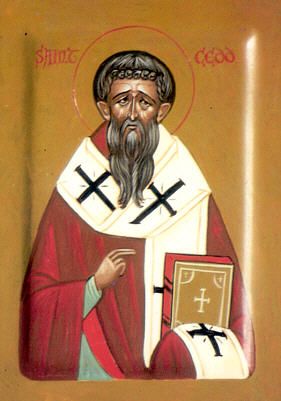
St. Cedd of London

St. Cedd of London

January 7 · Bishop
T

St. Tyllo

January 7 · Hermit
← All 1726 saints in the library
Sources & notes

Feast-day sources

Story sources

Sources

Credits

Image: Lucian of Antioch (Menologion of Basil II).jpg · Authors of Menologion of Basil II (circa 985 AC, Constantinople), Byzantine manuscript illuminators[1]: Pantoleon with G · Public domain, via Wikimedia Commons

From Sabine Baring-Gould, The Lives of the Saints, new and revised edition (Edinburgh: John Grant, 1914; first edition 1872). Public domain.

Image: Authors of Menologion of Basil II (circa 985 AC, Constantinople), Byzantine manuscript illuminators[1]: Pantoleon with G, Wikimedia Commons (Public domain)

From Sabine Baring-Gould, The Lives of the Saints, new and revised edition (Edinburgh: John Grant, 1914; first edition 1872). Public domain in the United States. Reproduced unedited, except for short bracketed notes in grey that we added to explain names and terms (“S.” is the old abbreviation for Saint). Some history and judgments reflect 19th-century scholarship.