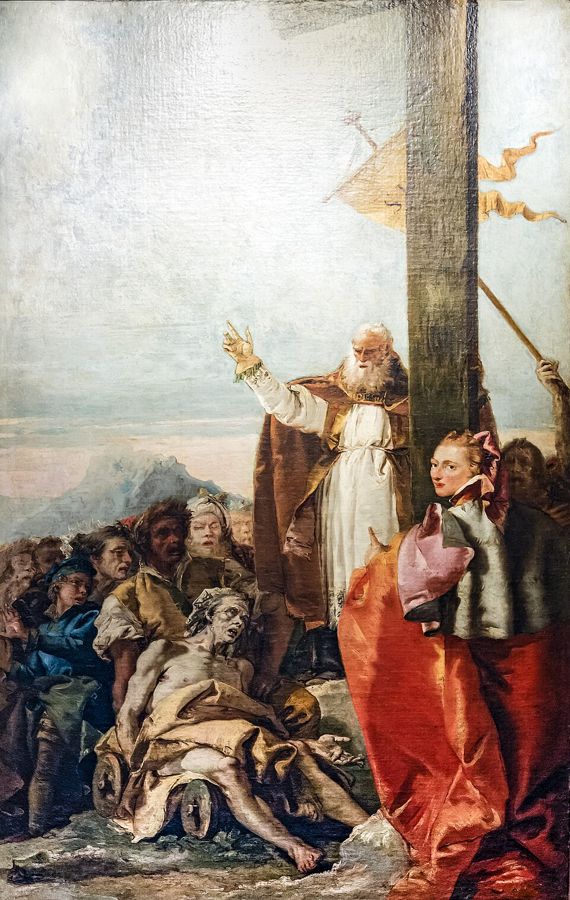
Bishop of Jerusalem (312-34). The date of Macarius's accession to the episcopate is found in St. Jerome's version of Eusebius [Eusebius of Caesarea (d. c. 339), the first historian of the Church]'s "Chronicle" (ann. Abr. 2330). His death must have been before the council at Tyre, in 335, at which his successor, Maximus, was apparently one of the bishops present. Macarius was one of the bishops to whom St. Alexander of Alexandria wrote warning them against Arius (Epiph., "Hær.", LXIX, iv). The vigour of his opposition to the new heresy is shown by the abusive manner in which Arius speaks of him in his letter to Eusebius of Nicomedia (Theodoret, "H. E.", I, 4). He was present at the Council of Nicæa, and two conjectures as to the part he played there are worth mentioning. The first is that there was a passage of arms between him and his metropolitan [the archbishop who heads a group of dioceses], Eusebius of Cæsarea, concerning the rights of their respective sees. The seventh canon of the council-"As custom and ancient tradition show that the bishop of Ælia [Jerusalem] ought to be honoured, he shall have precedence; without prejudice, however, to the dignity which belongs to the Metropolis"-by its vagueness suggests that it was the result of a drawn battle. The second conjecture is that Macharius, together with Eustathius of Antioch, had a good deal to do with the drafting of the Creed finally adopted by the Council of Nicæa. For the grounds of this conjecture (expressions in the Creed recalling those of Jerusalem and Antioch) the reader may consult Hort, "Two Dissertations", etc., 58 sqq.; Harnack, "Dogmengesch.", II (3rd edition), 231; Kattenbusch, "Das Apost. Symbol." (See index in vol. II.)
From conjectures we may turn to fiction. In the "History of the Council of Nicæa" attributed to Gelasius of Cyzicus there are a number of imaginary disputations between Fathers of the Council and philosophers in the pay of Arius. In one of these disputes where Macarius is spokesman for the bishops he defends the Descent into Hell. This, in view of the question whether the Descent into Hell was found in the Jerusalem Creed, is interesting, especially as in other respects Macarius's language is made conformable to that Creed (cf Hahn, "Symbole", 133). Macarius's name appears first among those of the bishops of Palestine who subscribed to the Council of Nicæa; that of Eusebius comes fifth. St. Athanasius, in his encyclical letter to the bishops of Egypt and Libya, places the name of Macarius (who had been long dead at that time) among those of bishops renowned for their orthodoxy. Sozomen (H. E., II, 20) narrates that Macarius appointed Maximus, who afterwards succeeded him, Bishop of Lydia, and that the appointment did not take effect because the poeple of Jerusalem refused to part with Maximus. He also gives another version of the story, to the effect that Macarius himself changed his mind, fearing that, if Maximus was out of the way, an unorthodox bishop would be appointed to succeed him (Macarius). Tillemont (Mém. Ecclés., VI, 741) discredits this story (1) because Macarius by so acting would have contravened the seventh canon of Nicæa; (2) because Aetius, who at the time of the council was Bishop of Lydda, was certainly alive in 331, and very probably in 349. Of course, if Aetius outlived Macarius, the story breaks down; but if he died shortly after 331, it seems plausible enough. The fact that Macarius was then nearing his end would explain the reluctance, whether on his part or that of his flock, to be deprived of Maximus. Tillemont's first objection carries no weight. The seventh canon was too vague to secure from an orthodox bishop like Macarius very strict views as to the metropolitan rights of a Semi-Arian [followers of Arius, who taught that the Son is a created being, not fully God] like Eusebius. St. Theophanes (d. 818) in his "Chronography" makes Constantine, at the end of the Council of Nicæa, order Macarius to search for the sites of the Resurrection and the Passion, and the True Cross. It is likely enough that this is what happened, for excavations were begun very soon after the council, and, it would seem under the superintendence of Macarius. The huge mound and stonework with the temple of Venus on the top, which in the time of Hadrian had been piled up over the Holy Sepulchre, were demolished, and "when the original surface of the ground appeared, forthwith, contrary to all expectation, the hallowed monument of our Saviour's Resurrection was discovered" (Euseb., Vit. Const., III, 28). On hearing the news Constantine wrote to Macarius giving lavish orders for the erection of a church on the site (Euseb., Ib., III, 30; Theodoret, H. E., I, 16). Later on, he wrote another letter "To Macarius and the rest of the Bishops of Palestine" ordering a church to be built at Mambre, which also had been defiled by a pagan shrine. Eusebius, though he gives the superscription as above, speaks of this letter as "addressed to me", thinking, perhaps of his metropolitan dignity (Vit. Const., III, 51-53). Churches were also built on the sites of the Nativity and Ascension.
(For the story of the finding of the True Cross see I, 4.)
Read the rest of the article
Acta SS., 10 March; Venables in Dict. Christ. Biog., s. v.