Baring-Gould’s sources: Roman Martyrology. Amongst the Greeks on March 9th; the ancient Martyrology attributed to S. Jerome on March 9th, as also that of Bede, and most ancient Martyrologies. In the Roman, it has been transferred to the 10th, because the feast of S. Frances is a double. Authorities:—The Ancient Latin and Greek Acts, the former a recension of more ancient Acts, made in 900; the latter of less antiquity, also the Armenian Acts. These saints are spoken of by S. Ephraem Syrus, (d. 378), and by S. Gregory Nyssen, (d. 396), and S. Basil has a sermon on them. There is also a homily upon them extant by S. Gaudentius, B. of Brescia, (375.) The invention of their relics is mentioned by Sozomen, Hist. Eccl. lib. ix. c. 2.
When the Emperor Licinius [Roman emperor in the East 308–324] had broken with his brother-in-law Constantine, he threw off the mask of toleration he had worn, and openly persecuted the Christians. When in Cappadocia [a region of central Turkey], he published an edict commanding every Christian, on pain of death, to abandon his religion. Agricola, governor of Cappadocia and Lesser Armenia, resided at Sebaste, where S. Blaise, bishop of that city, was one of the first victims. In the army which was quartered there was the Thundering Legion. Its commanding officer was Lysias. Forty soldiers of that legion, natives of different countries, but all young, brave, and distinguished for their services, refused to sacrifice to the idols. When Agricola announced the imperial order to the army, these forty brave men advanced to his tribunal, and announced themselves to be Christians. They were at once cast into prison, where they raised the 90th (91st) psalm, in solemn chant, as the darkness closed upon them; "Whoso dwelleth under the defence of the Most High; shall abide under the shadow of the Almighty." Our blessed Lord appeared to them, and bade them play the man, and win the crown of victory. Then Cyrio, one of the confessors, said to his brethren, "It has pleased God to unite us forty brethren in one communion of faith and warfare, let us not part in life or in death. Let us ask of God to send us forty to our crown together."
Six or seven days after they were brought again before the governor, and were sentenced to be exposed naked through the bitter winter night on the ice of a pond; but he ordered that a fire and warm bath should be prepared in a small building opening on the pond, and that any of the confessors who should take advantage of this should be regarded as having apostatized.
Night closed in over the city. The shops were shut; the streets were still. Men went not willingly forth into the bitter cold. No friendly cloud hung in the sky—it was a clear, starry night;—the constellations glowed in the intense frost. The citizens heaped up their fires, and gathered closer around them. The soldiers canvassed the constancy of the sufferers. There, on the frozen pool, stood the martyrs of Jesus Christ. From the open door of the hut, a bright cheerful gleam of fire-light shone; reflecting itself on the clear dark ice. Some presently fell, and slept that sleep which ends only in death; some walked hurriedly up and down, as if to keep in the heat of life; some stood with their arms folded, almost lost in prayer; some consoled themselves and their brethren in the conflict. They prayed earnestly that He, who had in a special manner consecrated the number forty to Himself; who had bade Moses tarry in the mount forty days, who had fed Elijah with that food, in the strength whereof he went forty days and forty nights; who had given Nineveh forty days for repentance; they called on Him who had Himself fasted forty days, and had lain forty hours in death, not to fail them then. "Forty wrestlers," they said, "O Lord, we have entered the arena; let forty victors receive the prize!"
One of the soldiers guarding the pond was waiting by the fire, and slept. And in his sleep he beheld this vision. He stood by the side of the pool, and saw the martyrs in their conflict. As he gazed on them, an angel came down from the sky with a golden crown in his hands. Its brightness was not of this world; it was most bright, most beautiful. He brought another, and another, and another, till the dreamer perceived that he was charged with the everlasting diadems of the victorious martyrs. Nine-and-thirty crowns he brought, but he came not with the fortieth.
"What may this mean?" he asked, as he awoke. As he was wondering, there was a stir without, and the soldiers brought in one of the confessors. He could endure it no more, he had come to the fire and the warm bath. He who had dreamed went forth. Still the cloudless night; still the intense piercing blast from the range of the Caucasus. Most of the sufferers, on the frozen pool, had fallen where they stood. To them the bitterness of death was past; for they were in the last fatal sleep; and their diadem, though not yet attained, were certain. Others were praying, "Forty wrestlers we have entered the arena; let forty victors receive the prize."
O wonderful power of prayer in all! but most wonderful virtue of intercession in Christ's martyrs! At that moment a thought rushed into the mind of the soldier; a thought so sweet, so cheering, that the bitter Armenian night seemed to him as pleasant as the breath of a May morning. "One has fallen from his crown; I may attain to it."
In half-an-hour he had roused the governor from his sleep, and had professed himself a Christian. In half-an-hour more he stood himself on the frozen pool, a confessor [in old usage, a saint who was not martyred, or who suffered for the faith without being killed] among the other confessors. And there was yet life in some of the sufferers to hail this new brother in arms in the spiritual warfare. He, too, contending to the end, received the prize; the virtue of Baptism, as the Church has ever taught, being supplied to him in this case by the grace of that martyrdom whereof he was accounted worthy.
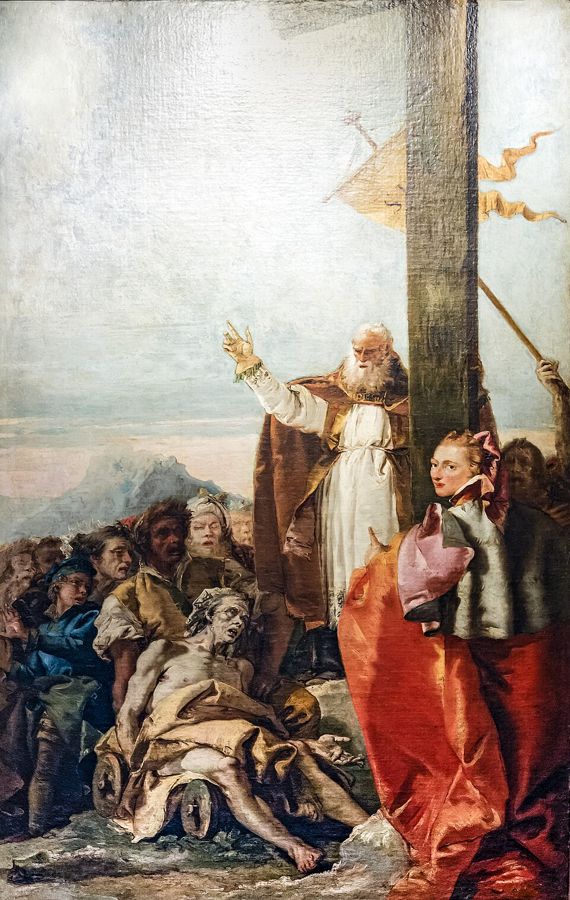
Morning broke at last, and a few still lived, amongst others Melithon, the youngest of the soldiers. Agricola ordered the legs and arms of those who survived to be broken, and as the order was carried into execution, they sang faintly with their frozen lips, "Our soul hath escaped out of the snare of the fowler; the snare is broken, and we are delivered." The mother of Melithon was present. She raised him in her arms, and laid him with the other bodies in the wagon which was to convey them to a fire in which they were all to be consumed. Melithon still lived, and smiled faintly upon her. "Oh, son of my bosom, how glad am I to see thee offer to Christ the last remains of thy life. Blessed is the womb that bare thee, and the paps that thou hast sucked!" And she followed the tumbril to the fire into which her yet breathing son was cast, together with the frozen bodies of his comrades.
A few fragments still remain of the church, which in after years was raised on the scene of the martyrdom. The names of these martyrs were Quirio or Cyrio, Candidus, Domnus, Melitho, Domitian [Roman emperor 81–96], Eunoicus, Sisinius, Heraclius, Alexander, John, Claudius, Athanasius, Valens, Helianus, Ecditius, Acacius, Vivianus, Helias, Theodulus, Cyrillus, Flavius, Severian, Valerius, Chudio, Sacerdo Priscus, Eutychius, Smaragdus, Philoctimo, Aetius, Nicolas, Lysimachus, Theophilus, Xantheas, Augias, Leontius, Hesychius, Caius and Gorgo.