A shepherd who stayed with his people through hard times.
Read the essentials →A shepherd who stayed with his people through hard times.
November 13
November 12
Bishop
Machar placed himself under S. Columba in Hy, or Iona, and was sent to convert the inhabitants of the island of MulL There he healed seven lepers, and turned to stone a boar which rushed forth against him. He was ordained bishop, and sent among the Piets with twelve companions, and ordered by S. Columba to stop where a river took the form of a pastoral staff. Having found such a spot, he built a church, and preached the Word with great success.
Share your faith, in words and by example. Preaching and conversion are central here.
Look after people who are sick or suffering. The sick come up again and again in this story.
Learn from the kind of life it was. A shepherd who stayed with his people through hard times.
Machar placed himself under S. Columba [Irish abbot of Iona (d. 597), apostle of Scotland] in Hy, or Iona, and was sent to convert the inhabitants of the island of MulL There he healed seven lepers, and turned to stone a boar which rushed forth against him.
He was ordained bishop, and sent among the Piets with twelve companions, and ordered by S. Columba to stop where a river took the form of a pastoral staff. Having found such a spot, he built a church, and preached the Word with great success. It is said that he accompanied S. Columba to Rome, and that S. Gregory gave him the name of Maurice, and appointed him to the vacant episcopal throne of Tours. On reaching Tours with his master, the people they found were ignorant of where S. Martin [St. Martin of Tours (d. 397), soldier turned bishop] lay. S. Columba promised to find the body if he were given a relic from it. He prayed, discovered the remains of S. Martin, and carried off the missal of the saint which lay with the body. Maurice remained at Tours as bishop, and ruled the diocese three years and a half. Then, after a glorious vision of Christ, S. Cohimba, and S. Martin, he died, and was buried at Tours. This story deserves no credit. S. Columba never went to Rome or to Tours. S. Gregory the Great was made Pope in 590, and S. Columba died in 597. He was far too old and infirm to have made such a journey in the last years of his life. The church of Tours knows nothing of a Bishop Maurice.
Mochumma, as we learn from O’Donell’s Life of S. Columba, accompanied the abbot from Ireland when banished by the Synod of Teilte, in 562. In vain Columba represented to him that he ought not to abandon his parents and native soil. “It is thou,” answered the young man, “who art my father, the Church is my mother, and my country is where I can gather the largest harvest for Christ.” Then, in order to make all resistance impossible, he made a solemn vow aloud to leave his country and follow Columba. “ I swear to follow thee wherever thou goest, until thou hast led me to Christ, to whom thou hast consecrated me.” It was thus, says his historian, that he forced himself, rather than offered himself, as a companion to the great exile, in the course of his apostolical career among the Piets, and he had no more active or devoted auxiliary.
There are two parishes in Aberdeen bearing his name, and Mackeris Haugh in Kildrummie. That he was a bishop is possible, that he preached in Mull and in Aberdeenshire is probable. Dochonna and Tochannu are forms of his name.
Feast: November 12
Traditional: November 13
One short email a day for nine days. The day's prayer, a line from St. Machar's story, and a nudge to keep going.
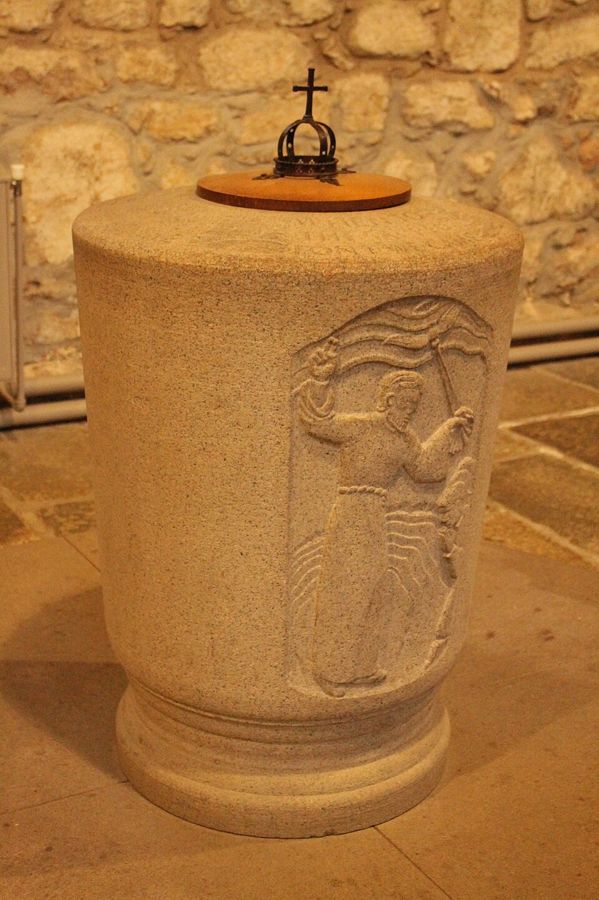
Image: The font at St Machar's Cathedral by Hew Lorimer.jpg · Stephencdickson · CC BY-SA 4.0, via Wikimedia Commons
From Sabine Baring-Gould, The Lives of the Saints, new edition in 16 vols. (London: John C. Nimmo, 1897–98); text from the Internet Archive scan (OCR, lightly cleaned; errors possible). Public domain.
Image: Stephencdickson, Wikimedia Commons (CC BY-SA 4.0)
From Sabine Baring-Gould, The Lives of the Saints, new edition in 16 vols. (London: John C. Nimmo, 1897–98); text from the Internet Archive scan (OCR, lightly cleaned; errors possible). Public domain in the United States. Reproduced unedited, except for short bracketed notes in grey that we added to explain names and terms (“S.” is the old abbreviation for Saint). Some history and judgments reflect 19th-century scholarship.
