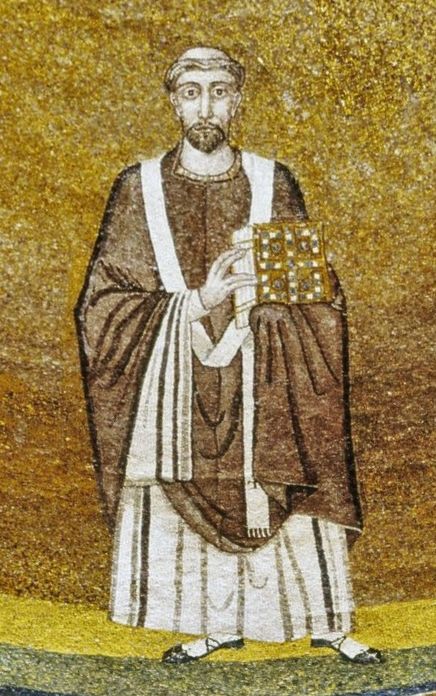
Macrina, the name of two saints, grandmother and granddaughter. They belonged to the family of the great Cappadocian Fathers, Sts. Basil and Gregory of Nyssa.
St. Macrina the Elder.—Our knowledge of the life of the elder Macrina is derived mainly from the testimony of the above-mentioned Fathers of the Church, her grandchildren (Basil, Ep. cciv, 7; ccxxiii, 3; Gregory of Nyssa, "Vita Macrinæ Junioris"), and the panegyric of the third great Cappadocian, St. Gregory of Nasiansus, on St. Basil (Gregory Nas., Oratio xliii). She was the mother of the elder Basil, the father of Basil, Gregory, and other children whose names are known to us, including Macrina the Younger. Her home was at Neocæsarea in Pontus [a region on the Black Sea coast of Turkey]. In her childhood she was acquainted with St. Gregory Thaumaturgus, first bishop of her native town. As this venerable doctor, who had won Neocæsarea almost completely for Christianity, died between 270 and 275, St. Macrina must have been born before 270. During the Diocletian [Roman emperor 284–305, who began the ‘Great Persecution’ of Christians in 303] persecution she fled from her native town with her husband, of whose name we are ignorant, and had to endure many privations. She was thus a confessor [in old usage, a saint who was not martyred, or who suffered for the faith without being killed] of the Faith during the last violent storm that burst over the early Church. On the intellectual and religious training of St. Basil and his elder brothers and sisters, she exercised a great influence, implanting in their minds those seeds of piety and that ardent desire for Christian perfection which were later to attain so glorious a growth. As St. Basil was probably born in 331, St. Macrina must have died early in the fourth decade of the fourth century. Her feast is celebrated on 14 January.
St. Macrina the Younger, b. about 330; d. 379. She was the eldest child of Basil and the Elder Emmelia, the granddaughter of St. Macrina the Elder, and the sister of the Cappadocian Fathers, Sts. Basil and Gregory of Nyssa. The last-mentioned has left us a biography of his sister in the form of a panegyric ("Vita Macrinæ Junioris" in P. G., XLVI, 960 sq.). She received an excellent intellectual training, though one based more on the study of Holy Writ than on that of profane literature. When she was but twelve years old, her father had already arranged a marriage for her with a young advocate of excellent family. Soon afterwards, however, her affianced husband died suddenly, and Macrina resolved to devote herself to a life of perpetual virginity and the pursuit of Christian perfection. She exercised great influence over the religious training of her younger brothers, especially St. Peter, afterwards Bishop of Sebaste, and through her St. Gregory received the greatest intellectual stimulation. On the death of their father, Basil took her, with their mother, to a family estate on the River Iris, in Pontus. Here, with their servants and other companions, they led a life of retirement, consecrating themselves to God. Strict asceticism, zealous meditation on the truths of Christianity, and prayer were the chief concerns of this community. Not only the brothers of St. Macrina, but also St. Gregory of Nazianzus and Eustathius of Sebaste were associated with this pious circle and were there stimulated to make still further advances towards Christian perfection. After the death of her mother Emmelia, Macrina became the head of this community, in which the truth of the earnest Christian life matured so gloriously. On his return from a synod at Antioch, towards the end of 379, Gregory of Nyasa visited his deeply venerated sister, and found her grievously ill. In pious discourse, the brother and sister spoke of the life beyond and of the meeting in heaven. Soon afterwards Macrina passed blissfully to her reward. Gregory composed a "Dialogue on the Soul and Resurrection" (περὶ ψυχῆς καὶ ἀναστάσεως), treating of his pious discourse with his dying sister. In this, Macrina appears as teacher, and treats of the soul, death, the resurrection, and the restoration of all things. Hence, the title of the work, τὰ Μακρίνια (P.G., XLVI, 12 sq.). Her feast be celebrated 19 July.
Read the rest of the article
Acta SS., Jan I, 952 sq; July. IV, 589 sq.; Allard, St-Basile (Paris, 1899); Bouty, Sainte Macrine in Revus Augustinienne (July, 1902), 265-88.