M

Maieul, in Latin Majolus, was born at Avignon (in southern France, where the popes lived from 1309 to 1377) to a rich and noble family.

Read the essentials →
May 10 · Abbot

St. Majolus

St. Majolus

Maieul, in Latin Majolus, was born at Avignon (in southern France, where the popes lived from 1309 to 1377) to a rich and noble family.

Traditional feast

May 10
1914 / pre-1969 calendar, per Baring-Gould (1897)

Current feast

Not verified yet

Represents

Abbot

Their story

Adapted in modern English from Alban Butler's Lives of the Saints · Baring-Gould original below

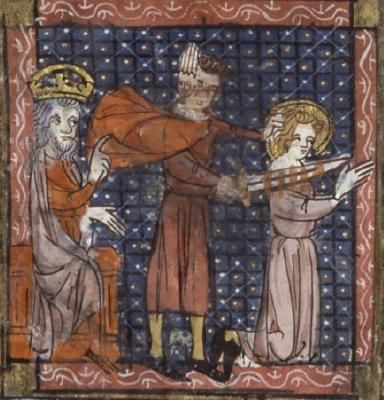
Maieul, in Latin Majolus, was born at Avignon (in southern France, where the popes lived from 1309 to 1377) to a rich and noble family. He studied at Lyons and became archdeacon of Macon, then fled to Cluni to avoid being made Archbishop of Besancon, and became a monk there.

Abbot Aimard made him joint abbot. The Emperor Otho the Great trusted him completely, and he reconciled the Empress St Alice with her son Otho II. They wanted him made pope, but he refused, saying he was unfit and that his ways were too unlike those of the Romans.

He named St Odilo his coadjutor in 991. At the request of Hugh Capet he set out to reform the abbey of St Denys, but fell ill on the way and died at Souvigni on 11 May 994.

Early life

The book says little or nothing about early life. This is how the account begins.

The aged Aymard, oppressed with years, was at length obliged to surrender the government of the abbey into the hands of S. Majolus (948). But the old man in the infirmary, having one day fancied a bit of cheese, and ordered ineffectually that it should be brought to him, took it into his head that he was neglected, and he suddenly resumed his authority, and put Majolus to penance. In fact the old man had asked for his piece of cheese when the monks were at dinner, and the serving brothers had their hands full of work, so that it was impossible to attend to his caprice at that moment.

What they represent

How they teach us to live

Drawn from themes in the original account

Look after people who are sick or suffering. The sick come up again and again in this story.

Pray a little every day. Prayer runs all through this account.

Practise small acts of self-denial. The account dwells on fasting and penance; a skipped snack or a phone-free hour is a start.

Read more

The full original · 496 words

Read Baring-Gould’s full account

Baring-Gould’s sources: Roman and Benedictine Martyrologies, but some on May 4th, or April 14th. Authority: — A life written by Nalgod, his disciple. Majolus in French is Mayeul. ] S. Majolus was born about the year 906, of a wealthy family at Valenzola, in the diocese of Riez. But having lost all his family possessions through the incursions of the Saracens and Huns, he retired to Macon to his uncle Berno, bishop of that city, who constituted him his archdeacon. He afterwards became monk at Cluny, under the abbot Aymard.

The aged Aymard, oppressed with years, was at length obliged to surrender the government of the abbey into the hands of S. Majolus (948). But the old man in the infirmary, having one day fancied a bit of cheese, and ordered ineffectually that it should be brought to him, took it into his head that he was neglected, and he suddenly resumed his authority, and put Majolus to penance. In fact the old man had asked for his piece of cheese when the monks were at dinner, and the serving brothers had their hands full of work, so that it was impossible to attend to his caprice at that moment. However, Aymard, finding that he was really unable to dp the work required of an abbot, and satisfied that Majolus was not really neglectful of him, and desirous of usurping his dignity, returned to inaction, and on his death Majolus was elected abbot. On his way to Rome, a monk who was accompanying him, disobeyed him in an important matter, and afterwards apologized and asked pardon. “And set me a penance for my fault,” he asked. “Are you in earnest, my son?” asked the abbot. “ I am,” answered the monk. “ Then,” said Majolus, “Go and kiss yon poor leper.” The monk went at once to the leper and embraced him. The obedient kiss healed the leper.

On his way back from Rome, as he crossed the S. Bernard, Majolus was taken by the Saracens [medieval Christian name for Arab and Muslim peoples] and imprisoned at Pont-Oursier, on the Dranse above Martigny. Seeing a Saracen about to cleave the head of one of his companions with his scimitar, Majolus sprang forward, and caught the blow on his arm. He saved the life of his comrade, but long suffered from the wound, and bore the scar to his dying day. He was shut up in a cave, and the only book he had to while away the tedious hours of captivity was a treatise on the Assumption of the Virgin, falsely attributed to S. Jerome [translator of the Bible into Latin (d. 420)]. This interested S. Majolus so much that he prayed he might be released before the feast of the [May xi.

Assumption. His prayer was heard, he was ransomed by the monks of Cluny for a thousand pounds of silver. When the Holy See was vacant in 974, the emperor Otho II [German king and emperor, co-ruler with his father Otto I from 967 and sole ruler 973–983]. endeavoured to persuade S. Majolus to accept the papacy, but he steadfastly refused the proffered honour. In 991, feeling that his powers were exhausted, he chose S. Odilo (Jan 1) to be his successor, and he was unanimously elected by the brethren.

Majolus died on the nth May, 994, on Friday the morrow of the Ascension, and was buried in the church of S. Peter at Cluny. His body was translated in 1096, by Pope Urban II. to Souvigny, and again under Honorius IV. in 1286. The relics [the bodily remains of a saint, or objects they used, kept with honor] of S. Majolus were burnt at the French Revolution, and all that remains of him at Souvigny is a comb.
Feast days

Feast: May 10

Nine days · Free

Pray the novena
with us.

One short email a day for nine days. The day's prayer, a line from St. Majolus's story, and a nudge to keep going.

Also on May 10
C

Sts. Calepodius and…

May 10 · Priest, Martyr, Martyrs
Sts. Gordian and Epimachus

Sts. Gordian and…

May 10 · Martyrs
C

St. Comgall

May 10 · Abbot
← All 1726 saints in the library
Sources & notes

Feast-day sources

Story sources

Sources

Credits

From Sabine Baring-Gould, The Lives of the Saints, new edition in 16 vols. (London: John C. Nimmo, 1897–98); text from the Internet Archive scan (OCR, lightly cleaned; errors possible). Public domain.

From Sabine Baring-Gould, The Lives of the Saints, new edition in 16 vols. (London: John C. Nimmo, 1897–98); text from the Internet Archive scan (OCR, lightly cleaned; errors possible). Public domain in the United States. Reproduced unedited, except for short bracketed notes in grey that we added to explain names and terms (“S.” is the old abbreviation for Saint). Some history and judgments reflect 19th-century scholarship.