St. Marcella

Turning grief into prayer and service.

Read the essentials →
January 31 · Widow

St. Marcella

St. Marcella

Turning grief into prayer and service.

Traditional feast

January 31
1914 / pre-1969 calendar, per Baring-Gould (1914)

Current feast

January 31
Secondary source · Wikipedia

Represents

Widow

Their story

Adapted in modern English from Baring-Gould (1914) · original text below

Marcella was a young widow from a long and illustrious Roman line, and she was famously beautiful. She turned down many suitors, among them a consul, and resolved to imitate the ascetics of the East.

When St Jerome came to Rome, Marcella, with her mother Albinia and her sister Asella, led the circle of noble women who took him as their guide. Her knowledge of Scripture astonished him. She wore him out with her thirst to learn more than he could teach, and he half feared he had found a judge rather than a disciple. In her palace on the Aventine she gathered the most devout noblewomen, with Jerome presiding, for mutual strength and learning. She spent the last thirty years of her life in her villa outside the city, which she turned into a monastery.

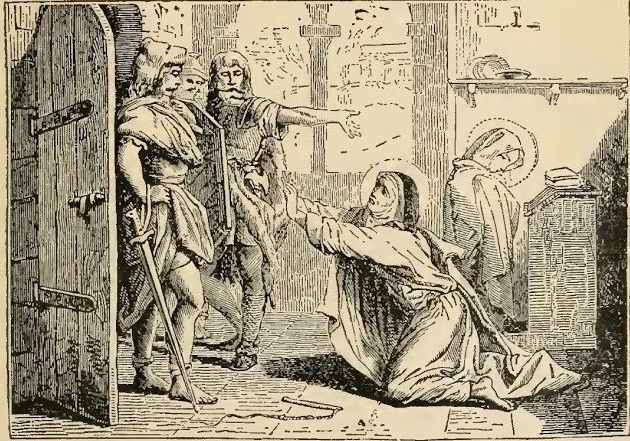
When Alaric's Goths plundered Rome in 410, they scourged Marcella to make her hand over her treasures, but she had long since given them to the poor. Her real anguish was for her spiritual daughter, the young nun Principia. She fell at the soldiers' feet and begged them to spare her from insult. They took both women to the Church of St Paul, which Alaric had granted the right of sanctuary, and left Principia unharmed. Marcella did not live long afterwards. She died peacefully in Principia's arms around the end of August 410.
Early life

Selected sentences from the original account, unaltered.

Marcella, a young widow, whose name alone is enough to recall the best days of the Roman republic, and whose rare beauty, enhanced by the long and illustrious line of her ancestors, drew around her numerous suitors, rejected the suit of Cerealtis, the consul, and resolved to imitate the lives of the ascetics of the East. Afterwards, when S. Jerome came to Rome to renew the instructions and narratives of those holy men by adding to them the living commentary of his own life, Marcella, with her mother Albinia, and her sister Asella, placed herself at the head of that select number of illustrious matrons who took him as their guide and oracle.

What they represent

How they teach us to live

Drawn from themes in the original account

Learn from the kind of life it was. Turning grief into prayer and service.

Keep their day. Remember them on January 31 with a short prayer, and ask for their help.

Read more

The full original · 334 words

Read Baring-Gould’s full account

Baring-Gould’s sources: Roman Martyrology. Authority: the Letters of S. Jerome.

Marcella, a young widow, whose name alone is enough to recall the best days of the Roman republic, and whose rare beauty, enhanced by the long and illustrious line of her ancestors, drew around her numerous suitors, rejected the suit of Cerealtis, the consul, and resolved to imitate the lives of the ascetics of the East. Afterwards, when S. Jerome [translator of the Bible into Latin (d. 420)] came to Rome to renew the instructions and narratives of those holy men by adding to them the living commentary of his own life, Marcella, with her mother Albinia, and her sister Asella, placed herself at the head of that select number of illustrious matrons who took him as their guide and oracle. She astonished the holy doctor by her knowledge of the Divine Scriptures; she fatigued him by her thirst always to know more of them than he could teach her; she made him afraid to find in her a judge rather than a disciple. In her palace on Mount Aventine, she collected, under the presidency of Jerome, the most pious among the noble ladies, for mutual strength and enlightenment. After having thus first given to Rome the true model of a Christian widow, she passed the last thirty years of her life in her suburban villa transformed into a monastery. The Goths [Germanic peoples who invaded the Roman Empire, many of them Arian Christians] under Alaric plundered Rome in 410. S. Marcella was scourged by them to deliver up her treasures, which however she had long before distributed among the poor. All the while she was in anguish of soul for her dear spiritual child Principia, and falling at the feet of the cruel soldiers, she tearfully implored them to spare her insult. They conducted them both to the Church of S. Paul, to which Alaric had granted the right of sanctuary, and suffered the beautiful young nun Principia to remain unmolested. S. Marcella did not survive this long, but died peacefully in the arms of Principia, about the end of August, 410, but her name occurs in the Roman Martyrology on Jan. 31st.

Feast days

Feast: January 31

Nine days · Free

Pray the novena
with us.

One short email a day for nine days. The day's prayer, a line from St. Marcella's story, and a nudge to keep going.

Also on January 31
Sts. Cyrus, John and Others in Egypt

Sts. Cyrus

January 31 · Martyrs
A

St. Aidan or Maidoc of…

January 31 · Bishop
U

St. Ulphia

January 31 · Virgin
← All 1726 saints in the library
Sources & notes

Feast-day sources

Story sources

Sources

Credits

Image: Marcella of Rome.jpg · Diodore Rahoult · Public domain, via Wikimedia Commons

From Sabine Baring-Gould, The Lives of the Saints, new and revised edition (Edinburgh: John Grant, 1914; first edition 1872). Public domain.

Image: Diodore Rahoult, Wikimedia Commons (Public domain)

From Sabine Baring-Gould, The Lives of the Saints, new and revised edition (Edinburgh: John Grant, 1914; first edition 1872). Public domain in the United States. Reproduced unedited, except for short bracketed notes in grey that we added to explain names and terms (“S.” is the old abbreviation for Saint). Some history and judgments reflect 19th-century scholarship.