A whole life given to God with an undivided heart.
January 31
January 31
Virgin
The blessed Ulphia was the daughter of noble parents in Gaul, she was singularly beautiful in face and graceful in person; consequently she was sought by many suitors, but, with her father's consent she vowed to observe perpetual chastity.
Pray a little every day. Prayer runs all through this account.
Make time for silence. Solitude and withdrawal to pray shape this life.
Learn from the kind of life it was. A whole life given to God with an undivided heart.
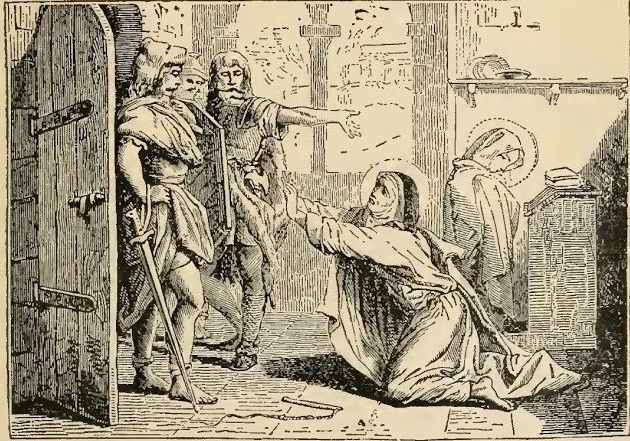
The blessed Ulphia was the daughter of noble parents in Gaul [roughly modern France and Belgium], she was singularly beautiful in face and graceful in person; consequently she was sought by many suitors, but, with her father's consent she vowed to observe perpetual chastity. At the age of twenty-five she received the veil from the hands of the Bishop of Amiens, and then she retired to S. Acheuil at some little distance from the city, where she ministered to S. Domitius, an aged hermit and canon of Amiens. The old man was wont to knock at the door of her little hut as he passed on his way to matins, and she rose and accompanied him. Now the place was marshy and many frogs inhabited the pools. One night they sang so shrilly that Ulphia could not sleep, but tossed on her couch, and drew her serge-habit about her ears, without being able to stop their voices from penetrating her brain and keeping her awake. After many hours she fell asleep. Shortly after, Domitius came by and rapped with his stick at the door. There was no answer, so he called, "Ulphia, my child, get up!" Then he rapped louder than before. Still there was no answer, so he called, "Ulphia, my child, the second watch of the night is past." As he received no answer, he supposed she had gone on before. But when he reached the church, he looked round, and he saw her not. And when matins was over, he returned in haste and fear, thinking something had befallen his dear child. But when he came to the cell, Ulphia stood in the door. Then she reproached him for not having called her. "I did call thee, I knocked loud," said the old man. "It was the frogs' doing!" exclaimed Ulphia, and she told him how they had kept her awake half the night. Then casting herself on the ground, she prayed to God to quiet the noisy frogs; and Domitius knelt beside her and said, Amen. After that the reptiles troubled her no more.
When she was dying she prayed, "Saviour! sanctify, confirm, keep, rule, strengthen, comfort me; and in the end bring me to Thy sempiternal joys." And when the two virgins who had watched by her had said Amen, she fell asleep, and they left her. At dawn, one of them looked in and saw that she was dead, and in dying she had crossed her hands upon her breast, her face was bright and her lips as though she smiled.
Feast: January 31
One short email a day for nine days. The day's prayer, a line from St. Ulphia's story, and a nudge to keep going.
From Sabine Baring-Gould, The Lives of the Saints, new and revised edition (Edinburgh: John Grant, 1914; first edition 1872). Public domain.
From Sabine Baring-Gould, The Lives of the Saints, new and revised edition (Edinburgh: John Grant, 1914; first edition 1872). Public domain in the United States. Reproduced unedited, except for short bracketed notes in grey that we added to explain names and terms (“S.” is the old abbreviation for Saint). Some history and judgments reflect 19th-century scholarship.