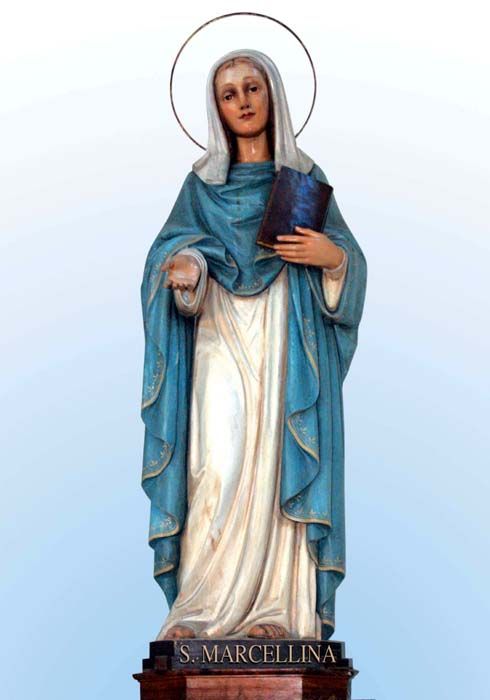
St. Marcellina

Marcellina was the only sister of St Ambrose of Milan, and older than he.

Read the essentials →
July 17 · Virgin

St. Marcellina

St. Marcellina

Marcellina was the only sister of St Ambrose of Milan, and older than he.

Traditional feast

July 17
1914 / pre-1969 calendar, per Baring-Gould (1897)

Current feast

July 17
Secondary source · Wikipedia

Represents

Virgin

Their story

Adapted in modern English from the Catholic Encyclopedia (1913) · original text below

Marcellina was the only sister of St Ambrose of Milan, and older than he. She was born around 330 to 335, most likely at Trier, where her father was praetorian prefect (one of the empire's highest civil officials) of the Gauls. Even before her father died she had gone to Rome, her family's home, and there she gave up the world for a life of virginity, prayer and self-denial. On Christmas Day, probably in 353, Pope Liberius (pope 352–366) gave her the veil of a consecrated virgin. Ambrose preserved the advice the pope gave her that day.

After Ambrose became Bishop of Milan in 374 he called his sister there, and she became his zealous helper in spreading the religious life among the young women of Milan. In 377 he dedicated his books 'On Virgins' to her. She outlived her brother and died in 398 or soon after. She was buried in the crypt under the altar of the Ambrosian Basilica and honoured as a saint.
Early life

The book says little or nothing about early life. This is how the account begins.

Thin entry · the 1897 book gives only 0 words. We have not filled the gap with invented detail.

What they represent

How they teach us to live

Drawn from themes in the original account

Keep their day. Remember them on July 17 with a short prayer, and ask for their help.

From the Catholic Encyclopedia

1913 · 284 words

The only sister of St. Ambrose of Milan, b. about 330-5; d. about 398. She was older than St. Ambrose, and was born most probably at Trier, where her father resided as praefectus praetorio Galliarum. Even before her father's death she went to Rome, the home of her family, and, before her mother's arrival at the capital with her two sons, had already forsaken the world, elected to live a life of Christian virginity, and devoted herself to the practice of piety and asceticism. On Christmas Day, probably in 353, she received the veil of consecrated virginity from the hand of Pope Liberius. The advice, which the pope addressed to her on this occasion, has been preserved by St. Ambrose (De virginibus, III, i-iii), especially emphasized being the obligations of Christian virgins to preserve virginal purity. After Ambrose had become Bishop of Milan (374), he summoned his sister thither, and found in her a zealous assistant in fostering and extending the ascetic life among the maidens of Milan. To her Ambrose dedicated his work on viriginity, written in 377 ("Libri III de virginibus ad Marcellinam" in P.L. XVI, 187-232). Marcellina survived her brother, and died in 398 or shortly afterwards. She also was buried in the crypt under the altar of the Ambrosian Basilica, and was honoured as a saint. Her feast is celebrated on 17 July.

Laudatio Marcellinae in MOMBRITIUS, SS., II, 95-7; Acta SS., IV, July, 231-8; BlRAGHI, Vita della vergine romana-milanese S. Marcellina, sorella di S. Ambrogio (4th ed., Milan. 1889), SEPTIMUS A LANDE ET ALANUS DE MACULANIS, Dissert. hist. de tumulo S. Marcellinae virg. sororis S. Ambrosii in eiusdem imperiali basilica humanae (Milan, 1725). see also bibliography to AMBROSE, SAINT.

Read more

The full original · 0 words

Read Baring-Gould’s full account

Baring-Gould’s sources: Roman Martyrology. Specially venerated at Milan. Authorities: — Mention in the writing of her brother, S. Ambrose,] S. Marcellina, the sister of the great Ambrose, and of Satyrius, at an early age took the veil from the • hands of Pope Liberius. She was fond of reading, and to her S. Ambrose addressed his book, De Virginibus. She was older than her brothers, and had indeed partly educated them, so that both regarded her with the tenderest love and respect. When Satyrius died, in the magnificent oration of S. Ambrose on his brother’s death, he says, “Superest soror sancta, integritate venerabilis, sequalis moribus, non impar officiis.” S. Marcellina, who lived at Rome, sometimes visited her brother Ambrose at Milan. Having learned, in the year 378, that he was ill, not long after he had sent hei his book “ De Virginibus,” she went to Milan to see him. She made another visit to Milan to her brother later, on account of a virgin named Indicia, of Verona, who had been trained under her, but who had been condemned by the bishop for some fault, and had appealed to the judgment of S. Ambrose. After the death of S. Ambrose, Marcellina probably settled at Milan, and died there.

Feast days

Feast: July 17

Nine days · Free

Pray the novena
with us.

One short email a day for nine days. The day's prayer, a line from St. Marcellina's story, and a nudge to keep going.

Also on July 17
S

Sts. Speratus and…

July 17 · Martyrs
St. Hyacinth

St. Hyacinth

July 17 · Martyr
A

St. Alexis

July 17 · Confessor
← All 1726 saints in the library
Sources & notes

Feast-day sources

Story sources

Sources

Credits

Image: Sainte Marcellina.jpg · Aandersonrc · CC BY-SA 4.0, via Wikimedia Commons

From Sabine Baring-Gould, The Lives of the Saints, new edition in 16 vols. (London: John C. Nimmo, 1897–98); text from the Internet Archive scan (OCR, lightly cleaned; errors possible). Public domain.

Image: Aandersonrc, Wikimedia Commons (CC BY-SA 4.0)

From “Catholic Encyclopedia (1913)/St. Marcellina,” The Catholic Encyclopedia (New York: Robert Appleton Company, 1907–1914), via Wikisource. Public domain. Matched by name and feast date; text unedited except for our bracketed notes in grey.

From Sabine Baring-Gould, The Lives of the Saints, new edition in 16 vols. (London: John C. Nimmo, 1897–98); text from the Internet Archive scan (OCR, lightly cleaned; errors possible). Public domain in the United States. Reproduced unedited, except for short bracketed notes in grey that we added to explain names and terms (“S.” is the old abbreviation for Saint). Some history and judgments reflect 19th-century scholarship.