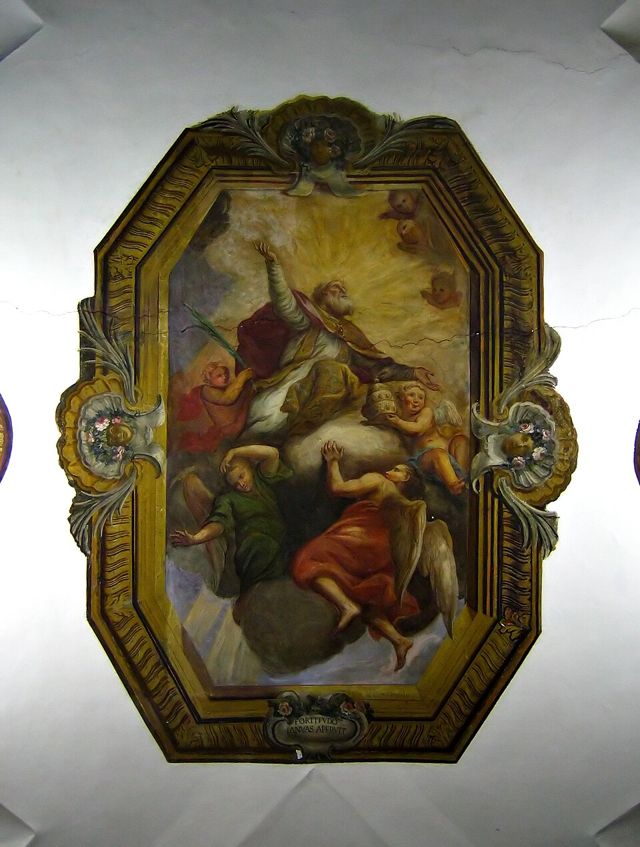
His date of birth unknown; elected pope in May or June, 308; died in 309. For some time after the death of Marcellinus in 304 the Diocletian [Roman emperor 284–305, who began the ‘Great Persecution’ of Christians in 303] persecution continued with unabated severity. After the abdication of Diocletian in 305, and the accession in Rome of Maxentius [rival emperor at Rome 306–312, defeated by Constantine] to the throne of the Caesars in October of the following year, the Christians of the capital again enjoyed comparative peace. Nevertheless, nearly two years passed before a new Bishop of Rome was elected. Then in 308, according to the "Catalogus Liberianus", Pope Marcellus first entered on his office: "Fuit temporibus Maxenti a cons. X et Maximiano usque post consulatum X et septimum" ("Liber Pontif.", ed. Duchesne, I, 6-7). This abbreviated notice is to be read: "A cons. Maximiano Herculio X et Maximiano Galerio VII [308] usque post cons. Maxim. Herc. X et Maxim. Galer. VII [309]" (cf. de Rossi, "Inscriptiones christ. urbis Romæ", I, 30). At Rome, Marcellus found the Church in the greatest confusion. The meeting-places and some of the burial-places of the faithful had been confiscated, and the ordinary life and activity of the Church was interrupted. Added to this were the dissensions within the Church itself, caused by the large number of weaker members who had fallen away during the long period of active persecution and later, under the leadership of an apostate, violently demanded that they should be readmitted to communion without doing penance. According to the "Liber Pontificalis" Marcellus divided the territorial administration of the Church into twenty-five districts (tituli), appointing over each a presbyter, who saw to the preparation of the catechumens for baptism and directed the performance of public penances. The presbyter was also made responsible for the burial of the dead and for the celebrations commemorating the deaths of the martyrs. The pope also had a new burial-place, the Cœmeterium Novellœ on the Via Salaria (opposite the Catacomb of St. Priscilla), laid out. The "Liber Pontificalis" (ed. Duchesne, I, 164) says: "Hic fecit cymiterium Novellae via Salaria et XXV titulos in urbe Roma constituit quasi diœcesis propter baptismum et pœnitentiam multorum qui convertebantur ex paganis et propter sepulturas Inartyrum". At the beginning of the seventh century there were probably twenty-five titular churches in Rome; even granting that, perhaps, the compiler of the "Liber Pontificalis" referred this number to the time of Marcellus, there is still a clear historical tradition in support of his declaration that the ecclesiastical administration in Rome was reorganized by this pope after the great persecution.
The work of the pope was, however, quickly interrupted by the controversies to which the question of the readmittance of the lapsi into the Church gave rise. As to this, we gather some light from the poetic tribute composed by Damasus in memory of his predecessor and placed over his grave (De Rossi, "Inscr. christ. urbis Romæ", II, 62, 103, 138; cf. Idem, "Roma sotterranea", II, 204-5). Damasus relates that the truth-loving leader of the Roman Church was looked upon as a wicked enemy by all the lapsed, because he insisted that they should perform the prescribed penance for their guilt. As a result serious conflicts arose, some of which ended in bloodshed, and every bond of peace was broken. At the head of this band of the unfaithful and rebellious stood an apostate who had denied the Faith even before the outbreak of persecution. The tyrannical Maxentius had the pope seized and sent into exile. This took place at the end of 308 or the beginning of 309 according to the passages cited above from the "Catalogus Liberianus", which gives the length of the pontificate as no more than one year, six (or seven) months, and twenty days. Marcellus died shortly after leaving Rome, and was venerated as a saint. His feast-day was 16 January, according to the "Depositio episcoporum" of the "Chronography" of 354 and every other Roman authority. Nevertheless, it is not known whether this is the date of his death or that of the burial of his remains, after these had been brought back from the unknown quarter to which he had been exiled. He was buried in the catacomb of St. Priscilla where his grave is mentioned by the itineraries to the graves of the Roman martyrs as existing in the basilica of St. Silvester (De Rossi, "Roma sotterranea", I, 176)
A fifth-century "Passio Marcelli", which is included in the legendary account of the martyrdom of St. Cyriacus (cf. Acta Sanct., Jan., II, 369) and is followed by the "Liber Pontificalis", gives a different account of the end of Marcellus. According to this version, the pope was required by Maxentius, who was enraged at his reorganization of the Church, to lay aside his episcopal dignity and make an offering to the gods. On his refusal, he was condemned to work as a slave at a station on the public highway (catabulum). At the end of nine months he was set free by the clergy; but a matron named Lucina having had her house on the Via Lata consecrated by him as "titulus Marcelli" he was again condemned to the work of attending to the horses brought into the station, in which menial occupation he died. All this is probably legendary, the reference to the restoration of ecclesiastical activity by Marcellus alone having an historical basis. The tradition related in the verses of Damasus seems much more worthy of belief. The feast of St. Marcellus, whose name is to this day borne by the church at Rome mentioned in the above legend, is still celebrated on 16 January. There still remains to be mentioned Mommsen's peculiar view that Marcellus was not really a bishop, but a simple Roman presbyter to whom was committed the ecclesiastical administration during the latter part of the period of vacancy of the papal chair. According to this view, 16 January was really the date of Marcellunus's death, the next occupant of the chair being Eusebius [Eusebius of Caesarea (d. c. 339), the first historian of the Church] (Neues Archiv, 1896, XXI, 350-3). This hypothesis has, however, found no support.
Read the rest of the article
Liber Pontif., ed. DUCHESNE, I, 164-6; cf. Introduction, xcix-c; Acta SS., Jan., II, 369; LANGEN, Gesch. der röm. Kirche, I, 379 sqq.; ALLARD, Hist. des persécutions, V, 122-4; DUCHESNE, Hist. ancienne de l'Eglise, II, 95-7.