Baring-Gould’s sources: Honoured in the Greek Menæa and Roman Martyrology on the same day. His life, by an anonymous writer, is given by Simeon Metaphrastes.
S. Marcian was born at Constantinople; he belonged to a noble Roman family, related to that of the Emperor Theodosius [name of Roman emperors; Theodosius I (379–395) made Christianity the state religion]. From his childhood he served God in watching, fasting, and prayer. His great compassion for the necessities of the poor made it impossible for him to refuse relief, when he had anything to give away.
In the reign of the Emperor Marcian, Anatolius, the Archbishop, ordained him priest. His love for the poor manifested itself, not merely in abundant almsgiving, but also in his making their instruction in the truth his favourite pursuit. The severity of his morals was made a handle by those who feared the example of his virtue, as a tacit rebuke of their sloth and avarice, to fasten on him a suspicion of Novatianism; but his meekness and silence triumphed over this, and other slanders.
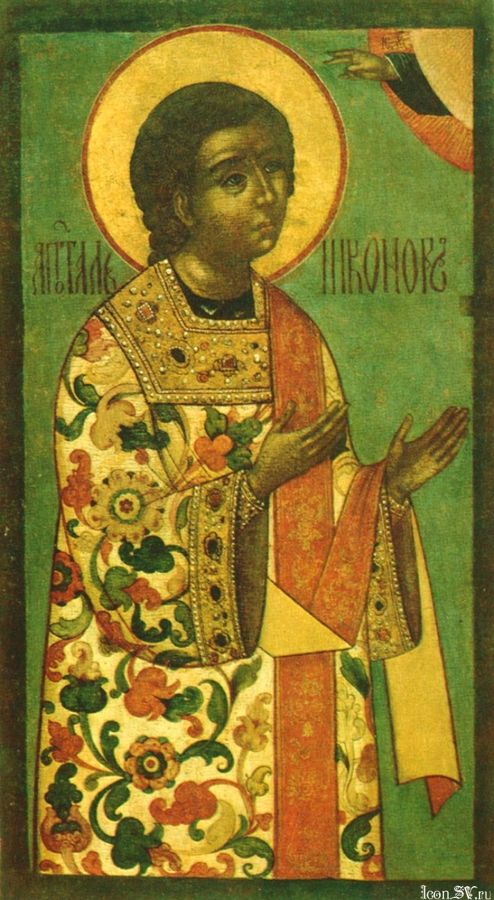
The patriarch [the title of the bishops of the great ancient sees: Rome, Constantinople, Alexandria, Antioch, Jerusalem] Gennadius conferred on him the dignity of treasurer of the church of Constantinople. S. Marcian built, or repaired, in a stately manner a great number of churches. The following incident is related of the dedication of the church of S. Anastasia, for which he had obtained a site, and which he had built in spite of numerous impediments. On the day that the church was to be consecrated, he was on his way to attend the ceremony, when he was accosted in the street by a very poor man, whose rags scarce held together, and who implored him, for the love of God, to give him an alms. S. Marcian felt in his bosom, but found he had no money there. The pauper would take no refusal, and the compassionate heart of the treasurer was melted at the aspect of his tatters and emaciation. Quickly he slipped off the tunic he wore under his sacerdotal vestments, handed it to the beggar, and then hurried on to the new church, drawing his alb and chasuble about him, to conceal the deficiency of a nether garment. The church was crowded, the Emperor Leo and the Empress, the senate, and almost the whole city were present. Marcian was bidden celebrate the Holy Sacrifice before all, in the new church he had built. So, full of shame, he began, hoping that the folds of his chasuble would conceal the absence of a tunic. But all saw him as though clothed beneath his sacerdotal vestments with a garment as of pure gold, which flashed as he moved. The patriarch Gennadius was offended, and rebuked him when the liturgy was over, for having worn a private garment, more splendid than his ecclesiastical vesture, and worthy only of an emperor. Marcian fell at his feet, and denied that he had worn any such raiment. Then Gennadius, wroth at his having spoken falsely, as he thought, for he supposed his eyes could not have been deceived, caught him by the vesture, and drew it aside, and behold! Marcian was bare of all other garments save his sacerdotal apparel.
S. Marcian built also the church of S. Irene, another of S. Isidore, and a baptistery of magnificent appearance, surrounded with five porches, like that at Jerusalem. "But this one," says the chronicler, "was greater than that by the sheep market, for here greater miracles were wrought than there. To that, an angel descended on one day in the year, and healed but one at a time; at this, whenever a servant of the Lord ministers, Christ himself is present. The healing, moreover, is not but once a year, but daily, and not of bodies only, but of souls as well."
S. Marcian's great compassion extended to women of bad character, and despising the slander and gossip which he might occasion, by visiting them in their houses, setting only before his eyes the blessedness of plucking these brands from the burning, he often sought them out in haunts of crime; and if they had taken up evil courses through poverty only, he found for them honest occupations, and by his exhortations and tears, and his overflowing charity, he convinced and persuaded many of these unhappy women, so that they came openly and did penance, and some he sent on pilgrimages to Jerusalem, and some went into solitude, and recompensed for the past by self-mortification in the desert.