M

Building a community where people could actually live the Gospel.

Read the essentials →
May 1 · Abbot

St. Marculf

St. Marculf

Building a community where people could actually live the Gospel.

Traditional feast

May 1
1914 / pre-1969 calendar, per Baring-Gould (1897)

Current feast

Not verified yet

Represents

Abbot

Their story

Adapted in modern English from Alban Butler's Lives of the Saints · Baring-Gould original below · little is known

Marcou, or Marculfus, was abbot of Nanteu in the diocese of Coutances in Normandy. He was famous for miracles, especially for healing scrofula, the 'king's evil (scrofula, a tuberculous swelling of the neck that kings were believed to cure by touch)'.

He died on 1 May 558, and his feast is kept in the martyrologies of Coutances and Evreux.

Early life

The book says little or nothing about early life. This is how the account begins.

Thin entry · the 1897 book gives only 45 words. We have not filled the gap with invented detail.

…was crowned, in 1825, the relics were brought to the hospital of S. Marcoul, at Rheims, and the king there touched several scrofulous persons. S. Marculf is represented touching the chin of a sick person, to represent him as the patron invoked against king's evil.
What they represent

How they teach us to live

Drawn from themes in the original account

Look after people who are sick or suffering. The sick come up again and again in this story.

Learn from the kind of life it was. Building a community where people could actually live the Gospel.

Read more

The full original · 45 words

Read Baring-Gould’s full account

Baring-Gould’s sources: Gallican Martyrology, Usuardus. Authorities Two ancient lives. Three festivals are observed in his honour in the diocese of Coutances, May ist, July 7th, Oct. nth.] S. Marculf was born at Bayeux, and was of Frank parentage, as his name shows (Forest-wolf.) He preached in the diocese of Coutances, and obtained from king Child ebert a grant of land at Nanteuil, on the coast, for a monastery. He spent every Lent in an islet off the coast. Taking with him a companion, Romardus, he visited Jersey, where he found a hermit named Helier, occupying a cave in the rock, now crowned by Elizabeth Castle. Whilst he was in Jersey a pirate fleet of Saxons appeared off the island. The natives implored the prayers of S. Marculf. A storm rose, when a large body of the pirates was advancing over the sand flats, swept some of their ships upon the Violets, a reef of sunken rocks, carried others out to sea, and the rising tide rushing over the sands, assisted the islanders in disposing of their invaders. S. Marculf returned to Nanteuil, and made a second visit to the king. On this occasion he lay down to rest near Compiegne. A hare that was being pursued by hunters took refuge in his hood. Marculf awoke to find himself surrounded by yelping hounds. He protected the hare from them in spite of the threats of the hunters. The relics of the saint are preserved at Corbeny, in the diocese of Laon; and it was the custom of the French kings after their coronation at Rheims, to make a pilgrimage to Corbeny, and there after touching the relics of S. Marculf, heal those sick with king's evil. The relics were saved at the Revolution, and are now restored to their place in the church of Corbeny. When Charles X. [May i.

…was crowned, in 1825, the relics [the bodily remains of a saint, or objects they used, kept with honor] were brought to the hospital of S. Marcoul, at Rheims, and the king there touched several scrofulous persons.

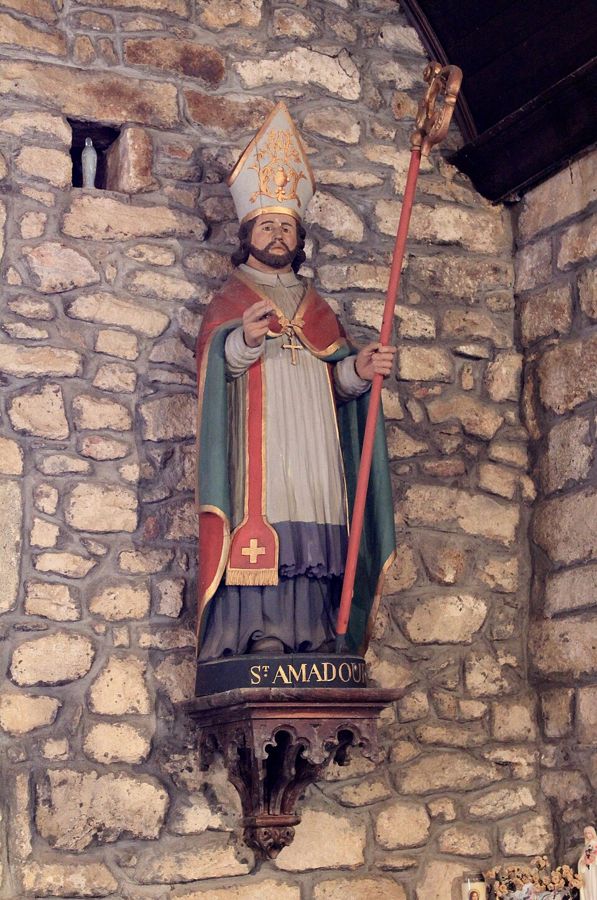
S. Marculf is represented touching the chin of a sick person, to represent him as the patron invoked against king's evil.
Feast days

Feast: May 1

Nine days · Free

Pray the novena
with us.

One short email a day for nine days. The day's prayer, a line from St. Marculf's story, and a nudge to keep going.

Also on May 1
St. Philip

St. Philip

May 1 · Apostle, Martyr
St. James the Less

St. James the Less

May 1 · Apostle
St. Amator of Auxerre

St. Amator of Auxerre

May 1 · Bishop
← All 1726 saints in the library
Sources & notes

Feast-day sources

Story sources

Sources

Credits

From Sabine Baring-Gould, The Lives of the Saints, new edition in 16 vols. (London: John C. Nimmo, 1897–98); text from the Internet Archive scan (OCR, lightly cleaned; errors possible). Public domain.

From Sabine Baring-Gould, The Lives of the Saints, new edition in 16 vols. (London: John C. Nimmo, 1897–98); text from the Internet Archive scan (OCR, lightly cleaned; errors possible). Public domain in the United States. Reproduced unedited, except for short bracketed notes in grey that we added to explain names and terms (“S.” is the old abbreviation for Saint). Some history and judgments reflect 19th-century scholarship.