A whole life given to God with an undivided heart.
Read the essentials →A whole life given to God with an undivided heart.
July 29
July 29
Virgin
At Bethany lived Martha and Lazarus, and their young and beautiful sister, Mary. Before the death of their parents, the estates were divided, and Mary became mistress of Magdala.
Share your faith, in words and by example. Preaching and conversion are central here.
Learn from the kind of life it was. A whole life given to God with an undivided heart.
…longer jealously, and Mary pours out her love in the costly offering of the spikenard ointment. The apostleship of S. Martha at Tarascon in Provence is fable. The story is late, not without romantic interest. The tomb and relics [the bodily remains of a saint, or objects they used, kept with honor] of S. Martha, as will be presently related, are shown at Tarascon. The legend of S. Martha and her sister Mary Magdalen, and her brother Lazarus, their voyage to Provence, their apostleship there, and their death, form the subject of a curious religious romance attributed to Hrabanus Maurus, archbishop of Mainz, who died, a.d. 856. This life is founded on a somewhat earlier one. The Latin text of the earlier life is imbedded in that of Hrabanus, if the long Latin legend be by him. It exists in MS. at Magdalene College, Oxford, and has been published by the Abbe Faillon. 1 The story is sufficiently curious for an outline of it to be given here. It is believed in profoundly at the present day in Provence, though not resting on a shadow of evidence deserving of serious consideration. At Bethany lived Martha and Lazarus, and their young and beautiful sister, Mary. They were thechildren of Eucheria, a woman of royal Hebrew blood, and of a Syrian father named Theophilus-. 3 Theophilus. was of noble race, and his rank was high in the state, the most important offices in the administration of affairs being committed to him. Indeed he was made prince of Syria and all the maritime parts of Palestine, but having heard Christ preach, he left all and followed him.
The family possessions included a large portion of 1 *' Monuments inedits sur l'apostolat de S. Marie Madeleine," Paris, iS$S. The legend is, however, 1 have no doubt, not by Hrabanus Maurus, but is a Latin translation [the solemn moving of a saint’s relics to a new shrine] of a Provencal metrical romance, and its date the iath cent. 2 The names are Greek, it may be pbservr.d in passing. Jerusalem, and those handsome estates, Bethany in Juda, Magdala in Galilee, and another Bethany (Bethabara) beyond Jordan, where the Baptist preached. Before the death of their parents, the estates were divided, and Mary became mistress of Magdala. Martha “endowed with the courage of a man and the heart of a woman, used her fortune liberally. Unmarried, she remained free from ties, and showed herself amiable and gentle to her household, affable to the poor, merciful and generous to all.”
As for Mary — u she was resplendent in beauty — too beautiful ! — she was remarkable for the perfect proportion of her limbs, the grace of her visage, her abundant hair, her exquisite charms, and her character full of gentleness; her mouth and lips of graceful contour were a mixture of roses and lilies. In short, she was so graceful in form and beautiful in face that she was declared to be an extraordinary and marvellous masterpiece of Creative power.” This is quite in the style of Provencal romances, of one of which the Latin life is a translation in all probability, and not a composition of Rabanus Maurus, at all. 1 “ But as the splendour of beauty is rarely associated with chastity, and the abundance of wealth is usually the enemy of continence, this young girl, swimming in a sea of pleasure, began, as is the wont of youth, to re1 Take a specimen. *' Lancelot had a beautiful complexion, neither white nor brown, but the one playing into the other, so as to be, what one might call clair brunet. His countenance was illumined by his natural rosy tint so sweetly harmonised with the white and the brown, that one could not say that the white was eclipsed by the brown, nor the brown by the while: thus the one was tempered by the other and blended by the rose, which kindled the other colours; so united weTe they, that no man could say there was too much white, or brown, or Tose, but that each justly balanced the others.** This is of Launcelot at the age of three. M. Fauriel might well exclaim, “Ilya de quoi trembler de le voir devenir homme.” Hist, de la Poesie i’rovencale, T. ii., p. 359S. Martha.
joice in the elevation of her spirit and to allow herself to he drawn away by the lusts of the flesh. The flower of youth, and corporeal grace and superfluity of riches enervate good manners; material beauty, a lively spirit breathing love — that evil whose aspect is sweet; nobility of blood, beauty of face, and great riches are wont to uproot modesty of soul, and the ardour of youth, the allurements of the flesh, and the infirmity of sex ruin the chastity of body.” And so it goes on, repeating over and over again the same ideas slightly varied, as in Lancelot’s face the rose and the brown and the white are mingled. Hrabanus Maurus would have blushed to write such trash. It is entirely consistent with the taste of the romancists of Langedoc.
When Christ was invited to the house of Simon the Pharisee, Mary “ De la Tour,” or Magdalen, went thither with her alabaster box of ointment of spikenard. The box comes in for an elaborate description. The thoughts and emotions of Mary occupy pages.
After the conversion of Mary Magdalen, which in the legend is a tedious paraphrase of the simple Gospel narrative, she joins Joanna and Susanna, and the other women who ministered to Our Lord.
On his return from Tabor, after his transfiguration, Our Lord came to Bethany, and went into the house of Lazarus and Martha, and sat down to table u with his twelve apostles, seventy- two disciples, and the pious women. Martha waited at table, with liberality, as was her custom, assisted by her stewardess Marcella, and Susanna, and Joanna, whose husband was the steward of the realm of Antipas, tetrarch of Galilee, and officer of the prince’s table.” When Christ was in Galilee, the mansion at Magdala was thrown open to him and his disciples. One day when there, he had healed a man deaf and dumb, when there was a crowd gathered. His mother was without, and wished to come to him. Then followed the incident narrated in the Gospel, whereupon Marcella cried out, u Blessed is the womb that bare thee, and the paps that thou hast sucked.” 1 It is unnecessary to follow the author of the romance as he goes over the ground occupied by the Gospels, at tedious length. We will resume the story after the Ascension, and Descent of the Holy Ghost. At the former of these events Mary Magdalen, Martha and Lazarus, we are told, were present, and on them also, assembled with the Apostles, the fiery tongues descended at Pentecost, to give them with the Eleven an especial Apostolic character and mission.
When the persecution -against the Church broke out at Jerusalem,, and the Apostles were scattered, the pious women also left Jerusalem. tl Amongst these was the venerable hostess of the Son of God, Martha, the very holy, whose brother Lazarus was then bishop of Cyprus, she followed her sister Magdalene. With Martha was the blessed Marcella, a woman of great devotion and great faith, the servant of the Blessed Martha; it was she who said to Our Lord, Blessed is the womb that bare thee, &c.. Saint Parmenas, a deacon, full of faith and grace, was also of the number j it was to his care and protection that Martha confided herself, as S. Mary Magdalene had confided herself to the pontiff Maximin. They took their course towards the W est, by the admirable counsel of divine providence, that the glory and celebrity of the blessed Mary and her sister Martha might spread throughout the universe, not only through the Gospel, but also, that as the East had been 1 The Roman Breviary in the lesson for S. Martha, mentions S. Marcella, her servant, and attributes this saying to her. SS. MARTHA AND MARY.
Feast: July 29
One short email a day for nine days. The day's prayer, a line from St. Martha's story, and a nudge to keep going.
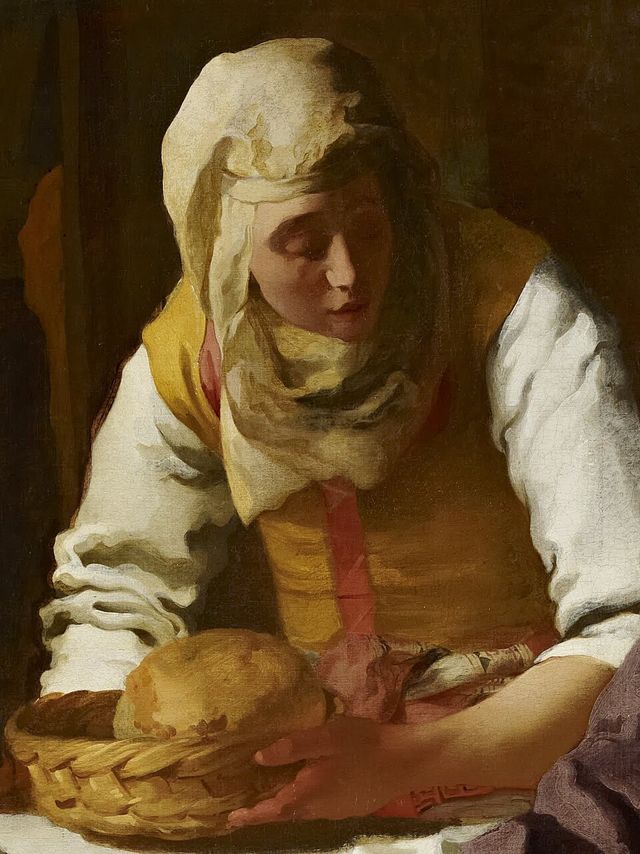
Image: Johannes (Jan) Vermeer - Christ in the House of Martha and Mary - Google Art Project (cropped2).jpg · Johannes Vermeer · Public domain, via Wikimedia Commons
From Sabine Baring-Gould, The Lives of the Saints, new edition in 16 vols. (London: John C. Nimmo, 1897–98); text from the Internet Archive scan (OCR, lightly cleaned; errors possible). Public domain.
Image: Johannes Vermeer, Wikimedia Commons (Public domain)
From Sabine Baring-Gould, The Lives of the Saints, new edition in 16 vols. (London: John C. Nimmo, 1897–98); text from the Internet Archive scan (OCR, lightly cleaned; errors possible). Public domain in the United States. Reproduced unedited, except for short bracketed notes in grey that we added to explain names and terms (“S.” is the old abbreviation for Saint). Some history and judgments reflect 19th-century scholarship.