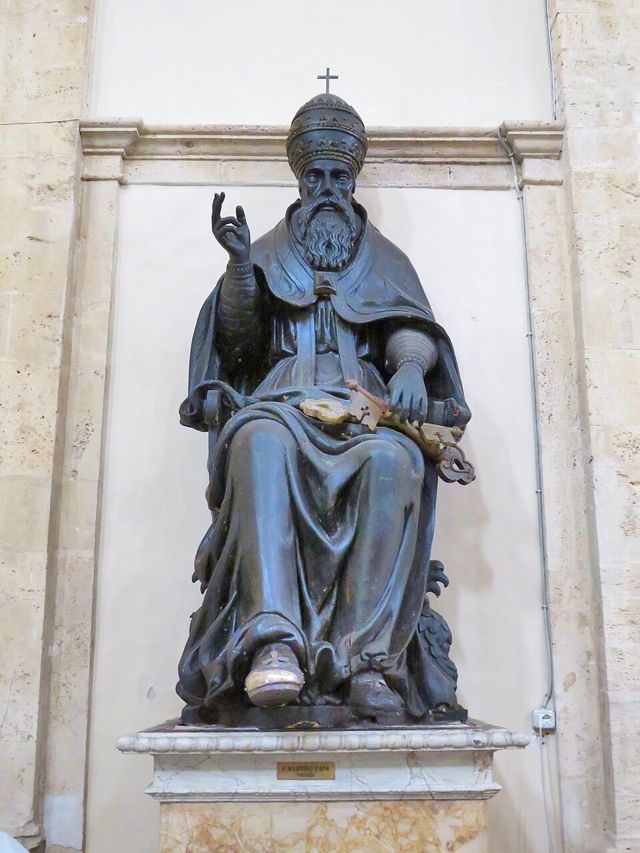
Baring-Gould’s sources: Roman Martyrology. Usuardus, & c. By the Greeks as a confessor on April 11, and as a martyr on November 12. Authorities: —His Letters, and the “ Commemoratio eorum quae.... acta sunt in S. Martinum,” in Mansi, t x. p. 855.] Martin, a native of Todi, son of Fabricius, was elected Pope on the death of Theodore, in 649. It was a time of controversy. Paul, a Monothelite, was patriarch of Constantinople, occupying the throne of the exiled Pyrrhus. Pyrrhus was also a Monothelite. He came to Rome when Theodore was Pope, to claim his interference, and to secure it, he proclaimed his adhesion to the doctrine of the Two Wills. But his conscience reproached him for this abandonment of his convictions for the sake of his interests, and he returned to Ravenna, and there recanted his acknowledgment of the two wills. Theodore excommunicated him with a pen dipped in the consecrated chalice. Theodore at the same time excommunicated Paul. Paul revenged himself by suppressing the religious worship of the papal envoys at court, maltreating, and even causing to be scourged, some of their attendants. Constans II., the emperor, sought to put an end to the controversy by publishing a decree, which has received the name of the Type. It began with the statement of the cause of its issue: “ We have remarked that our orthodox people have been thrown into great perplexity, because on the subject of the oeconomy of God, that is, the Incarnation, some profess that there was but one will, saying that Christ, one and the same, operated the Divine and the human, while others teach and profess two wills and two energies. The former support their opinion by saying that our Lord Jesus Christ is but [Nov. is.
One Person in two natures, which are neither confounded nor separated, and that He wills and operates at one and the selfsame time that which is Divine and that which is human. The others say, as in one person two natures are united without division, the difference of these natures is not effaced, and following the attributes of these natures, one and the selfsame Christ operates the Divine and the human.... We have thought, with the help of God, that it is our duty to extinguish the flame of contention, and not to suffer souls to be thereby imperilled. We therefore forbid our subjects from this moment to dispute and quarrel whether there be the one will and one energy, or the two wills and two energies. Our ordinance is not issued to destroy any teaching of the holy fathers on the subject of the Divine Word, we wish simply to bring to an end all wrangling over this question, and that our subjects should conform themselves to the sacred scriptures and the traditions of the five oecumenical councils, and to the teaching and propositions of the fathers, without curtailing or adding thereto, or twisting them to a perverse meaning. Let every effort be made to preserve the doctrine held before the present controversy broke out, and let neither party blame the other.”
To facilitate this peaceful issue, the emperor ordered the removal of the Ecthesis of Heraclius, formulating the doctrine of the One Will, from the narthex of the great church at Constantinople, and threatened the factions with divers punishments.
Immediately after the publication of the Type, and probably before it came to his knowledge, Theodore died. Martin had been apocrisiarius of the Holy See at Constantinople, before his elevation to the vacant chair of S. Peter, and was therefore hot and vehement on the controversy which had raged around him. The Acts of S. Ouen assert that the emperor at once asked Martin, in a friendly manner, to give Nov. xa.] 5. Martin.
his adhesion to the Type, but that the Pope refused it in the most peremptory manner; and Martin then asked the king of the Franks [the Germanic people who ruled Gaul and gave France its name] to send learned bishops to Rome to deliberate with him how best to combat and overthrow the pacific attempts of the emperor, and rake up the controversial fire which was consuming the East. The king resolved to send to Rome Ouen of Rouen, and Eligius of Noyon, but they were prevented by circumstances from undertaking the journey.
In October, 649, a council of a hundred and five bishops assembled in the Lateran [St. John Lateran, the pope’s cathedral in Rome] at Rome.. The bishops were nearly all from Italy and the adjacent islands. After five sessions, in which Monothelitism was convicted on the authority of the fathers of being heretical and antichristian, twenty canons were framed condemning the heresy and its authors. But Pope Martin was not content with anathematizing the erroneous doctrine of the Single Will, with humbling the rival prelate of Constantinople by excommunication in full council, with declaring the edict of the deceased emperor Heraclius, the Ecthesis, absolutely impious; he denounced as of equal impiety the Type of the reigning emperor, counselling peace. Its exhortation to sink differences in Christian charity he scorned as a persuasive to unholy acquiescence in heresy; abstention from controversial vehemence on such doctrines was a wicked suppression of Divine truth.
Nor was Martin wanting in activity to maintain his bold position. He published the decrees of the Lateran Council throughout the West. He appointed a legate [an official representative sent by the pope] in the East to supersede the Monothelite patriarchs of Antioch and Jerusalem. Paul of Thessalonica had agreed to condemn the doctrine, but hesitated about excommunicating those who through misunderstanding had accepted the doctrine of the One Will. Martin poured out on him the vials of his wrath. fNov. is.
Because he thus abstained, Martin condemned him as a concentration of all heretical pravity.1 He wrote to the faithful of the patriarchates of Antioch and Jerusalem, to stir them up against Macedonius and Peter, the bishops of Antioch and Alexandria, who had accepted the Ecthesis and the Type. Whilst the Lateran Council was holding its session, the emperor sent his chamberlain, Olympius, to Italy to obtain the acceptance of the Type by eveiy means in his power. On reaching Rome, it is pretended by later writers — like Anastasius the Librarian — that Olympius endeavoured to obtain the assassination of the Pope at the moment that Martin was communicating the chamberlain, but that a sudden blindness fell on the servant detailed for the murder, so that he could not see either the Pope, or the communion, or the kiss of peace. The reason why the would-be murderer saw none of this was that there was no intending murderer to see them.
Olympius was hastily summoned from Rome to repel an invasion of Sicily by the Saracens [medieval Christian name for Arab and Muslim peoples], and died of fatigue in that island. Another exarch came in his place, Theodoras Calliopas (June, 653), a man firm and crafty. He marched to Rome at the head of a body of soldiers, and summoned the Pope to surrender to the imperial authority. Some delay took place; Martin wrote to one of his friends that he was ready to exult rather than weep in the midst of his difficulties. On June 15, the day when Theodore entered Rome, he retired with all his clergy into the church of the Saviour, the Lateran basilica. The Pope sent a deputation to the exarch to offer him compliments on his arrival, and to excuse 1 “ Ut per hoc non solum eos etiam quos anathematizamus, nempe ipsas haereticorum personas, anathemadzare recuses.... sed ut etiam omnem omnium errorem Paganorum, Judaeorum, haereticorum in te confirmed sed etiam omnia omnium horum dogmata condemnamus, ut contraria et inimica veritati, tu veto omnia tina nobiscum voce non anathematizas quae anathematizamus, consequent est, te horum omnium errorem confirmasse, qui a nobis sive ab ecclesia catholic! ana thematizatur."
Nov. xu.] Martin. his presence on the plea of indisposition. The exarch received the deputation with favour, and when he remarked that the Pope had not come to meet him, and heard the reason, or rather the excuse, he dissembled his annoyance at the discourtesy, and said he would pay the Pope a visit next day. Martin was well enough on that day, Sunday, to say mass before a crowd. The exarch, tired with his journey, deferred his visit till Monday. On that day he sent his secretary to the Pope to ask why he had filled his house with stones, arms, and provisions as if for a siege. Martin denied that he had done so, and bade the secretary visit every room and convince himself that he had done nothing of the sort Martin then made complaints of the false accusations which had been made against him, as of having offered to give armed support to the “ infamous ” Olympius. The Pope had ordered his bed to be strewed before the high altar in the Lateran. The exarch and his troops entered the church, the light of the candles flickered on the armour of the soldiery. Theodore Calliopas at once announced to the priests and deacons that he was the bearer of a decree to the effect that Martin, having seized on the episcopate irregularly and unlawfully,1 must be conducted to Constantinople, and a successor appointed in his room. The charge was probably correct. He had, apparently, attempted to dispense with the sanction of the emperor on his election, and first among the Popes had made an effort to shake himself free of the imperial authority which claimed a right to accept or reject the Pope-Elect. Various other charges were trumped up against him, as that he had sent money to the Saracens, and had not taught the right faith on the Blessed Virgin Mary. The people shouted, “ Anathema to him who says that Martin has opposed the faith; anathema to him who is not faithful to the faith.” The exarch quieted the people by explaining 1 “ Irregulari ter et tine lege.” Mart. Epist. ii. ad Theod. [Nor. xs.
that the question was not one of difference in faith, but one of usurpation of office. On Tuesday the clergy of Rome visited the Pope. During the night he was removed to Ostia, and embarked for Constantinople with six or seven servants. After a three months’ voyage they reached the island of Naxos, where Martin was left a prisoner. The only favour accorded him was that he might bathe, and lodge in a hostel; but the guards kept for themselves the presents which were brought and offered him by his friends and admirers.
On September 17, 654, Pope Martin reached Constantinople, and was transferred at once to the prison called Prandearia, where he spent ninety-three days. During this time he wrote his second letter to Theodore, in which he complains that he had been kept forty-eight days without a bath. His bowels, he said, were out of order, his food was nasty and insufficient. When he was taken from prison to be tried he was very weak, and could not stand without support The president asked, “ Unhappy one, tell me, what wrong has the emperor done you?” Martin answered nothing. Witnesses were produced, testifying that he had intrigued with Olympius against the emperor. It was no doubt true that Olympius and Martin had been on terms of intimacy at Rome; how far, in their mutual recriminations against Constans II., Olympius had confided to Martin projects of revolt, cannot be said. It is not probable that the accusations were wholly unfounded. Martin, instead of rebutting them, tried to force the doctrinal question into the forefront. “ When the Type was published and sent to Rome ” he began, but was cut short by the prefect, Troilus, who said, “We are not speaking of doctrine, but of rebellion. You knew that Olympius was plotting against the emperor, and instead of arresting him, you kept on terms with him.” •S'. Martin.
Martin exclaimed, “ And you did not hinder George and Valentine from revolting against the emperor. How could I constrain a man backed by all the military force of Italy? However, settle my case as quickly as you can, and as you like.”
The president rebuked the interpreter for translating this defiant speech literally, and then went to the emperor to report what had taken place. The Pope was taken from the tribunal, and placed in the great court to be seen by the people, and that the emperor might see him, he was lifted upon a platform. A fiscal officer issued from the apartments of the emperor, and assailed him with the words, “ You have struggled against the emperor, what hope remains for you now ? You abandoned God, and God has abandoned you.” The pontifical ornaments of the Pope were plucked off, and he was given into the hands of the prefect of the city, with the sneering order from Demosthenes, “ Let him be cut to pieces.” A chain was attached to his neck, and he was taken to the praetorium, and shut up in the prison of Diomede. It was winter, and cold, and his clothes were in rags. Two good women, the wife and daughter of the jailer, supplied him with warm clothing. Gregory, the prefect, sent him meats; the weary man received them with a sigh. " Let us hope that you will not die,” said the prefect, and ordered his chains to be removed. Next day the emperor visited the patriarch [the title of the bishops of the great ancient sees: Rome, Constantinople, Alexandria, Antioch, Jerusalem] Paul, who was dying, to tell him what had been done. The patriarch was shocked and indignant, and remonstrated with the emperor, and entreated him not to use further violence.
Martin, who hoped for speedy martyrdom, heard with regret that his life was likely to be spared. On the death of Paul, Pyrrhus, who had returned from Italy, resumed the throne of Constantinople. A long examination of Martin took place on the conduct of Pyrrhus at Rome. For eightyfive days Martin languished in prison: he was at length shipped, March 26, 655, for Cherson in the Tauric Chersonese. There he was kept short of food, and died on September 16 in the same year. His body was buried at Cherson, in the church of S. Mary of Blachema. Two letters written by him from Cherson still exist, in which he complains of being neglected by his friends and the Roman clergy, who had abandoned him, and sent him neither wine nor com.
There can be little doubt that the real reason of his imprisonment, and the harsh treatment which accelerated his death, was his opposition to the Type of Constans, and that most of the charges against him were false or exaggerated.