St. Matthias

Faithfulness to Christ when it cost everything.

Read the essentials →
February 24 · Apostle, Martyr

St. Matthias

St. Matthias

Faithfulness to Christ when it cost everything.

Traditional feast

February 24
1914 / pre-1969 calendar, per Baring-Gould (1897)

Current feast

May 14
Verified · General Roman Calendar

Represents

Apostle
Martyr

Their story

Adapted in modern English from Baring-Gould (1897) · original text below

Matthias was not one of the Twelve whom Christ first chose, and the Gospels say nothing of him. He was probably one of the seventy disciples who followed Jesus through his public ministry. After the Ascension, Peter told the apostles that someone must take the place of Judas: a man who had been with Jesus throughout and could witness to his life, death and resurrection.

Two were put forward, Joseph called Barsabas or Justus, and Matthias. The apostles drew lots, since the Holy Spirit had not yet been given, and the lot fell to Matthias. Soon after, the Holy Spirit came upon the apostles at Pentecost.

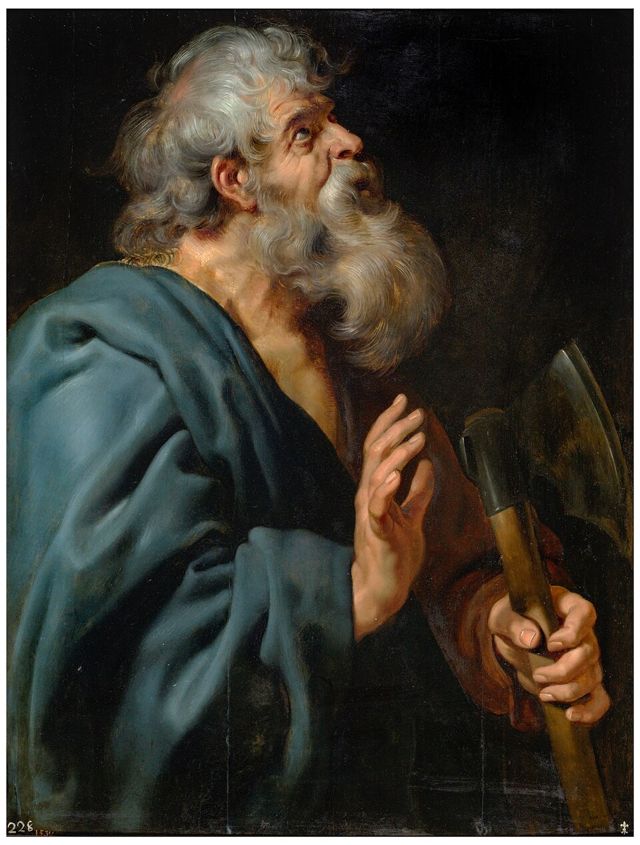
Matthias first preached in Judea and then went on to other lands. The Greeks report, with some probability, that he went east to Cappadocia. There he met a fierce people who treated him brutally, and after much labour and many conversions he was martyred about the year 64. Little is certain about how he died. The Greek Menaea (the Eastern Church's monthly books of saints' services) and several old breviaries say he was crucified. His relics are claimed by both Rome and Trier. In art he usually carries an axe or halberd.

Early life

The book says little or nothing about early life. This is how the account begins.

SAINT MATTHIAS not having been an Apostle of the first election, immediately called and chosen by our Blessed Lord, particular remarks concerning him are not to be expected in the narrative of the Holy Gospels. He was, probably, one of the Seventy disciples who had attended on Christ the whole time of his public ministry.

What they represent

How they teach us to live

Drawn from themes in the original account

Learn from the kind of life it was. Faithfulness to Christ when it cost everything.

Keep their day. Remember them on February 24 with a short prayer, and ask for their help.

From the homilies

Preached on Scripture

“This is the only Saint's day which is to be celebrated with mingled feelings of joy and pain. It records the fall as well as the election of an Apostle. St. Matthias was chosen in place of the traitor Judas. In the history of the latter we have the warning recorded in very deed, which our Lord in the text gives us in word, "Hold that fast which thou hast, that no man take thy…”

Text: “Hold that fast which thou hast, that no man take thy crown.”

Read more

The full original · 596 words

Read Baring-Gould’s full account

Baring-Gould’s sources: Roman Martyrology, but in leap year on Feb. 25th. So all Latin Martyrologies, with the exception of the ancient Roman one bearing the name of S. Jerome, which does not include any mention of S. Matthias, and the Church of Milan venerates S. Matthias on Feb. 7; the Greeks commemorate him on August 9th. The election of this Apostle is said to have taken place on May 12th. Authorities:—The Acts of the Apostles, and various traditional notices concerning him. The Apocryphal Syriac Acts of S. Matthias are extant.

SAINT MATTHIAS not having been an Apostle of the first election, immediately called and chosen by our Blessed Lord, particular remarks concerning him are not to be expected in the narrative of the Holy Gospels. He was, probably, one of the Seventy disciples who had attended on Christ the whole time of his public ministry. A vacancy having been made in the college of the Apostles by the suicide of the traitor Judas, the first thing which they did after their return from Mount Olivet—where Our Lord took leave of them on His Ascension—to S. John's house on Mount Sion, was to fill up their number with a fit person; for this purpose, S. Peter informed them that Judas, according to the prophetic prediction, having fallen from his ministry, it was necessary that another should be substituted in his room, one that had been a constant companion and disciple of the Holy Jesus, and, consequently, capable of bearing witness to His life, death, and resurrection. Two were proposed as candidates—Joseph, called Barsabas and Justus (whom some make the same with Joses, one of the brethren of Our Lord), and Matthias—both duly qualified for the place. The way of election was by lots, a way frequently used both among Jews and Gentiles for the determination of doubtful and difficult cases, and especially in the choosing judges and magistrates: and this course the Apostles rather took because the Holy Ghost was not yet given, by whose immediate dictates and inspiration they were chiefly guided afterwards. The lots were put into the urn, and the name of Matthias was drawn out, and thereby the Apostolate devolved upon him. Not long after, the promised powers of the Holy Ghost were conferred upon the Apostles, to fit them for that great and difficult employment upon which they were sent; and, among the rest, S. Matthias betook himself to his charge and province. The first period of his ministry he spent in Judæa; whence, having reaped a considerable harvest, he betook himself to other provinces. The Greeks, with some probability, report him to have travelled eastwards into Cappadocia [a region of central Turkey] (which they erroneously call Æthiopia). Here, meeting with a people of a fierce and intractable temper, he was treated by them with great rudeness and inhumanity; and from them, after all his labour and sufferings, and a numerous conversion of men to Christianity, he obtained at last the crown of martyrdom, about the year of Christ, 64. Little certain information can be ascertained concerning the manner of his death; but the Greek Menæa, which are corroborated by several ancient breviaries, relate that he was crucified, and that as Judas was hanged upon a tree, so Matthias suffered upon a cross. His body is said to have been kept a long time at Jerusalem, thence thought to have been translated to Rome by S. Helena, mother of Constantine the Great, where some supposed portions of it are shown with great veneration at this day; though others contend that his relics [the bodily remains of a saint, or objects they used, kept with honor] were brought to and are still preserved at Trèves. Among many apocryphal writings attributed to the Apostles, there was a Gospel published under his name, mentioned by the ancient ecclesiastical historians, and condemned with the rest by Gelasius, Bishop of Rome, as it had been rejected by others before him.

S. Matthias is seldom represented in works of art; when his figure does occur, he generally carries an axe or halbert, sometimes a spear or lance, occasionally a book and a stone. The Greeks represent S. Matthias as an old man with a rounded beard.
Feast days

Feast: May 14
Traditional: February 24

Nine days · Free

Pray the novena
with us.

One short email a day for nine days. The day's prayer, a line from St. Matthias's story, and a nudge to keep going.

Also on February 24
M

Sts. Montanus

February 24 · Martyrs
S

St. Sergius

February 24 · Martyr
P

St. Prætextatus of Rouen

February 24 · Bishop, Martyr
← All 1726 saints in the library
Sources & notes

Feast-day sources

Story sources

Sources

Credits

Image: Rubens apostle Matthias grt.jpg · Peter Paul Rubens · Public domain, via Wikimedia Commons

From Sabine Baring-Gould, The Lives of the Saints, new edition in 16 vols. (London: John C. Nimmo, 1897), digitized text from Project Gutenberg. Public domain.

Image: Peter Paul Rubens, Wikimedia Commons (Public domain)

John Henry Newman, “Divine Decrees” (Sermon 11) · Scripture: Rev. iii. 11; Job xxii. 2, 3; Matt. xix. 28; 1 Sam. xiii. 13, 14
John Henry Newman, Parochial and Plain Sermons, vol. 2 (London: Rivington, 1835). Written in English; public domain. Published 1835 (before 1931): public domain in the U.S. Read the full text →

From Sabine Baring-Gould, The Lives of the Saints, new edition in 16 vols. (London: John C. Nimmo, 1897), digitized text from Project Gutenberg. Public domain in the United States. Reproduced unedited, except for short bracketed notes in grey that we added to explain names and terms (“S.” is the old abbreviation for Saint). Some history and judgments reflect 19th-century scholarship.