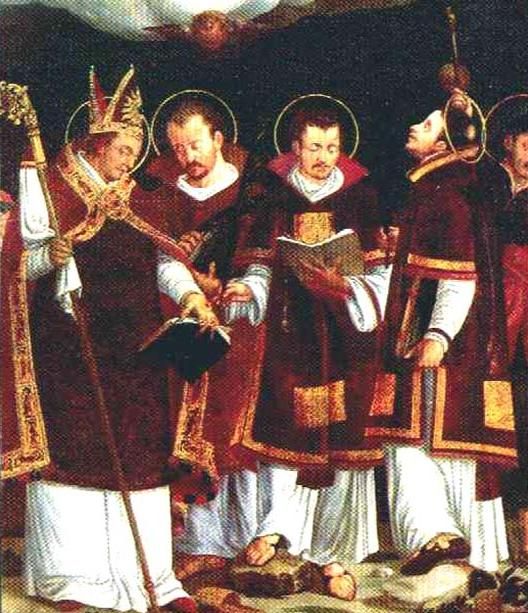
St. Maxentius

Building a community where people could actually live the Gospel.

Read the essentials →
June 26 · Abbot

St. Maxentius

St. Maxentius

Building a community where people could actually live the Gospel.

Traditional feast

June 26
1914 / pre-1969 calendar, per Baring-Gould (1897)

Current feast

June 26
Secondary source · Wikipedia

Represents

Abbot

Their story

Adapted in modern English from Alban Butler's Lives of the Saints · Baring-Gould original below · little is known

Maxentius was born at Agde and baptized Adjutor. He grew up in the monastery of St. Severus. To escape praise he fled and was brought back after two years. He went to Poitou, changed his name to Maxentius and placed himself under the abbot Agapetus, and the monks later chose him as their superior.

He soon resigned and shut himself in a cell, though the monks still sought his advice. During Clovis's war with Alaric, Gregory of Tours relates, his presence stopped soldiers from plundering the monastery, and a soldier who tried to strike him was numbed until Maxentius cured him.

He died about 515. Butler and Baring-Gould agree.

Early life

The book says little or nothing about early life. This is how the account begins.

His advance inspired some with admiration, and others with jealousy; and finding that his actions and conduct were misconstrued, he left the monastery, and retired into a solitary place for two years. After that he returned, and he seemed to restore abundance to a land which for two years had suffered from drought; the plentiful showers which accompanied his return, convinced the most prejudiced that he was favoured by God, and obliged them to stifle their jealousy. When the renown of his sanctity spread, he again left his country, this time to avoid the honour given to him, and took refuge in Poitou.

What they represent

How they teach us to live

Drawn from themes in the original account

Build up the community you belong to. This life was lived with and for a community.

Learn from the kind of life it was. Building a community where people could actually live the Gospel.

Read more

The full original · 370 words

Read Baring-Gould’s full account

Baring-Gould’s sources: Roman, Gallican, and Benedictine Martyrologies. Authority: — A life by a contemporary.] S. Maxentius, also called S. Adjutor, and in France, S. Maixent, was born at Agde, in Gallia Narbonensis, of a noble family, and was committed by his parents to the holy abbot Severus, to be brought up by him in the way of perfection.

His advance inspired some with admiration, and others with jealousy; and finding that his actions and conduct were misconstrued, he left the monastery, and retired into a solitary place for two years. After that he returned, and he seemed to restore abundance to a land which for two years had suffered from drought; the plentiful showers which accompanied his return, convinced the most prejudiced that he was favoured by God, and obliged them to stifle their jealousy.

When the renown of his sanctity spread, he again left his country, this time to avoid the honour given to him, and took refuge in Poitou. After having visited the tomb of S. Hilary, he sought the venerable priest Agapitus, on the banks of the S£ve, and asked to be admitted among his disciples. In order the more effectually to conceal himself, he changed his name of Adjutor into Maxentius [rival emperor at Rome 306–312, defeated by Constantine]. But his light could not be hid. His master Agapitus, and all the brethren under that holy man, saw the brilliancy of his virtues, and chose him to be their abbot Lives of the Saitits.

(June a5. He ate only barley bread, and drank water, and prayed so incessantly that his back became bent, and his knees callous. During the war waged by Clovis, king of the Franks [the Germanic people who ruled Gaul and gave France its name], against Alahc, king of the Visigoths, a troop of soldiers approached his monastery. The monks, in their alarm, implored the holy abbot to fly from their swords, and not expose his life to danger.

Maxentius, undeterred, advanced to meet the soldiers. His mildness, and the angelic sweetness of his face, arrested the sword of a barbarian, when it was already raised to hew him down, and the man flinging himself at the feet of the abbot, implored his pardon. Maxentius received many benefits from King Clovis, and died at the age of seventy, in the monastery that bears his name.

He is called in France S. Maixent, or S. Maissent In art he is represented with birds perched on his shoulders, or caressing with one hand a bird resting on the other; as his gentleness is said to have attracted the forest songsters about him when he walked, and when he sat in his celL
Feast days

Feast: June 26

Nine days · Free

Pray the novena
with us.

One short email a day for nine days. The day's prayer, a line from St. Maxentius's story, and a nudge to keep going.

Also on June 26
Sts. John and Paul

Sts. John and Paul

June 26 · Martyrs
St. Vigilius

St. Vigilius

June 26 · Bishop, Martyr
C

St. Corbican

June 26 · Feast
← All 1726 saints in the library
Sources & notes

Feast-day sources

Story sources

Sources

Credits

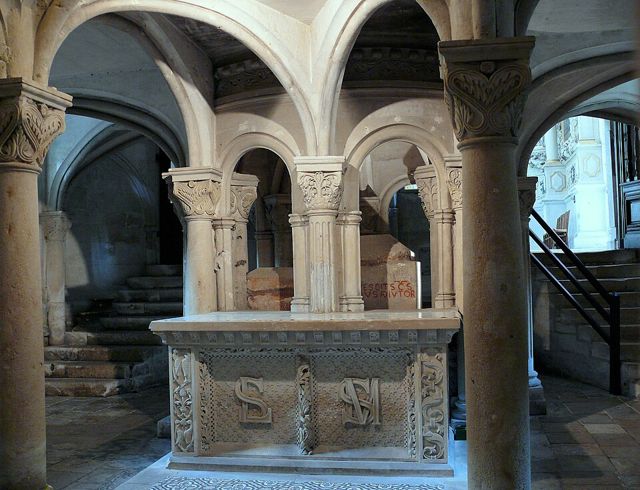
Image: Saint-Maixent-l'Ecole - Crypte Saint-Maixent et Saint-Léger.JPG · MOSSOT · CC BY-SA 3.0, via Wikimedia Commons

From Sabine Baring-Gould, The Lives of the Saints, new edition in 16 vols. (London: John C. Nimmo, 1897–98); text from the Internet Archive scan (OCR, lightly cleaned; errors possible). Public domain.

Image: MOSSOT, Wikimedia Commons (CC BY-SA 3.0)

From Sabine Baring-Gould, The Lives of the Saints, new edition in 16 vols. (London: John C. Nimmo, 1897–98); text from the Internet Archive scan (OCR, lightly cleaned; errors possible). Public domain in the United States. Reproduced unedited, except for short bracketed notes in grey that we added to explain names and terms (“S.” is the old abbreviation for Saint). Some history and judgments reflect 19th-century scholarship.