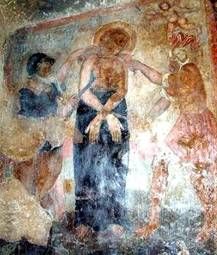
Bishop and theological writer, b. probably in Rhaetia, about 380; d. shortly after 465. Only two dates are historically established in his life. In 451 he was at the synod of Milan where the bishops of Northern Italy accepted the celebrated letter (epistola dogmatica) of Leo I, setting forth the orthodox doctrine of the Incarnation against the Nestorians [Nestorius (d. c. 451), whose teaching split Christ into two persons; condemned at Ephesus in 431] and Eutychians [followers of Eutyches, who said Christ had only a divine nature; condemned at Chalcedon in 451] (Mansi, "SS. Conc. Coll. Ampl.", VI, 143). Among nineteen subscribers Maximus is the eighth, and since the order was determined by age, Maximus must then have been about seventy years old. The second established date is 465, when he was at the Synod of Rome. (Mansi, VII, 959, 965 sq.) Here the subscription of Maximus follows immediately after the pope's, showing he was the oldest of the forty-eight bishops present. The approximate time and place of his birth may be surmised from a passage in Sermo 81 (P.L., LVII, 695), where he designates himself as a witness of the martyrdom of three missionary priests in 397 at Anaunia in the Rhaetian Alps. History does not mention him after 465. He is the first known bishop of Turin, then a suffragan [a bishop under the authority of an archbishop] see of Milan [a bishop’s “see” is his diocese, named from his seat (Latin sedes)]. His successor was St. Victor. His name is in the Roman martyrology on 25 June, and the city of Turin honours him as its patron. A life which, however, is entirely unreliable, was written after the eleventh century, and is printed in "Acta SS.", June, VII, 3rd ed., 44-46. It states that a cleric one day followed him with an evil intention to a retired chapel, where the saint was wont to pray. The cleric suddenly became so thirsty that he implored Maximus for help. A roe happened to pass which the saint caused to stop, so that the cleric could partake of its milk. This legend accounts for the fact that St. Maximus is represented in art as pointing at a roe.
He is the author of numerous discourses, first edited by Bruni, and published by order of Pius VI at the Propaganda in 1784 (reprinted in P.L., LVII). These discourses, delivered to the people by the saint, consist of one hundred and eighteen homilies, one hundred and sixteen sermons, and six treatises (tractatus). Homilies 1-63 are de tempore, i.e. on the seasons of the ecclesiastical year and on the feasts of Our Lord; 64-82, de sanctis, i.e. on the saints whose feast was commemorated on the day on which they were delivered; 83-118, de diversis, i.e. exegetical, dogmatical or moral. Sermons 1-55 are de tempore; 56-93, de sanctis; 93-116, de diversis. Three of the treatises are on baptism, one against the Pagans, and one against the Jews. The last two are extant only in fragments, and their genuineness is doubtful. The sixth treatise, whose genuineness is also doubtful, contains short discourses on twenty-three topics taken from the Four Gospels. An appendix contains writings of uncertain authorship; thirty-one sermons, three homilies, and two long epistles addressed to a sick friend. Many writings, however, which Bruni ascribes to Maximus are of doubtful origin. The discourses are usually very brief, and couched in forcible, though at times over flowery language. Among the many facts of liturgy and history touched on in the discourses are: abstinence during Lent [the forty days of fasting before Easter] (hom. 44), no fasting or kneeling at prayers during paschal time (hom. 61), fasting on the Vigil of Pentecost (hom. 62), the synod of Milan in 389 at which Jovinianus was condemned (hom. 9), the impending barbarian invasion (hom. 86-92), the destruction of the Church of Milan by the barbarians (hom. 94), various pagan superstitions still prevalent at his time (hom. 16, 100-02), the supremacy of St. Peter (hom. 54, 70, 72, serm. 114). All his discourses manifest his solicitude for the eternal welfare of his flock, and in many he fearlessly rebukes the survivals of paganism and defends the orthodox faith against the inroads of heresy.
Ferreri, S. Massimo, vescovo di Torino e i suoi tempi (3rd ed., Turin, 1868); Savio, Gli antichi vescovi d'Italia (Turin, 1899), 283-294; Fessler-Jungmann, Institutiones Patrologiae, II (Innsbruck, 1892), ii, 256-76; Argles in Dict. Christ. Biog., s. v. Maximus (I6); Bardenhewer, Patrology, tr. Shahan (St. Louis, 1908), 527-8.