Baring-Gould’s sources: Roman, Norwegian, Danish, Swedish, Anglican Martyrologies. Authorities: — Olafs Saga helga Haraldssonar, in the Heimskringla, VII., of Snorro Sturlason, b. 1179, d. 1241. Another, Olafs Saga helga hin minni, written in the latter part of the 12th cent. Another, Olafs Saga helga hin minni, in the Fornmanna Sogur, IV. andV. Although these were committed to writing a century after the events, they existed from the date of the death of S. Olaf, having been committed to memory. Of their historical accuracy there can be no question.] Olaf the Saint, the patron of Norway, must not be measured by Christian men of another age or other lands. He was zealous for the propagation of the Christian faith in Norway, but he propagated it with the sword, hacking off the hands, and digging out the eyes of those who refused baptism. If he was diligent in his observance of the fasts of the Church, he was unscrupulous in passing the bounds of temperance on all other days. He rigidly observed the sanctity of the Sunday, but his moral life was far from pure. His successor, Magnus, was not his son by his Queen Astrid. If he was ferociously cruel, he was severely just. He inherited all his pagan ancestors’ vices, but they were united to a chivalrous, zealous enthusiasm for the Christian faith. A saint he can only be termed by stretching that appellation to its extremest limits. S. Olaf was the son of King Harald Grsenske and Aasta, daughter of Gudbrand. On the death of Harald, Aasta married Sigurd Syr, petty king in Ringarik, in Norway, and Olaf was brought up in his fosterfather’s house. When King Olaf Trygvason came to Ringarik to spread Christianity, Sigurd and his wife, and Olaf Harald’s son, were baptized. Olaf Trygvason fell in battle in 1000, and Norway passed under the S. Olaf.
…rule of the Danish king Sweyn, who set his brother, Earl Harald, to govern it. Olaf the Saint, not deeming it safe for him to remain in Norway, went, at the age of twelve, at the head of a piratical expedition, harrying the shores of Denmark, Sweden, and France.
He is thus described at that age: — u He was not tall, but middle sized, stout and strong. He had light brown hair, and a white and red complexion. His eyes were peculiarly fine, beautiful and piercing, so that one was afraid to look him in the face when he was angry. Olaf was very expert in all bodily exercises, understood well how to handle the bow, and to throw the spear. He was a great swimmer, and handy at smith’s work/' As Olaf Haraldson was too young to rule men, to steer ships, and command a piratical expedition, Rane, nicknamed the foster-father of kings, was given charge of the young boy, by his mother Aasta. “ When Olaf in this way got a ship and men, the crew gave him the title of king; for it was the custom that those commanders of troops who were of royal descent, on going out upon a viking cruise, should receive the title of king immediately, although they had no land or kingdom. Rane sat at the helm; and some say that Olaf himself was but a common rower, although he was king of the men-at-arms. They steered east along the land, and came first to Denmark. So says Otto Swart, in his lay which he made about King Olaf: — " Young was the king when from his home He first began in ships to roam, His ocean steed to ride To Denmark on the tide.
TJuly a 9. Well exercised art thou in truth — In manhood's earnest work, brave youth ! Out from the distant North Mighty hast thou come forth."
And again — “ Thy ship from shore to shore With many a well plied oar, Across the Baltic foam is dancing, — Shields, and spears, and helms glancing ! Hoist high the swelling sail To cat eh the freshening gale !
There's food for the raven-flight Where thy sail-winged ship shall light; Thy landing-tread The people dread; And the wolf howls for a feast On the shore-side in the East.”
Towards autumn he sailed to Sweden, as he thought he had cause of hostility against the Swedes, because they had killed his father Harald. His first battle was fought at Sotholm within the Skiergard, or smooth water within the fringe of skerries which guards the coast. He attacked some vikings there, threw grappling irons into their ships, boarded them and cleared them of men. Thence he steered his way into the Mselar lake, that beautiful little inlaud sea, to which access is obtained by an inlet near Stockholm. He sailed along the shores, ravaging the land on both sides. News of the havoc reached Olaf, the Swedish king, and he laid iron chains across Stokkesund, the channel between the Maelar lake and the sea, and guarded the entrance with his troops. Olaf the Saint sailed East, intending to escape out of the lake before winter; but found the entrance watched and barred. He therefore dug a canal across the flat land that lay between the Maelar and the sea. Now a great number of rivers run into the Malar lake; but as the only outlet is small, when heavy autumn rains fall, the water rushes through the narrow jaws of the Stokkesund like the sluice of a water wheel, and all the low land round the lake is flooded. That autumn the rain fell in torrents, the rivers were swollen, and the lake brimmed over, rushed into the cutting made by Qlaf, and swept his boats through it into the open sea.
Olaf then sailed to Gothland in harvest, and prepared to plunder; but the Gothlanders assembled, and sent men to him, offering him msney if he would spare his hand from burning their stacks and farms. Olaf took the money, and spent the winter in Gothland. Next spring he went plundering, and burning, and murdering along the coast of the Eysyssel and up into Finland. He next returned to Denmark, and joined company with another pirate, Thorkell the Tall, brother of Earl Sigvald, and they sailed along the Jutland coast to Sudurwick, where they fell in with a fleet of Danish vikings, fought and dispersed them. After having harried the coast of Friesland and Holland, he made for the English coast.
" It was then that the Danish king, Sweyn Forkedbeard was in England with a Danish army (a.d. 1014), and had fixed there for some time, and had seized upon king Ethelred’s kingdom. The Danes [Viking raiders from Scandinavia] had spread themselves so widely in England that Ethelred had been oblige? to desert the country, and had gone to France. Tyhe same autumn that king Olaf came to England it happened that king Sweyn died suddenly at night in his bed, and it is said by Englishmen that S. Edmund killed him, in the same way that the holy Metcurius killed the apostate Julian. When Ethelred, king of the English, heard this in Flanders, he returned vol. viii. 16 directly to England j and no sooner was he come back than he sent an invitation to all men who would enter into his pay, to join him in recovering the country. Then many people flocked to him; and among others came king Olaf, with a great troop of Northmen to his aid.
11 They steered first to London, and sailed into the Thames with their fleet; but the Danes had a castle within (the Tower). On the other side of the river is a great trading place, called Sudrvik (Southwark). There the Danes had raised a great work, dug large ditches, and within had built a bulwark of stone, timber, and turf, where they had stationed a large army. King Ethelred ordered a great assault; but the Danes defended themselves bravely, and king Ethelred could make nothing of it. Between the castle and Southwark there was a bridge, so broad that two waggons could pass each other upon it. On the bridge they raised barricades, both towers and wooden parapets, in the direction of the river (*'.*., across the bridge), which were nearly breast high; and under the bridge were piles driven into the bottom of the river. “ Now when the attack was made, the troops stood on the bridge everywhere, and defended themselves. King Ethelred was very anxious to get possession of the bridge, and he called together all the chiefs to consult how they should get the bridge broken down. u Then king Olaf said he would attempt to lay his fleet alongside of it, if the other ships would do the same. It was then determined in this council that they should lay their war forces under the bridge; and each made himself ready with his men.
“ King Olaf ordered great platforms of floating wood to be tied together with hazel bands, and for this he July a9.J Ola/.
took down old houses; and with these, as a roof, he covered his ships so widely, that it reached over the ship’s sides. Under this screen he set pillars so high and stout, that there both was room for swinging their swords, and the roofs were strong enough to withstand the stones cast down upon them.
“Now when the fleet and men were ready, they rowed up along the river; but when they came near the bridge, there were cast down among them so many stones and missile weapons, such as arrows and spears, that neither helmet nor shield could hold against it; and the ships themselves were so greatly damaged, that many retreated out of it.
“ But King Olaf, and the Northmen fleet with him, rowed quite up under the bridge, laid their cables around the piles which supported it, and then rowed off with all the ships as hard as they could down the stream. The piles were thus shaken at their foundations and were loosened under the bridge. Now as the armed troops stood thick with men on the bridge, and there were likewise many heaps of stones and other weapons on it, and the piles underneath were loosened or broken, the bridge gave way; and great part of the men upon it fell into the river, and all the rest fled, some into the castle, some into Southwark. Thereafter Southwark was stormed and taken.
“Now when the people in the castle saw that the River Thames was mastered, and that they could not hinder the passage of ships up into the country, they became afraid, surrendered the tower, and took Ethelred to be their king. So says Ottar Swart: — “London Bridge is broken down,— Gold is won, and bright renown.
[Juij ag. Shields resounding, War-horns sounding, Women shouting in the din ! Arrows singing, Mail coats ringing — Odin makes our Olaf win 1 u And Sigvat the Scald relates as follows: — “At London Bridge stout Olaf gave Odin’s law to his war-men brave — ‘ To win or die P Their foemen fly.
Some by the dyke-side refuge gain — Some in their tents on Southwark plain ! This sixth attack Brought victory back. “ King Olaf passed all the winter with king Ethelred, and fought a great battle at Hringmara Heath in UlfkeFs land and here again the king was victorious. “ So says Sigvat the Scald.
“To Ulfkel's land came Olaf bold, A seventh sword-thing be would hold. The race of Ella filled the plain — Few of them slept at home again 1 Hringmara’s heath Was a bed of death: Haarfager’s heir Dealt slaughter there.
M And Ottar sings of this battle thus: — “ From Hringmar field The chime of war. Sword striking shield, Rings from afar.
Tbe living fly; The head piled high. The moor enrich, Red runs the ditch.” But though Ethelred the Unready had obtained 1 Somewhere in East Anglia, probably Assington in Essex, July 29.I 6". Olaf London, he was not as yet the master of the whole of England.
Canute, son of Sweyn, was in Lindesey (part of Lincolnshire), and he caused great mischief still. But king Ethelred felhon Canute when he did not expect it, and drove him to his ships. Canute then went to Sandwich, and cut ‘off the ears, noses, and hands of the English hostages who had been given to his father. Canterbury was still in the hands of the Danes, but Olaf and his Northmen marched thither, attacked, and took the town, “ killing many people and burning the castle.”
On the capture of Canterbury, Ottar Swart made an “All in the grey of morn Broad Canterbury forced Black smoke from house-roofs borne Hides fire that does its worst; And many a man laid low, By the battle axe’s blow, Waked hy the Norseman’s cries,, Scarce had time to rub his eyes.”
And the scald Sigvald sang: — “ Of this eighth battle I can tell How it was fought, and what befell The castle tower With all this power He could not take,.
Nor would forsake. The Perthmen 1 fought, N or quarter sought: By death or flight They left the fight. Olaf could not this earl stout From Canterbury quite drove out.”
Olaf was entrusted with the land defence of England, 1 Perthshire men, as hired soldiers, are alluded to here by Sigvald. and he sailed round the land with his war ships. At New Romney 1 * he met the Danes again, and had a hard battle with them. Of this fight Sigvald says: — “ The youthful king stained red the hair Of Angle men, and dyed his spear At Nymode in their heart’s black blood * And where the Danes the thickest stood— When the shrill storm round Olaf's head Of spear and arrow thickest fled, There thickest lay the Thing men dead 1 Nine battles now of Olaf bold Battle by battle, I have told. 7 ’ Ethelred ordered that Olaf should be paid for his assistance 21,000, or, as some say, 30,000 pounds, and for collecting this sum, Olaf was allowed to overrun the country extorting it from the people and murdering and burning where it was refused. The English historians say that the English thought this as great a grievance as having the Danes in the land. Ottar sings of the doings of Olaf the Saint in England: — “ The English race could not resist thee, With money thou madest them assist thee; Unsparingly thou madest them pay A tax to thee in every way; Money, if that might be got — Goods, cattle, house gear, if not They gathered spoil, borne to the strand, Swept the best wealth out of English land.’ 7 S. Olaf remained in England till the death of Ethelred, a.d. 1016, when he sailed away, fought a battle off the coast of Normandy, then coasted all along the West of France, and lay to in the mouth of the Garonne waiting for a favourable wind, intending to 1 Nyamode, probably New Romney; others suppose Newport in the Isle of Wight.
S. Olaf. coast and harry Spain, sail through the straits of Gibraltar, and visit Jerusalem. But one night he saw in a dream a gigantic man, who warned him to return to Norway, there to receive his crown. After this he returned northwards and plundered and burnt Partheny on his.way- He reached Normandy, and spent the winter of 1016 — 1017 at Rouen, where he met the sons of Ethelred, who had been expelled England by king Canute, after the murder of Edmund Ironside. They made an agreement with Olaf that he should have Northumberland, if he should succeed in driving the Danes out of England. In spring a.d. 1017, Olaf made an attempt on the South West coast, which was unsuccessful. He then sailed to Northumberland and did a little fighting and burning there; and laden with vast booty, he then made for Norway.
He landed at Soelo (Lucky Isle). li A lucky day for me,” said Olaf, il to have lit on Lucky Isle.” As they were going up in the isle, the king slipped with one foot in the clay, but supported himself from falling with the other foot. “ Hah !” said he, “ the king falls.” “ Nay,” replied Rane, “ thou didst not fall, king, but set fast foot in soil.” The king laughed, and said, “ It may be so, if God wills it.”
Olaf had two vessels, he laid them at anchor in a sound, one on each side, with a thick cable between them. Hakon, Earl Eric’s son, was the first who came to offer battle. He rowed right in between the boats. Then Olaf made his men draw the cable up under Hakon’ s ship’s keel, and wind it up with the capstan. As soon as the stern was lifted, the bows plunged down; the water rushed in, and sank the vessel; and Earl Hakon and most of his men who were not drowned were taken prisoners. Olaf offered Hakon his life and liberty if he would swear that he would leave the country and never take arms against him again. Hakon took the required oath, and was allowed to depart. A favourite ballad of two hundred stanzas tells a different story from authentic history. S. Olaf, when he was in Northumbria [the Anglo-Saxon kingdom of northern England and south-east Scotland], was accompanied by his brother Harald, and making for the shore of Norway, they laid a wager that he who arrived first there should be king; but cried Harald, “We will change vessels, the Ormen (Serpent) is so fast, the Oxen she sails slow.”
Olaf agrees; off they set; but the Saint stayed to hear mass before he started. Harald, sure of victory, exultingly led the way across the open sea. They came off Kyrkesund, surrounded by a reef of rocks; within was calm water and the Isle of Tjorn. Harald, in the Ormen, hovered outside the reef, waiting for the turn of the tide and a favourable gale, but S. Olaf dashed unscathed across the rocks scarcely covered by the foaming breakers, outstripped his brother, and gained the crown of Norway.
He erected six small watch-towers in memory of this miracle. Four piles of brickwork remain on Tjorn, called at this day S. Olaf s Vardar; two out of the six have fallen and disappeared.
To return to the history in the Saga. Olaf then went to his mother's house to see her and his step-father, Sigurd Syr. “ He came to the house one day very early. Olaf s mother, Aasta, was sitting in the room, and round her were some of her girls. When the servants told her of King Olafs approach, Aasta stood up directly, and ordered the men and girls to put everything in the best order. She ordered four girls to bring out all that belonged to the decoration of the room, and put it in order with hangings and benches. Two fellows brought straw for the floor, two brought forward four-cornered tables and drinking jugs, two bore victuals, and placed meat on the table, two carried in the ale; and all the other serving-men and girls went outside the house. Messengers were sent to seek king Sigurd wherever he might be, and take him his best dress-clothes, and his horse with gilt saddle, and his bridle, which was gilt and set with precious stones. Four men she sent off to invite all the great people to a feast. All who were in the house she made to dress themselves in their best clothes, and they lent clothes to those who had none suitable.
“King Sigurd Syr was standing in his cornfield when the messengers came to him with the news. He had many people on his farm. Some were then shearing corn, some bound the sheaves, some drove it to the garner; but the king, with two men, went sometimes into the field, sometimes to the barn. His dress, it is told, was this: — he had a blue kirtle and blue hose; shoes laced about the legs; a grey cloak, and a grey widebrimmed hat; a veil before his face (to keep off the mosquitoes); a staff in his hand with a gilt silver head on it, and a silver ring round it. Sigurd was a gain-making man, who attended carefully to his cattle and husbandry, and managed his house-keeping himself. He was not given to pomp, and was rather taciturn.
The messengers told king Sigurd that king Olaf was about to arrive, and that Aasta urged him to do his best to support Olaf in his attempt to recover his kingdom, and at all events, to put in a decent and dignified appearance when he met her son.
King Sigurd would not make up his mind in a hurry. “ This matter means fighting all the power of Sweden and Denmark / 5 said he. “Then the king sat down, and made them take off their shoes, and put on his corduvan (Cordova tanned leather) boots, to which he bound his gold spurs. Then he put off his cloak and coat, and dressed himself in his finest clothes, with a scarlet cloak over all; girded on his sword, set a gilded helmet on his head, and mounted his horse. He sent his labouring carles out of the way, and gathered to him thirty well dressed men, and rode home with them.
“ As they approached the house, they saw on the other side of the house the banners of Olaf coming waving; and there was he himself with some hundred well equipped men. People were gathered on all the roofs to see them. King Sigurd immediately greeted his stepson in a friendly way, and invited him to come in and take a cup of drink with him. But Aasta went up and kissed her son, and invited him to stay with her in the house, and offered land and people, and all she had to help him.”
King Sigurd seems to have felt that he was nothing beside the impetuous Aasta, that whatever his prudence might dictate, she was resolved on uncompromising partisanship. A consultation was held, Sigurd spoke out his objections, but was overruled by his wife. King Olaf, who had been cautiously invited in to “ take a cup of drink,” stayed on with his hundred men as guests of Sigurd Syr, “ who entertained them, day about, the one day with fish and milk, the other day with flesh and King Olaf had now to make a tour through the Uplands and visit all the petty kings, who were in reality S. Olaf.
only the largest farmers of each district, and canvas them. After some demur, all the Upland kings and bonders agreed to acknowledge Olaf as sovereign. The Earls Swend and Hakon had ruled in Norway under the Danish supremacy; Hakon Olaf had upset into the sea, and driven out of the country. Earl Swend hastened to collect an army to oppose Olaf. Swend’s army was 2,000 men strong and was assembled at Nidaros, the present Drontheim, and marched along the Gaular-dale to surprise and attack Olaf, who had only time to escape on board his ships, leaving all his provisions on shore, which were destroyed by the army of his opponent. Nothing more was done that winter. But next spring both Earl Swend and King Olaf prepared for a fight.
“ King Olaf steered his fleet out from Viken, until the two fleets were not far from each other, and they got news of each other the Saturday before Palm Sunday. King Olaf had a ship called the Carl’s Head, 1 on the bow of which a king’s head was carved, and he himself had carved it.
“ King Olaf had in his ships 100 men armed in coats of ring-mail, and in foreign helmets. Most of his men had white shields, on which the cross was gilded, but some had painted it in blue or red. He had also had the cross painted in front on all the helmets in a pale colour. He had a white banner, on which was a serpent figured. He ordered a mass to be read before him, went on board ship, and ordered his people to refresh themselves with meat and drink. He then ordered the warhorns to sound to battle, and row off to meet the earl.”
\ Probably the Head of Charlemagne [king of the Franks, crowned emperor in 800], who was held in high veneration by Olaf. His son Magnus was named after him. The conflict was short, furious, and decisive. Olaf was victorious, Earl Swend spread sails, and fled out of the country. He went to Russia, where he fell sick and died shortly after.
The results of the battle were the complete submission of the whole of Norway to king Olaf. A long desultory war ran on between king Olaf of Norway and king Olaf of Sweden, which ended in S. Olaf marrying Astrid, the daughter of the Swedish king, and a reconciliation being patched up between them. Now Ingigerd, the king of Sweden’s daughter, born in wedlock, had been promised to S. Olaf, but had instead been given to Jaroslav of Russia. A dowry, also, which should have gone with Astrid, the king’s daughter by a Wendish slave girl, was not fully paid.
West Gothland was discontented with the rule of the Swedish king, and some of the chief men in it meditated transferring their allegiance to the crown of Norway. The chief man of West Gothland was Egmund of Skara, law-giver of that district. The resolution of the chiefs was carried out in a curious manner, characteristic of a state of civilization when fables are in vogue to veil plain meanings. Egmund mounted his horse and rode to Upsal, where king Olaf of Sweden was. He went before the king, bent his knee, and saluted him. The king asked him if be brought any news from Gothland. Egmund answered, u There is little news among us Gothlanders; but it appears to us a piece of remarkable news that the proud, stupid Atli, whom we took to be a great sportsman, went into the forest in winter with his snow-shoes and his bow. After he had got as many furs as his handsledge could carry, he returned home from the woods. S. Olaf, But on the way he saw a squirrel in the trees, and shot at it, but did not hit it; he was angry, and left his sledge to run after the squirrel; but still the squirrel sprang where the wood was thickest, sometimes at the roots, sometimes from branch to branch. When Atli shot at it, the arrows flew too high or too low, and the squirrel never jumped so that Atli could get a fair aim at him. He ran all day after the squirrel, which ever eluded him, till night fell, and it was dark. Then he lost himself in the snow, and lay there all night through in a heavy snow storm. As to his sledge, with all the furs he had got in his hunting, it was buried under the snow, and Atli was never able to find it again. So he lost both furs and squirrel and arrows.”
“ This is no news of importance,” said the king. “ Have you come all this way to tell me this ?”' “No, king,” answered Egmund, “I Have come to ask your judgment in a law case.”
“What is it?” asked Olaf. Egmund replied, “ There were two noble-born men of equal birth, but unequal in property and disposition. They quarrelled about some land, and did each other much damage; but most was done to him who was the least powerful of the two. At last the quarrel was settled, and it was arranged that a composition should be paid by the most powerful of the two. But at the first payment, instead of paying a goose, he paid a gosling, for an old sow he gave a sucking pig, and for a mark of gold, half a mark, and for a half a mark a pat of clay. What is your judgment, sire ?”
“Let the full payment be made, or he who has thus treated the other shall have his property and goods confiscated, and half go to the king, and half to the aggrieved party.' u Egmnnd took fitnesses to the judgment, and hastily departed. Now in the evening at supper, no Egmund appeared at the king’s table; next day the king asked the cause of his absence. He was told that directly after he had received the king’s judgment Egmund had galloped away. It now flashed on the king that the law-giver’s story and case were fables and applied to him. He was Atli. His sledge full of furs was Sweden; the squirrel was poor little Norway. In aiming at getting Norway he was in danger of losing Sweden. He and S. Olaf were the two noble-born men at variance: and after a reconciliation had been effected, he had shirked the fulfilment of his promises. Instead of giving Olaf of Norway his well-born daughter Ingigerd, he had given him his base-born daughter Astrid.
The lesson proved of advantage. He hastened to make full friendship with S. Olaf, and indemnify him for the injuries he had done him, and thus arrested the secession of the Gothlanders.
S. Olaf had a son by his wife Astrid; but the son who was to succeed him was the child of a slavegirl named Alfhild, his concubine. 1 “When the child was born, it was very weak, and the priest told Sigvat the Scald to hasten to the king and tell him the event. Sigvat answered that the king was asleep, and he had forbidden any man to break his slumbers.
The priest replied, It is necessary that the child be baptized at once, for it appears to have very little/ life in it. Sigvat said, I had rather take on me to let thee. probably before he was married to Astrid. July a».) vS. Olaf.
baptize the child, than awaken the king. I will take it on myself if anything is amiss, and will give the child a name. “ They did so; and the child was baptized, and got the name of Magnus.
“The next morning, when the king woke and had dressed himself, the circumstance was told him. He ordered Sigvat to be called, and said, How darest thou baptize the child before I knew anything about it ? “Sigvat replies, Because I would rather give two men to God than one to the devil.
“ The king — What meanest thou ? “ Sigvat — The child was near death, and must have been the devil's if it had died as a heathen, and now it is God's.
“ The king — But why didst thou call him Magnus, which is not a name of our race. “ Sigvat— ^1 called him after King Carl -Magnus, who, I knew, had been the best man in the world. “ Then said the king, — Thou art a lucky man, Sigvat; but it is not wonderful that luck should accompany understanding." The king was overjoyed at the circumstance, for, among the heathen Norsemen, and among those just Christianized, it was thought that the communication of a name imparted to the recipient the valour and luck of him whose name was borrowed.
If S. Olaf was not very scrupulous about, breaking one of. the Ten Commandments, he was so about breaking another of them, “ It happened one Sunday that the king sat on his high seat at the dinner table, and had fallen into such deep thought that he did not observe how time went. In one hand he had a knife, and in the other a piece of fir wood from which he cut splinters from time to time. The table-servant stood before him with a bowl in his hands; and seeing what the king was about, and that he was involved in thought, he said, It is Monday, Sire ! to-morrow. The king looked at him when he heard this, and then it came into his mind what he was doing on the Sunday. Then’ the king ordered a lighted candle to be brought in; he swept together all the shavings he had made, set them on the fire, and let them burn on his naked hand; showing thereby that he would hold fast by God’s law and commandment, and not trespass without punishment on what he knew to be right.”
“ It was king Olaf s custom to rise betimes, put on his clothes, wash his hands, and then go to church and hear mattins and mass. After that he attended a council, to which he invited great and small — whoever were known to be men of understanding. He made them recite the laws of Hakon, Athels tan’s foster-son, and after considering them with men of understanding, he altered or added to them. But Christian matters he settled according to the advice of Bishop Grimkel and learned priests; and bent his whole mind to uprooting heathenism and old customs, which he thought contrary to Christianity.” For this purpose he visited the Uplands, and on his progress “ he inquired particularly how it stood with the Christianity of the people, and, where improvement was needful, he taught them the right customs. If any there were who would not renounce heathen ways, he took the matter so zealously in hand that he drove some out of the country, mutilated others of hands and feet, or stabbed their eyes out; hung up some, cut down some with the sword; and let none go unpunished that would not ■S. Olaf, serve God. He went thus through the whole district, sparing neither great nor small. He gave them teachers, and placed these as thickly in the country as he saw to be needful. In this manner he went about that district, and had three hundred deadly men-at-arms with him; and these thence proceeded to Raumarik. He soon perceived that the farther into the interior of the county he proceeded, the worse was the Christianity. He went on therefore everywhere in the same way, converting the people and severely punishing those who would not listen to his word.”
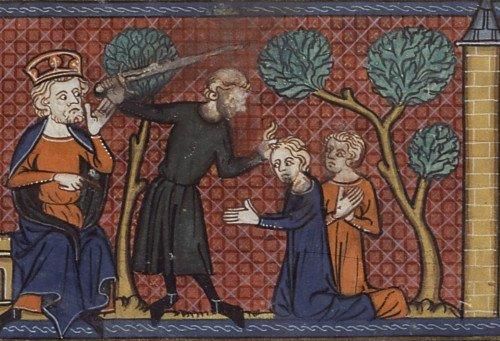
This led to a revolt of the five upland kings. Olaf suddenly surrounded the hall in which they slept, drew them forth, cut out the tongue of one, punched out the eyes of another, and banished the rest. The following little incident shall be quoted from the Saga writer literally. It presents before us King Olaf in a more pleasing light: — il It is told that when King Olaf was on a visit to his mother Aasta, she brought out her children, and showed them to him. The king took his brother Guttorm on one knee, and his brother Halfdan on the other. The king looked at Guttorm, and made a wry face. Both the boys were frightened. Then Aasta brought to him her youngest son, Harald, who was three years old. The king made a wry face at him also; but the urchin looked the king in the face without regarding it. The king took the boy by the hair, and plucked it; but the boy seized the king’s whiskers, and gave them a tug. 1 Ah !’ said the king, * Thou wilt be revengeful, my friend, some day.’ Next day the king was walking with his mother about the farm, and they came to a playground, where Aasta’s sons, Guttorm and Halfdan, were amusing themselves. They were building great 656 Lives of the Satnts. rjuiyag* houses and barns in their play, and they were supposing them full of cattle and sheep; and close beside them, in a clay pool, Harald was busy with chips of wood, sailing them in his sport along the edge. The king asked him what these were; and he answered, these were his ships of war. The king laughed, and said, ‘The time may come, friend, when thou wilt command ships/ Then he called to him Halfdan and Gnttorm; and first he asked Guttorm, ‘What wouldst thou like best to have ?' ‘ Corn, land/ he replied. ‘ And how great wouldst thou like thy corn land to be ?' ‘I would have the whole spit of land that runs into the lake sown with corn every summer/ On that tongue of land there are ten farms. The king replied, 4 There would be a great deal of corn there/ And, turning to Halfdan, he asked, ‘ And what wouldst thou like best to have ?' ‘Cows' he replied. ‘How many wouldst thou like to have ?' 4 When they went to the lake to be watered, I should like to have so many, that they stood as tight round the lake as they could stand/ 4 That would be a great house-keeping/ said the king; ‘and therein ye take after your father/ Then the king turned to Harald and said, 4 And what wouldst thou like best to have ?' ‘ House-servants/ ' And how many wouldst thou have ?' ‘ O ! so many as would eat up my brother's cows at a single meal/ The king laughed, and said to Aasta, ‘~Here, mother, thou art bringing up a king!' '' One of the Upland kings, Rserek, who had been blinded by Olaf, made more than one attempt on the king's life, but was treated with great forbearance by Olaf. The account of the acts of the king in the Saga are so graphic that it is best to give them in their original freshness.
“ When his wound was healed, King Olaf gave t Raerek two men to serve him, let him sit on the high seat by his side, and kept him in meat and clothes in no respect worse than he had kept him before. Raerek was taciturn, and answered short and cross when anyone spoke to him. It was his custom to make his foot-boy, when he went out in the day time, lead him away from the people, and then to beat the lad till he ran away. Then he complained to king Olaf that the lad would not attend to him, and so his servants were changed, but it was as before: no servant would remain with king Raerek. Then the king appointed a man called Swend to wait on king Raerek, who was his kinsman. Raerek continued his morose ways and solitary walks; but when he and Swend were alone together, he was merry and talkative, recalling former days when he was king. He said, L It is hard that thou and my other relation’s are so degenerated that you will not avenge the shame brought on our race.’ Swend said, they had too great power to deal with. Raerek said, 1 Why should we live longer as mutilated men with disgrace ? I, a blind man, may conquer them as well as they conquered me when I was asleep. Come then, let us kill this fat Olaf.’ Swend at last agreed to join him. The plan was laid that when the king was ready to go to vespers, Swend should stand on the threshold with a drawn dagger under his cloak. Now when the king came out of the room, it so happened that he walked quicker than Swend expected; and when he looked the king in the face he grew pale, and then white as a corpse, and his hand sank down. The king observed his terror, and said, 1 What is this, Swend ?’ Swend threw down his cloak and dagger, and fell at the king’s feet, saying, 1 All is in. God’s hand, and thine, king.’ The king ordered him to be seized and put in irons. He ordered Raerek’ s seat to be moved to another bench. He gave Swend his life, and he left the country. The king appointed a ! different lodging for Raerek to sleep in from that in which he slept himself, and in which many of his courtpeople slept. He set two of his court-men, who had been long with him, and whom he could trust, to attend Raerek night and day.”
One night Raerek and a Finn whom he had persuaded to assist him, murdered two of the guards and escaped. The king sent after them and caught Raerek before he had gone far. He was brought back, and watched more carefully than before.
“ It happened on Ascension-day that king Olaf went to high mass, and the bishop went in procession round the church, and conducted the king; and when they came back to the church, the bishop led the king to his seat on the north- side of the choir. There Raerek sat next to the king, and concealed his face in his cloak. When Olaf had seated himself, Raerek laid his hand cn the king’s shoulder and felt it. 1 ‘Thou hast fine clothes on, cousin, to-day/ said he. King Olaf replied, 'It is a festival to-day, in remembrance that Jesus Christ ascended to heaven "from earth.’ “ King Raerek said, 1 1 understand nothing about that, so as to hold in my mind all you tell me about ChristMuch of what you tell me appears incredible to me, although, no doubt, many wonderful things happened in the olden times.’ “ When mass was finished, Olaf stood up, held his hands up over his head, and bowed down before the altar, so that the cloak hung down behind his shoulders. Then king Raerek started up hastily and struck at the king with a long knife; but the blow was received in l To feel if he had his armour on.
>5 Iff the cloak at the shoulder, because the king was bending forward. The clothes were much cut, but the king was not wounded. When the king perceived the attack, he sprang upon the floor, and Raerek struck at him again with the knife, but did not reach him, and said, 1 Art thou flying, Olaf, from me, a blind man ?’ The king ordered his men to seize him, and lead him out of the church. After this attempt many hastened to king Olaf, and advised that Raerek should be killed.” Olaf, however, would not listen to this advice. “I will not sully my victory over five kings by shedding his blood,” said he. Then an odd incident occurred, characteristic of the age.
“ There was an Icelander named Thorarin. He was a remarkably ugly man, principally because he had ungainly limbs, but he was prudent and well-spoken. He had great ugly hands, and his feet were still uglier. Thorarin was in Tunsberg when the attempt on Olafis life was made by Raerek. Thorarin was just then done rigging out a merchant vessel that he owned, and with which he intended to sail to Greenland in the summer. King Olaf had Thorarin as his guest for some days, and conversed much with him; and Thorarin even slept in the king’s lodgings. One morning early, the king awoke while the others were still sleeping. The sun had newly risen in the sky, and there was much light within. The king saw that Thorarin had stretched out one of his feet from under the bed-clothes, and he looked at the foot awhile. In the meantime the others in the lodging awoke; and the king said to Thorarin, worth seeing, and that is a man’s foot so ugly, that I do not think an uglier could be found in this merchant town.’ Thereupon he told the others to look at it, and see if it were not so; and all agreed with the king. When Thorarin observed what they were talking about, he said, ‘ There are few things for which you cannot find a match, and that may be the case here.’ “The king said, ‘I will lay you a wager on it, that not an uglier foot can be found in the town.’ Then Thorarin said, *1 am willing to take the bet.’ The king said, ‘ And he who wins shall have the right to ask what he likes of the other.’ ‘ Be it so,’ said Thorarin. ’ Thereupon he stretched out his other foot from under the bed-clothes, and it was in no way handsomer than the other, and moreover was deficient in a little toe. which is so much uglier; and, besides, it has no little toe. Now I have won.’ ‘ Not so,’ replied the king. ‘The first foot had five ugly toes on it, and this one only four, so that the first is the ugliest.’ 1 The king’s decision must be right,’ said Thorarin, ‘but what does the king require of me?’ ‘To take Raerek to Greenland,’ answered the king.” So Raerek was taken away, not to Greenland, but to Iceland, as Thorarin’s boat was driven back by gales; and in Iceland Raerek ended his days — the only king who lived and died on that island.
King Olaf was fortunate in his bets. On another occasion he played the king of Sweden with dice for a farm. The Swedish king threw two sixes, and said Olaf of Norway need not throw; he could not beat that cast. Olaf shook the dice, threw, and had sixes also. The king of Sweden threw again, and had again two sixes. Olaf, king of Norway, then threw, and had six upon one dice, the other split in two, and turned up seven eyes; thus he won the farm.
July 3Q.] Hearing that the Dronthjem people continued their sacrificial feasts at the coming in of winter, mid-winter, and spring, and that Olver, a wealthy bonder of Egge, was preparing for the spring feast, Olaf secretly made ready an expedition, consisting of five ships sind three hundred armed men, and steered up the Dronthjem fiord. The wind was favourable, the ships sailed briskly before it, and nobody in the district was aware of the king’s design. He anchored at nightfall at Maere, at the head o i the fiord, and surrounded the house of Olver. Olver and his men were brought out and put to death. Then the king took all the provision prepared for the feast, and all the goods, clothes, arms, and treasure of Olver, and divided the booty among his men. Then he dispersed his men throughout the district, plundering and burning the farms of those who rejected or coldly received Christianity.
Thence the king went to North and South More, and in autumn he went into Raunsdal, everywhere enforcing submission to Christianity; and taking hostages from the bonders for their fidelity to the faith. He next visited Gudbrandsdale, but found such large bodies of armed farmers prepared to meet him, that he was unable to sack and burn their homesteads, and hack off their hands and feet, as they had done elsewhere. A meeting was summoned. It assembled in pouring rain. Under these gloomy auspices Olaf stood up before the people and invited them to believe^ in the true God who had made heaven and earth.
Gudbrand, the chief of the valley, rose and answered, “We know nothing of Him whom thou speakest ’ about. Dost thou call him a God whom no one can see ? But we have a god whom we should have brought unto the assembly to-day, but that it is so rainy, and the sight of him will make your blood run cold. If your God is so great, let Him make to-morrow to be a cloudy day without rain, and theji we shall be able to meet and discuss this matter with greater comfort.” The king asked about this god, and he was told it was Thor the Thunderer, represented with his hammer in his hand. Every day five cakes were set in front of the image, and they had vanished before next morning. Olaf went to mass next day early, and then attended the council. The sky was grey, no rain fell. The bishop, Grimkel, was there in his pontifical vestments, with his mitre on his head, and his staff in his hand. He spoke to the farmers of the true faith. Thord, one of the bonders, replied, “ That horned man, with a staff in his hand, crooked at the top like a ram’s horn, tells us many new things. If his God is as powerful as he says, let Him give us clear sunshine to-morrow forenoon, and then we will meet again here, and do one of two things, agree with the king to believe as he pleases, or else to fight him.”
There was a man with King Olaf called Kolbein, who carried a knobbed club in his hand. The king told Kolbein to stand beside him next morning and do exactly what he told him. Then he ordered his men privately to bore holes during the night in the ships of the farmers, and to set loose their horses that were hobbled or tied or stabled. All night the king remained in prayer. Next morning he heard mass early, and took his place at the council. Thor’s idol was brought to the meeting. It was a huge wooden image glancing with gold and silver. When it arrived, the bonders rose and bowed before it. Then it was set down in the middle of the field; on one side of it sat the bonders, and on the other the king and his people. kS. Olaf.
Then Gudbrand of the Dale stood up, and said, “ Where now, O king, is thy God ? I think he will be abashed before this glorious god of ours, whom I see you fear, for you will not raise your eyes to look at him. Neither you nor that horned man- yonder, whom you call your bishop, are as bold as yesterday.” The king whispered to Kolbein, “ Should the bonders turn their heads, strike the idol hard with your club.” Olaf then arose and spoke, “ Much hast thou talked to us this morning, and greatly hast thou wondered that thou canst not see our God; but we expect his arrival. Thou wouldst frighten us with thy blind and deaf god, who cannot move without your shoulders carrying him along. But now ” he paused, then in a loud voice he cried, “ Look to the East, behold our God coming !”
The sun was rising, and all turned to look. At that moment Kolbein smote the idol with his knotted club, crashed through the painted sides, beat it down, and out rushed a swarm of rats and mice.
The farmers fled in all directions, but their horses were running wild, their ships were scuttled; they could not escape. The king rose and addressed them. “I do not understand this noise and running about. Ye see yourselves what your God can do, — the idol ye adorned with gold and silver, and to which ye offered meat. Take now your gold and ornaments strewed about on the grass, and give them to your wives and daughters; but never hang them up hereafter on stocks and stones. Here I offer you two conditions, choose between them— either accept Christianity, or fight this very day; and the victory be to them to whom the God we worship gives it.”
The farmers sullenly submitted, and were forthwith baptized by the bishop. The king left teachers behind him, and then went on to enforce the observance of Christianity in Hedemark.
In the following year he visited the districts of Vors and Valders. At Vors the farmer armed against him, but did not dare to fight. He appointed a council at Valders, and the people attended it in arms. Whilst they were assembled, Olafis men went round the great lake of Valders setting fire to the farms. The unfortunate bonders were so distracted with anxiety for their burning homesteads, the smoke and flame from which rose in the sky, that they submitted. Then the king had them all baptized, and restored to them such of their property as had escaped the flames. Olaf sent messengers to Iceland requiring the natives to accept Christianity, and threatened if they refused to close all the harbours of Norway to their trading vessels, and arrest and imprison every Icelander who fell into his power. The Icelanders, as a matter of political and commercial expediency, declared their readiness to change their religion, and asked the king to send them teachers to instruct them in the faith he desired them to adopt. The harshness with which Olaf treated the people, his iron repression of every attempt to revive heathenism, but above all, the rigour, the impartial severity with which he put down piracy, the darling pursuit of the Northmen, raised great discontent, which burst out at length into general revolt.
Earl Hako of Denmark, kinsman of Canute, king of England, sailed with a large fleet to Norway, and the country was in one wide blazing insurrection; he was received with enthusiasm. Olaf was obliged to fly the kingdom and take refuge in Russia. But the opportune death of Hako caused his hopes to revive, and at the head of two hundred men he left Russia and landed in Sweden. As he made his way through the forests to the Norwegian frontier, he was joined by a few friends, but the vast majority of the chiefs, the farmers, and all the peasantry of Norway were opposed to him. Numbers of outlaws, vagabonds and forest- settlers, joined the king, eager for spoil. Among these were two, GaukaThorer and Afarfaste, vagabonds and robbers, at the head of a company of thirty men. Olaf endeavoured to persuade them to become Christians. Gauka-Thorer said, “ I and my comrades have no faith but in ourselves, and with this faith we slip along sufficiently well.” The king replied, “It is a great pity that such brave slaughtering fellows as you should not believe in Christ.” And he offered to advance them to great dignities if they would be baptized. But if not, he desired that they should leave the army. Afarfaste said he could not believe, and Gauka-Thorel muttered, “ It is a great shame that the king drives us thus from his army, and I never came before where I was not heartily welcome, nor will I leave now.” So they fell into the rear, but followed the army. Now when King Olaf had reached the frontier on Staf s Moor, he heard that the army of the Norwegian bonders was njarching against him, and that a battle was imminent. He mustered his force then, and found that he had more than 3,000 men. Of these 900 were heathens, and Olaf ordered that these men should allow themselves to be baptized. “We must not,” said he, “put our confidence in numbers, but in God alone; for through His power and favour we must be victorious, and to obtain His favour we must not have heathen men mixed up with our host.”
When the heathens heard this, they held a meeting, and 400 men agreed to be baptized; but 500 men refused and returned to Sweden. Then the brothers Gauka-Thorer and Afarfaste presented themselves before the king and offered again to follow him. Olaf asked if they were prepared to accept baptism. They stepped aside to talk to each other on the matter, and Afarfaste said, “ To give my opinion, I will not turn back, but go on into battle, and fight on one side or the other, I don’t care much which.” Gauka-Thorer replied, “ If I go into battle it will be on the king’s side, and if I must believe in a God, why not in the white Christ as well as in any other ? Now it is my advice that we be baptized, since the king insists on it.” Then they were baptized by a priest and confirmed by the bishop. King Olaf was so pleased that he took them into his body-guard, and bade them fight beside his banner in the battle. The king had white crosses painted on the shields and helmets of all his men; and announced to them that the battle-cry should be, “Forward, Christian men! Cross-men !”
Bishop Grimkel was in the army of Olaf, encouraging his men; in that of the bonders and peasants was Bishop Sigurd, reciting to them the wrongs they had endured at the hands of the king.
“ From his earliest youth,” said Bishop Sigurd, “ Olaf has been accustomed to plunder and kill. For this purpose he has wildly traversed all countries, until he turned at last to this, where he has vexed and harried the best men in the country. Ye know yourselves how he has treated the lendermen, of whom many of the worthiest have been murdered, and many obliged to fly the country; and how he has devastated his land with robber bands, burning and plundering houses, and killing people. What man among us has not suffered S. Olaf.
some injury at his hands ? Now he has come hither with a foreign troop, consisting mostly of forest-men, vagabonds, and such like marauders. } Do ye think he will now be more merciful to you, when he is roaming about with such a bad crew, after committing devastations before, contrary to the advice of all his friends and followers ?”
It is a severe condemnation of King Olaf, that after a reign of twenty-live years, he had alienated the heart of nearly every Norwegian from him. The historians who record his yearly proceedings show him acting not as a father, but as a tyrant to his people; with the most earnest desire to advance Christianity, he desolated his kingdom by letting loose his rapacious followers upon every land-owner whom he knew or suspected on the whisper of a foe, to harbour a lurking love of heathenish customs. Bishop Sigurd’s appeal was not exaggerated, it was a plain statement of undeniable truths. Olaf admitted it to the full, u The bonders know,” said he, “ that I have burnt their habitations, and punished them severely in many ways; but I proceeded against them with fire and sword because they rejected the true faith, betook themselves to sacrifices, and would not obey my commands. I had God’s honour to defend.”
At the same time it is impossible not to admire the evident zeal of Olaf, even if not showing itself in the best way possible. To advance true religion and God’s glory was the leading principle of his life. It was sovereign above every other purpose. If he acted cruelly and intemperately, it was because he was not fully instructed in the maxims of the gospel. He had to contend with men impatient of restraint, with a passion for war, and to control them severity was necessary. His position was one of great difficulty, and required consummate prudence and dispassionate judgment, virtues he did not possess.
He belonged neither to an age -nor to a race that understood mercy. The early Norse Christians listened with streaming tears to the narrative of the life of Christ, but never thought of imitating it. Olaf certainlv acted up to the light he had, and his life shows him struggling against heathen licence and barbarism towards what he knew and felt was'better. The armies met at Sticklastad. The night before the battle the king lay with his army around him on the field j he was long awake in prayer to God, and slept but little. Towards morning slumber fell on him, and when he awoke, daylight was shooting up over the pineclad Norwegian mountains that rimmed the East. The king thought it too early to awaken the army. He had near him an Icelandic scald, Thormod, called from his having composed a poem on the coal-black brows of a damsel on the Isa-fiord, Kolbunar-skald. 1 Thormod was lying near the king, and was awake.
“ Sing us a song,” said the king. Thormod raised himself up, and sang so loud that the whole army could hear him. He sang the grand old Norse battle-song the Biarkamal. These are the first verses: — "The dawn is breaking, The wood birds, shaking Their wings, out call From hut and hall, Heads heavy with wine.
Wake ! wake ye ! wake up ! Wake Thralls to work and weep; i There is an intensely interesting Icelandic Saga narrating the history of this Thormod and his foster-brother, the Fosthbreethra Saga. JniyasJ S. Olaf. 669 Chieftains cast off your sleep, Har 1 iron griping deals the blow I Hrolf 2 bends and spans his arrow to the bow 1 Ye that never fly, See how the whit'ning sky Calls to the battle field, calls to the war, To conflict with sword, to the wound, to the scar/' 3 Then the troops awoke, and when the war-song was ended they thanked him for it. The king took off a gold ring and gave it to Thormod. The scald thanked Olaf for the gift and said, a We have a good king; but it is not easy to say how long the king will live. It is my prayer, sire I that thou shouldst never part from me either in life or death.”
The king answered, “We shall go together as long as I rule, and you shall follow me.” Thormod said, “ I hope, sire, that whether in safety or in danger, I may stand near you.” Then he sang: — ** To thee, my king, I’ll still be true, Until another scald I view, Here in the field with golden sword, As in thy hall, with flattering word. Thy scald shall never prove a craven Though he may feast the croaking laven. The warrior’s fate unmoved I view-^ To thee, my king, I’ll still be true." The king then addressed his army, and bade them prepare for battle. After he had drawn up his army, he found that the hostile army was not near, as yet He sat down, and the people sat round him. He leaned back, and laid his head on the knee of Finn Amason. Then he fell asleep, and slept a little while. But now 1 One of Odin's names — the Lofty One. 2 Another name of Odin.
8 Unfortunately only fragments of the Biarka-mal exist. They will be found in Rafn's Fornalder Sogur, 1., p. no — 112. The translation ia verv difficult. the army of the bonders came in sight with banners flying.
Finn woke the king, and told him of the approach of the enemy. “ Why did you waken me, Finn ?” said Olaf. “ You spoiled the enjoyment of my dr earn. ” Finn said, “It is no time for dreaming. You must be awake, and preparing to meet the army of the ' bonders.”
The king replied, “ They are not yet so near us, and it would have been better to have let me sleep on.” Then said Finn, “ What was the dream, sire ?” The king told him his dream. He seemed to see a high ladder, upon which he went so high in the air that heaven was open: for so high reached the ladder. “ And when you woke me I was come to the highesl step towards heaven.”, Finn looked grave. “This dream bodes no good. You are fey, 1 I fear; unless it be mere want of sleep that has worked upon you.”
Just as they were going into battle, a handsome, wellarmed man offered himself to Olaf, to fight with him. He was a pagan, named Arnliot Gellina. The king asked him if he were a Christian. Arnliot answered, “ My faith has hitherto been to believe in my own power and strength, and a very satisfactory faith I have found it j but I am not indisposed, sire, to believe in you.” The king replied, “If you will put faith in me, you must also put faith in what I will teach you. You must believe that Jesus Christ has made heaven and earth, and all mankind, and to him shall all those who are good and rightly believing go after death.” 1 The involuntary acts or words of a man doomed, and under the shadow of approaching death, S. Olaf Arnliot answered, “ I have indeed heard of the white Christ, but neither know what he proposes, nor what he rules over; but now I will believe all thou desirest, and lay my lot in thy hands.”
Thereupon Arnliot was baptized. The king hastily taught him as much of the Faith as could be compressed into the few minutes at his disposal, and then dismissed him to his place in the host. The battle raged with great fury. The king’s war shout was, “ Forward, forward, Christ-man! cross-man I king’s-man !”' The weather was beautiful, and the sun shone clear, but when the battle began, a sea-fog rose over the sky, and the sun burned like a blood-red ball in the darkened heavens; and gradually a total eclipse came on. There was something awful in the roar of battle going on under the solemn grey light of an eclipsed sun.
The king fought with his great two handed sword before all his men. One of the leaders on the opposite side, Thorgeir of Quiststad, he cut across the face, slashing off the nose-piece of his helmet, and clove his head down below the eyes, so that they fell out. Kalf Arnason, another, with one Thorer Hund, next came against S. Olaf. King Olaf hewed at Thorer Hund, and struck him across the shoulders; but the sword would not bite; Thorer wore a reindeer-skin coat over his chain mail.
Thorer then smote at the king, and they exchanged some blows,- but the king’s sword would not cut where it met the reindeer skin, although Thorer was wounded in the hands. The king exclaimed to Biorn the marshal, “Do thou kill the dog on whom steel will not bite.” Biorn turned round the axe in his hands, and gave Thorer a blow with the hammer of it on the VOL. VIII. 18 shoulder so hard that he tottered. The king turned at the same moment against another man and dealt him his death-wound. Thorer Hund drove his spear right through the body of the marshal, exclaiming, “ So I kill bears.” 1 Then a bonder, Thorstein, struck at king Olaf with his axe, and the blow hit his left leg above the knee. Finn Arnason instantly killed Thorstein, The king, after the wound, staggered towards a stone, threw down his sword, and prayed to God to help him. Then Thorer Hund struck at him with his spear, and the stroke went under his mail-coat and into his belly ^ Then Kalf smote at him on the left side of the neck. These three wounds were king Olaf s death; and after his death, the greater part of the forces which had advanced with him were mown down on the field and lay about him.
Thorer Hund went to king Olaf s body, laid it straight out on the ground, and spread a cloak over it. He said afterwards that when he wiped the blood from the face it was very beautiful; and there was red in the cheeks, as if the king slept.
Thormod, the Icelandic scald, he who had sung the coal-black brows of his mistress, was under king Olaf s banner in the battle. When the king had fallen, the battle was raging so that all the king’s men were either killed or wounded. Thormod was severely wounded, and fell back, when the survivors retreated. Then the rearguard headed by one Dag rushed forward over the ground, strewn with dead, and endeavoured by their desperate courage to retreive the fortunes of the day. Thormod stood aside, weary and faint. And as he stood thus, an arrow struck him in the left side; but he broke 4 Biorn signifies bear in Norse.
July ag.] S. Olaf. off the shaft of the arrow, went out of the battle, and up towards the farm of Sticklastad, where the wounded were being attended to in a large barn. Thormod had his drawn sword in his hand. As he went in he met a man coming out, who said, “ The wounded in there howl and scream with pain, and bear their wounds very ill.”
Thormod said, tl Wast thou in the battle too ?” “I was with the bonders, which was the best side,” said he. “ And art thou wounded any way ?” said Thormod. “A little,” answered the man; u And hast thou been in the battle too ?”
Thormod replied, “1 was with them who had the best.” “ Art thou wounded ?” “ Not much to signify.” As the man — his name was Kimbe, saw that Thomod had a heavy gold ring on his arm, — it was that given him in the morning by S. Olaf, he said, “ Thou art certainly a king’s man. Give me thy gold ring, and I will hide thee. The bonders will kill thee if thou fallest in their way.”
Thormod answered, u Take the ring if thou canst get it. I have lost what is more dear to me than a ring.” Kimbe stretched out his hand, and wanted to take the ring; but Thormod, swinging his sword, cut off his hand: and Kimbe is said to have screamed and howled as badly as any whom he had been blaming before. Kimbe went off, and Thormod sat down in the barn, and listened to what people were saying. The conversation turned on what each had seen in the battle, and some praised King Olaf, and others spoke against him, Thormod went out, and entered into a chamber apart; in which there were many wounded men, and with them a woman binding their wounds.
There was fire upon the floor, at which she warmed water to wash and clean their wounds-. Thormod went to a pillar and stood leaning against it. The girl said to him, “ Are you one of the king’s men, or are you of the side of the bonders ?” In reply he sang a stave. Then the woman said, “Why do you not let your wound be dressed if you are hurt ?” Thormod answered, “ I have a wound which none may bind up.” Then she who was heating the water said to him, “ Why are you so pale, man, and so colourless ? if you are wounded let your sore be attended to.” But Thormod answered: — “lam not ruddy, the ruddy youth Readiest tend the tender maids.
Far in, deep-dyed in blood, Stands in my wound the spear That struck me, fair faced ! The trace of the rushing storm Of swift weapons burns me,"
And when he had said that, he died, leaning against the pillar, and fell dead to the earth. “But the verse was not completed by him, Harald Sigurd’s son added the words 1 burns me.’ ’ n The Saga of King Olaf, in the Heimskringla narrates the circumstances rather differently. 'It is said that Thormod rejoiced at the arrow having pierced him, for now that Olaf was dead, he had no wish to live. “ Thormod stood up and went in towards the fire, and stood there awhile. The young woman said to him, 1 Go out man, and bring in some of the split firewood which lies close beside the door.’ He went out and 1 Fostbraethra Saga ii S. Ola f brought in an armful of wood, which he threw down upon the floor. Then the nurse-girl looked him in the face, and said, ‘ Dreadfully pale is this man — why art thou so ?’.... and she said, ‘ Let me see thy wound, and I will bind it.* Thereupon Thormod sat down, cast off his clothes, and the girl saw his wound, and felt that a piece of iron was in it, but could not find where the iron had penetrated. In a stone pot she had stirred together leeks and other herbs, and boiled them, and gave the wounded men of it to eat, by which she discovered if the wounds had penetrated into the belly; for if the wound had gone so deep, it would smell through of the leek. She brought some of this now to Thormod, and told him to eat of it. He replied, ‘ Take it away, I have no appetite for my broth.’ Then she took a large pair of tongs, and tried to pull out the iron; but it sat too fast, and would in no way come, and as the wound was swollen, there was little to lay hold of. ‘Now,’ said Thorir, ‘cut in deep enough to get fast hold with the tongs, and let me pull.’ She did so. Then Thormod took a gold ring from his hand, and gave it to the nurse-girl. ‘It is a good man’s gift/ he said, ‘for King Olaf gave it me this morning.’ Then Thorir took the tongs, and pulled the iron out, and it was barbed. Then Thormod leaned back and Thus died this brave gallant heart. It speaks well for King Olaf that he could have inspired such affection in the cold Icelander. But this was not the only instance. I have ventured to transgress somewhat in giving this touching incident, but nothing speaks so highly for a man’s character as that it should inspire love and reverence in men of heroic minds.
1 Heimskringla, Saga The body of S. Olaf was taken to Drontheim and there buried, but as during the winter there grew up a belief that Olaf was a saint and a martyr, Bishop Grimkel had the body taken up the following year and enshrined.
It still reposes untouched in Drontheim Cathedral.