St. Oswald, Archbishop of York

OSWALD, the only saint commemorated on Feb. 29th, was the nephew of S. Odo, archbishop of Canterbury, and of Osketill, bishop, first of Dorchester, and afterwards of York.

Read the essentials →
February 29 · —

St. Oswald

St. Oswald, Archbishop of York

OSWALD, the only saint commemorated on Feb. 29th, was the nephew of S. Odo, archbishop of Canterbury, and of Osketill, bishop, first of Dorchester, and afterwards of York.

Traditional feast

February 29
1914 / pre-1969 calendar, per Baring-Gould (1897)

Current feast

February 29 (also listed: February 28, May 19)
Secondary source · Wikipedia

Represents

Feast

Their story

Adapted in modern English from Baring-Gould (1897) · original text below

Oswald was a nephew of St Odo, Archbishop of Canterbury, and of Osketill, who was bishop first of Dorchester and then of York. Odo educated him, and he became a canon and then dean of Winchester. He then took the monastic habit at the abbey of Fleury in France. Odo called him back to England, where he won the favour of St Dunstan, who recommended him to King Edgar, and on the king's orders he was chosen Bishop of Worcester around 959.

One of his first acts was to settle twelve monks at Westbury. He went on to build Ramsey Abbey on an island in Ramsey Mere. A council in 969 ordered the clergy either to live unmarried or to give up their cures, and Oswald and Ethelwold of Winchester were charged with enforcing it. Oswald was later made Archbishop of York without giving up Worcester. He founded a Benedictine (monks following the Rule of St. Benedict) monastery of the Mother of God at Worcester, and its church became the cathedral.

Every day he washed the feet of twelve poor men and then fed them. On the Tuesday after the third Sunday of Lent, 29 February, he was doing this as usual. He dried the feet of the last poor man, bent to kiss them, said 'Glory be to the Father, and to the Son, and to the Holy Ghost,' and quietly died. He was buried at Worcester. Ten years later his successor Adulph moved his remains to York.

Early life

Selected sentences from the original account, unaltered.

He was educated by S. Odo, and made first canon and then dean of Winchester, but he took the monastic habit in the abbey of Fleury, in France, and was recalled by S. Odo to England, where he found favour with S. Dunstan, who commended him to king Edgar, and, by his command, he was chosen bishop of Worcester, about the year 959.

What they represent

How they teach us to live

Drawn from themes in the original account

Give to people in need. The account records care for the poor.

Build up the community you belong to. This life was lived with and for a community.

From the Catholic Encyclopedia

1913 · 506 words

Archbishop of York, d. on 29 February, 992. Of Danish parentage, Oswald was brought up by his uncle Odo, Archbishop of Canterbury, and instructed by Fridegode. For some time he was dean of the house of the secular canons at Winchester, but led by the desire of a stricter life he entered the Benedictine [monks following the Rule of St. Benedict] Monastery of Fleury, where Odo himself had received the monastic habit. He was ordained there and in 959 returned to England betaking himself to his kinsman Oskytel, then Archbishop of York. He took an active part in ecclesiastical affairs at York until St. Dunstan procured his appointment to the See of Worcester. He was consecrated by St. Dunstan in 962. Oswald was an ardent supporter of Dunstan in his efforts to purify the Church from abuses, and aided by King Edgar he carried out his policy of replacing by communities the canons who held monastic possessions. Edgar gave the monasteries of St. Albans, Ely, and Benfleet to Oswald, who established monks at Westbury (983), Pershore (984), at Winchelcumbe (985), and at Worcester, and re-established Ripon. But his most famous foundation was that of Ramsey in Huntingdonshire, the church of which was dedicated in 974, and again after an accident in 991. In 972 by the joint action of St. Dunstan and Edgar, Oswald was made Archbishop of York, and journeyed to Rome to receive the pallium [a woolen band the pope gives to archbishops as a sign of their authority] from John XIII. He retained, however, with the sanction of the pope, jurisdiction over the diocese of Worcester where he frequently resided in order to foster his monastic reforms (Eadmer, 203). On Edgar's death in 975, his work, hitherto so successful, received a severe check at the hands of Elfhere, King of Mercia [the Anglo-Saxon kingdom of the English Midlands], who broke up many communities. Ramsey, however, was spared, owing to the powerful patronage of Ethelwin, Earl of East Anglia. Whilst Archbishop of York, Oswald collected from the ruins of Ripon the relics [the bodily remains of a saint, or objects they used, kept with honor] of the saints, some of which were conveyed to Worcester. He died in the act of washing the feet of the poor, as was his daily custom during Lent [the forty days of fasting before Easter], and was buried in the Church of St. Mary at Worcester. Oswald used a gentler policy than his colleague Ethelwold and always refrained from violent measures. He greatly valued and promoted learning amongst the clergy and induced many scholars to come from Fleury. He wrote two treatises and some synodal decrees. His feast is celebrated on 28 February.

Historians of York in Rolls Series, 3 vols.; see Introductions by RAINE. The anonymous and contemporary life of the monk of Ramsey, I, 399-475, and EADMER, Life and Miracles, II, 1-59 (also in P.L., CLIX) are the best authorities; the lives by SENATUS and two others in vol. II are of little value; Acta SS., Feb., III, 752; Acta O.S.B. (Venice, 1733), saec. v, 728; WRIGHT, Biog. Lit., I (London, 1846), 462; TYNEMOUTH and CAPGRAVE, ed. HORSTMAN, II (Oxford, 1901), 252; HUNT, Hist. of the English Church from 597-1066 (London, 1899); IDEM in Dict. of Nat. Biog., s.v.; LINGARD, Anglo-Saxon Church (London, 1845).
Read more

The full original · 390 words

Read Baring-Gould’s full account

Baring-Gould’s sources: Wilson's Anglican Martyrology, and those of Wyon, Menardus, and Morolycus. But Molanus on October 15th. Authorities:—His life by Eadmer; also Florence of Worcester, William of Malmesbury, and the Ramsey Chronicle.

OSWALD, the only saint commemorated on Feb. 29th, was the nephew of S. Odo, archbishop of Canterbury, and of Osketill, bishop, first of Dorchester, and afterwards of York. He was educated by S. Odo, and made first canon and then dean of Winchester, but he took the monastic habit in the abbey of Fleury, in France, and was recalled by S. Odo to England, where he found favour with S. Dunstan, who commended him to king Edgar, and, by his command, he was chosen bishop of Worcester, about the year 959. One of his first acts was to establish twelve monks at Westbury, in his diocese. He afterwards built Ramsey monastery, on an island in Ramsey Mere, given to the Order of S. Benedict [father of Western monks (d. c. 547), author of the Rule] by Earl Hilwyn, cousin of king Edgar, who had been cured of gout by an apparition of the patriarch [the title of the bishops of the great ancient sees: Rome, Constantinople, Alexandria, Antioch, Jerusalem] of western monks. S. Dunstan, as is well known, laboured diligently to enforce celibacy on the clergy in England. A council was held in 969, in which the clergy were ordered to live single or to resign their cures, and Oswald of Worcester, and Ethelwold of Winchester, were commissioned to enforce this decree. Oswald was afterwards made archbishop of York, without resigning the see of Worcester [a bishop’s “see” is his diocese, named from his seat (Latin sedes)]. He had established a Benedictine [monks following the Rule of St. Benedict] monastery, dedicated to the Mother of God, at Worcester, and the monastic church from that time became the Cathedral.

It was his wont to wash every day the feet of twelve poor men, whom he afterwards fed. On the Tuesday after the third Sunday in Lent [the forty days of fasting before Easter], Feb. 29th, he was performing this duty as usual. After he had wiped the feet of the last poor man, and had stooped to kiss them, he said "Glory be to the Father, and to the Son, and to the Holy Ghost," and gently expired.

He died, and was buried at Worcester. Ten years after, his remains were taken up by his successor, Adulph, and translated to York, on October 15th. It is said that when his body was taken into Worcester Abbey Church, after his death, a white dove hovered above it. His purple and gold stole was preserved in Beverley Minster, in the time of Thomas Stubbs, who mentions the fact in his account of the Archbishops of York.

Printed by Ballantyne, Hanson & Co. Edinburgh and London

Feast days

Feast: February 29

Nine days · Free

Pray the novena
with us.

One short email a day for nine days. The day's prayer, a line from St. Oswald's story, and a nudge to keep going.

Also on February 29
St. Hesychius

St. Hesychius

March 1 · Bishop, Martyr
St. Eudocia

St. Eudocia

March 1 · Martyr
St. Antonina

St. Antonina

March 1 · Martyr
← All 1726 saints in the library
Sources & notes

Feast-day sources

Story sources

Sources

Credits

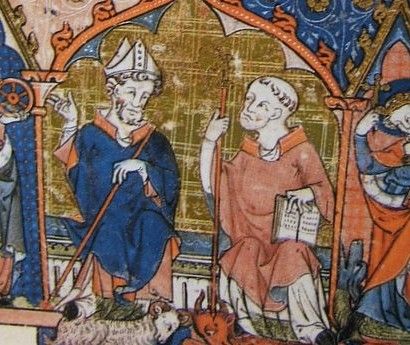
Image: Oswald and Eadnoth.jpg · AnonymousUnknown author · Public domain, via Wikimedia Commons

From Sabine Baring-Gould, The Lives of the Saints, new edition in 16 vols. (London: John C. Nimmo, 1897), digitized text from Project Gutenberg. Public domain.

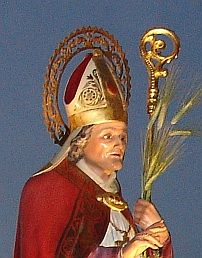
Image: AnonymousUnknown author, Wikimedia Commons (Public domain)

From “Catholic Encyclopedia (1913)/St. Oswald (1),” The Catholic Encyclopedia (New York: Robert Appleton Company, 1907–1914), via Wikisource. Public domain. Matched by name and feast date; text unedited except for our bracketed notes in grey.

From Sabine Baring-Gould, The Lives of the Saints, new edition in 16 vols. (London: John C. Nimmo, 1897), digitized text from Project Gutenberg. Public domain in the United States. Reproduced unedited, except for short bracketed notes in grey that we added to explain names and terms (“S.” is the old abbreviation for Saint). Some history and judgments reflect 19th-century scholarship.