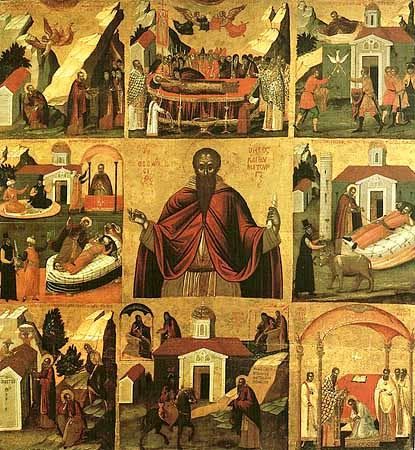
Leaving everything to pray, yet still drawing people who needed wisdom.
Read the essentials →Leaving everything to pray, yet still drawing people who needed wisdom.
January 11
Not verified yet
Hermit
The old anchorite refused to receive him, because his manner of life was too severe for a youth.
Pray a little every day. Prayer runs all through this account.
Make time for silence. Solitude and withdrawal to pray shape this life.
Learn from the kind of life it was. Leaving everything to pray, yet still drawing people who needed wisdom.
S. Palæmon was an aged hermit in the deserts of Upper Egypt, when Pachomius, released from military service, and desiring to flee the world, came to him and desired to become his pupil. The old anchorite [a hermit, sometimes walled into a cell beside a church] refused to receive him, because his manner of life was too severe for a youth. "I eat nothing but bread and salt," said he; "I never taste wine, and I watch half the night." Then, answered Pachomius, "I believe in Jesus Christ my Lord, who will give me strength and patience to assist thee in thy prayers to follow thy holy conversation."
Then Palæmon, beholding him with his spiritual eye, saw that he was a chosen vessel, and admitted him to be his disciple. So they lived together, serving the Lord in fasting and tears and prayer.
When the feast of Easter came, Pachomius, to honour the day of the Resurrection, prepared a dinner of herbs and oil, and set it before the master. But Palæmon, pressing his brow with his hands, exclaimed, "My Lord suffered on the Cross, and shall I taste oil?" So he refused it, and contented himself with bread and salt.
One evening, a solitary came into their cell, and asked to join them in prayer; then, filled with a spirit of presumption, he said, "If we are the true servants of God, let us say our prayers standing on live coals."
But Palæmon was wroth, and rebuked him for his pride.
However, the monk persisted, and by Satan's craft, he stood unhurt on the red-hot cinders. Then he retired to his own cell, puffed up with self-confidence. But pride goes before a fall, and shortly after he fell into fleshly lust; then, filled with shame, he crept back to the cave of Palæmon, and falling at his feet, with bitter tears, confessed his sin.
When S. Pachomius was inspired to found a monastery at Tabenna, he announced his intention to S. Palæmon. The old man accompanied his pupil, and took up his abode at Tabenna, for he loved Pachomius as his own son, and he could not bear to be separated from him. Therefore he said, "Let us make a compact together, that we part not the one from the other, till God break our union." And to this Pachomius gladly agreed. So they lived much together, till the old man died, and then his disciple buried him at Tabenna.
Feast: January 11
One short email a day for nine days. The day's prayer, a line from St. Palæmon's story, and a nudge to keep going.
From Sabine Baring-Gould, The Lives of the Saints, new and revised edition (Edinburgh: John Grant, 1914; first edition 1872). Public domain.
From Sabine Baring-Gould, The Lives of the Saints, new and revised edition (Edinburgh: John Grant, 1914; first edition 1872). Public domain in the United States. Reproduced unedited, except for short bracketed notes in grey that we added to explain names and terms (“S.” is the old abbreviation for Saint). Some history and judgments reflect 19th-century scholarship.