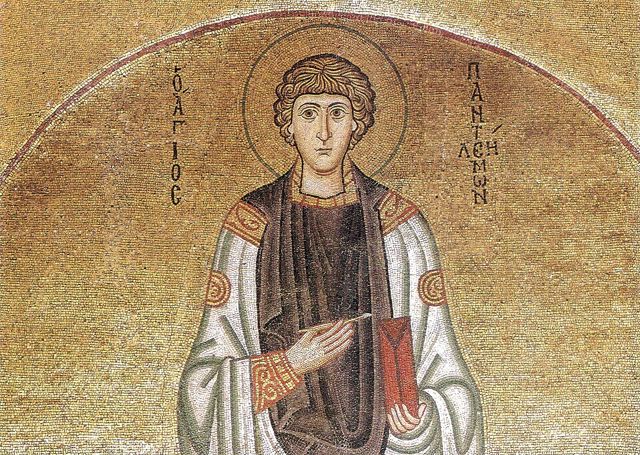
Baring-Gould’s sources: Roman Martyrology. Greek Mensea and Menology on the same day. The Martyrologium Parvum, and some copies of the Martyrology of S. Jerome, as also Ado and Notker on July 28th. Hrabanus Maurus on Feb. 18th. In some Martyrologies on April 23rd. Authorities: — The Acts, which are, however, apocryphal. Of these there are two versions, one by Metaphrastes, neither of any value.] That there was a martyr named Pantaleon at Nicodemia, in the persecution of Diocletian, can scarcely be doubted. There was a church dedicated to him at Constantinople at an early age, which was so old and out of repair that it had to be rebuilt entirely by Justinian I. a.d. 532. 1 It is said that Constantine erected a church to S. Pantaleon at Sebaste, but this statement rests on no good authority. It is, however, not improbable that the church under that invocation, on the headland near Constantinople, was erected in his reign. Justinian also restored a monastery in the desert of Jordan, dedicated to the same saint. 3 But the Acts of S. Pantaleon are so filled with fable, so amplified with marvellous details, as to be wholly untrustworthy as to particulars. He is said to have been a physician of Nicomedia, son of Eustorgius, a heathen, and a Christian mother named Eubule. He was attached to the person of the Emperor Maximian, but having been converted to Christianity by a priest named Hermolaus, he was denounced to the emperor, who ordered him to be executed with the sword. The fabulous Acts say that from his neck flowed milk, which watered the roots of an olive tree to which he was tied, and the tree at once put forth fruits. 3 The body of S. Pantaleon, together with a vessel of the milk that flowed from his neck, were shown at Constantinople, in 970. But the church of S. Gregory on the Celian hill at Rome, professes to possess part of the body, and in the church of S. Pantaleon at Rome some more bones, the skull, — or part of it, and a bottle i Procopius Caesariensis, De aedificiis Justiniani, lib. I., c. 9. s The first time the executioners smote, the neck of Pantaleon was hard as marble 1 and the sword would not cut it. This incident is taken from the Talmudic legends of Abraham and' Nimrod.
…of his blood, which liquifies on his festival. At Ravelli another vial of his blood, said to liquify the same dayThe liquifaction takes place during the singing of the hymn '‘Deus tuorum militum” at first vespers. Another bottle of his blood at Naples in the Dominican church, together with an arm of the saint. This blood, it is pretended, also liquifies. Other bones and another vial in the church of the Apostles, others and another bottle in that of the Conception, in the same town; an arm in that of San Ligorio, also at Naples. Another vial of his blood at Bari, another at S. Mark’s, Venice, with the hand and two bones of the head. In the church of Pantaleon at Venice a foot, leg, arm, part of the skull and a finger. In the church of S. Mary Magdalene, at Venice, another leg-bone and part of an arm. A bottle of blood at Lucca, and a skull of the saint “ emitting a marvellous odour;” this skull is entire. A body at La Bureba, near Burgos; an arm entire at Brindisi, at Crema the greater portion of a skull, at Ravenna a jaw. The entire body at Genoa; at Vo.l terra a bone, another at Milan, other bones at Andechs, Orvieto, Cambrai, Bruges, Luxembourg, Mechlin, &c. A head at Lyons, and all the rest of the body at S. Denys’, near Paris. Another bottle of blood at Lavello, near Naples, which also liquifies. A head and arm in the church dedicated to the saint at Cologne, and other relics [the bodily remains of a saint, or objects they used, kept with honor] in many of the other churches of Cologne. Another body at Oporto. S. Pantaleon is regarded as patron of physicians.
5 88 L ives of.the Saints. U“>y»7SS. AURELIUS, SABAGOTHA (NATALIA), AND OTHERS, MM. [Roman and Spanish Marty rologies. Authority s— A life by S. Eulogius, a contemporary, and a martyr in the same persecution, therefore perfectly trustworthy. He knew the martyrs and directed them in their conduct.] In the Mussulman domination of Spain, those Christians who were half Moors [the Muslims of North Africa and Spain] by blood, and those Moors who were converted to the faith, were certain to meet with death. Some zealous Christians, also, wanting in discretion called down upon themselves the vengeance of the conquerors by openly, insultingly, scoffing at Mahomed and the faith of Islam. To the former class belonged Aurelius, Sabagotha, Felix and his wife Liliosa; to the latter the monk George, all of whom suffered this day at Cordova, in the year of our Lord Aurelius was the son of a Christian, Gothic, mother and a Moor. He lost his parents at an early age, and was reared by an aunt, a devout Christian, who instilled the principles of her religion into the opening mind of the boy. When he was grown older, he married a beautiful, modest maiden, named Sabagotha, the daughter of a Moorish father and mother, but her mother had married a Christian after the death of her first husband, and had been converted by him, and Sabagotha had acquired from her mother and her stepfather a passionate attachment to the religion of Christ. She had been baptized, but secretly; so had Aurelius, and though openly their union was accomplished according to Mussulman rites, they were privately married by a Christian priest.
Aurelius had a kinsman, named Felix, married to a July 27.3 SS. Aurelius, Sabagotha & Others. 589 good wife, named Liliosa, a Christian, but secretly. Felix had been baptized, and had been brought up as a Christian, but out of fear, or to escape the disadvantages to which the Christians were exposed, — had embraced the religion of the Conquerors, and was heartily ashamed of his cowardice in having done so. The two husbands and their wives became attached friends, and opened their hearts to one another. It was galling, it was degrading to Aurelius, to have to act and speak as a Mussulman, conform to Moslem rites, when at heart he believed in Christ and abhorred Mahomet. One day he saw the martyr John the Merchant conducted through the market-place of Cordova, with his face to the tail of an ass, on which he was seated, laden with chains, his back bleeding from the scourge. He had been sentenced to this humiliating treatment for having publicly mocked at Mahomet.
Aurelius returned to his wife, and told her what he had seen. His conscience reproached him for having concealed his religion, and acted an imposition on his Moorish fellow countrymen, by pretending to observe the precepts of the Koran.
Sabagotha and he went to the prisons, and visited several confessors languishing therein, Isaac, John, and the maidens Flora and Mary (Nov. 24th). Then, uncertain how to proceed, Aurelius and Sabagotha consulted S. Eulogius, the writer of their history. They had two little girls, one aged nine, the other six. Should they desert their babes, and leave them to be brought up as Moslems ?. Eulogius advised them to make provision that the children should be consigned to Christian guardians, sell their goods, give part to the poor and dispose of the rest in sure hands, for the use of the little girls. Soon after this Flora and Mary suffered martyrdom, and their glorious death deepened the conviction in the hearts of the devout pair, that they ought openly to profess Christ.
One night shortly after, Sabagotha in dream saw the two virgin martyrs appear to her in robes of dazzling whiteness, with bunches of the flowers of Paradise in their hands. They bade Sabagotha be of good cheer, she and her husband were called to confess Christ with their blood. u But,” added the vision, “ we will give you a sign. We shall send a monk to lead you to your death.”
Aurelius now disposed of his property, and prepared for his confession. He and his wife visited the monastic societies at Tabana, and were encouraged by the abbot Martin, and his sister Elizabeth.
It was on one of these visits, that Sabagotha encountered a monk, named George; — he came from the monastery of S. Sabas, near Jerusalem, and had been sent into Africa to gather alms for the monastery, but as he collected little there, he came on into Spain; and was now thinking of returning to the Holy Land. He was a good man, humble, but very dirty — he had not washed for a quarter of a century.
Directly she saw him, Sabagotha knew that he was the monk who was to be her guide to death; she conducted him to her husband. The enthusiasm of the pair communicated itself to the monk, he resolved to share their confession and their crown. Felix and Liliosa were at one with Aurelius and Sabagotha in purpose. Felix was bent on wiping out the stain of his apostacy with his blood, and Liliosa could not think of not winning heaven with her husband. Sabagotha and Liliosa boldly, with unveiled faces, after the manner of Christian women, visited a church. The cadi heard of July 27*] SS. Aurelius, Sabagotha & Others. 591 it, and sent to make enquiries; they professed themselves Christians. He sent to their husbands, they made the same profession. Thereupon orders were issued for their apprehension. Aurelius hasted to where his little ones had been placed in security, took them in his arms, and imprinted on their cheeks his last kiss, then hasted home, and surrendered himself to the officers.
The monk George began loudly to insult the Matt omedan religion, whereat the soldiers threw him down, kicked, and beat him. “ Go to Hell with your prophet !” shouted George. They took him, and drove him along with the other prisoners.
They were led before the cadi. Aurelius and Sabagotha, Felix and Liliosa, were condemned to death, as renegades from the religion of the Prophet. George would have received a contemptuous dismissal, but he, fearing he should lose his crown, began to shout imprecations on the name of Mahomet and all his followers. “ He is a disciple of the Devil, a minister of Antichrist, the cause of the damnation of all who believe in him.” He was ordered to execution. Felix was. first executed, then George, Liliosa, Aurelius, and lastly Sabagotha. Their bodies were secretly buried by the Christians in various churches. The body of the monk George, the body without the head of S. Aurelius, and the head of S. Sabagotha, to whom the French give the more euphonious name of S. Natalie, were brought by two monks, Usuard and Odilard, in 858, to Paris, and placed in the church of S. Germain des Pres.