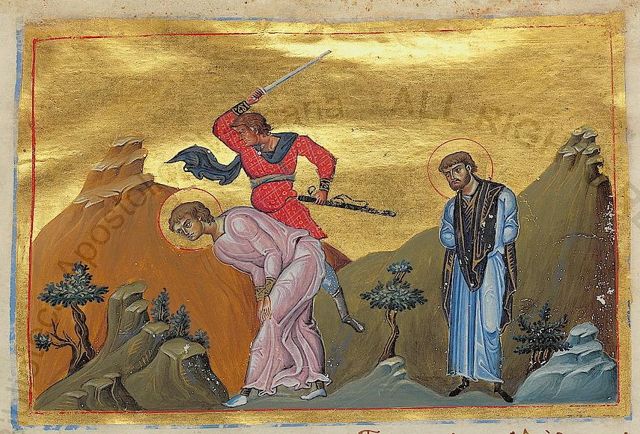
Head of the Catechetical School of Alexandria about 180 (Eusebius [Eusebius of Caesarea (d. c. 339), the first historian of the Church], "Hist. eccl.", V, x), still alive in 193 (Eusebius, "Chron." Abr., 2210). As he was succeeded by Clement who left Alexandria about 203, the probable date of his death would be about 200. He was trained in the Stoic philosophy; as a Christian missionary, he reached India (probably South Arabia), and found there Christians possessing the Gospel of St. Matthew in Hebrew, which they had received from St. Bartholomew. All this is given by Eusebius as what was "said" (Hist. eccl., V, xi). Eusebius continues: "In his 'Hypotyposes' he [Clement] speaks of Pantænus by name as his teacher. It seems to me that he alludes to the same person also in his 'Stromata'." In the passage of the "Stromata" (I, i), which Eusebius proceeds to quote, Clement enumerates his principal teachers, giving their nationality but not their names. The last, with whom Eusebius would identify Pantænus, was "a Hebrew of Palestine, greater than all the others [in ability], whom having hunted out in his concealment in Egypt, I found rest." These teachers "preserving the true tradition of the blessed doctrine from the Holy Apostles Peter and James, John and Paul . . . came, by God's will, even to us" etc. Against Eusebius's conjecture it may be suggested that a Hebrew of Palestine was not likely to be trained in Stoic philosophy. In its favour are the facts that the teacher was met in Egypt, and that Pantænus endeavoured to press the Greek philosophers into the service of Christianity. It may well be that a mind like Clement's "found rest" in this feature of his teaching.
Eusebius (VI, xiii) says again that Clement in his "Hypotyposes" mentioned Pantænus, and further adds that he gave "his opinions and traditions". The inference commonly drawn from this statement is that, in the extant fragments of the "Hypotyposes" where he quotes "the elders", Clement had Pantænus in mind; and one opinion or tradition in particular, assigned to "the blessed elder" (Eusebius, "Hist. eccl.", VI, xiv), is unhesitatingly ascribed to Pantænus. But this is incautious, for we cannot be sure that Clement would have reckoned Pantænus among the elders; and if he did so, there were other elders whom he had known (Hist. eccl., VI, xiii). Origen, defending his use of Greek philosophers, appeals to the example of Pantænus, "who benefited many before our time by his thorough preparation in such things" (Hist. eccl., VI, xix). That Pantænus anticipated Clement and Origen in the study of Greek philosophy, as an aid to theology, is the most important fact we know concerning him. Photius (cod. 118) states, in his account of the "Apology for Origen" by Pamphilus and Eusebius (see PAMPHILUS OF CÆSAREA, SAINT), that they said Pantænus had been a hearer of men who had seen the Apostles, nay, even had heard them himself. The second statement may have been a conjecture based upon the identification of Pantænus with one of the teachers described in "Stromata", I, i, and a too literal interpretation of what is said about these teachers deriving their doctrine direct from the Apostles. The first statement may well have been made by Clement; it explains why he should mention Pantænus in his "Hypotyposes", a book apparently made up of traditions received from the elders. Pantænus is quoted;
But these quotations may have been taken from the "Hypotyposes". The last named in his prologue to "Dionys. Areop." (ed. Corder, p. 36) speaks casually of his writings, but he merely seems to assume he must have written. A conjecture has been hazarded by Lightfoot (Apost. Fathers, 488), and followed up by Batiffol ("L'glise naissante", 3rd ed., 213 sqq.), that Pantænus was the writer of the concluding chapters of the "Epistle to Diognetus" (see DIOGNETUS). The chief, though not the only ground for this suggestion, is that Anastasius Sinaita in two passages (ed. Migne, pp. 860, 892) singles out Pantænus with two or three other early Fathers as interpreting the six days of Creation and the Garden of Eden as figuring Christ and the Church - a line of thought pursued in the fragment.
Read the rest of the article
BARDENHEWER, Gesch. der altkirch. Lit., II, 13 sqq.; HARNACK, Altchrist. Lit., 291 sqq.; TILLEMONT, Hist. ecclés., III, 170 sqq.; CEILLIER, Hist. des aut., II, 237 sqq.; ROUTH, Relig. sac., I, 237 sqq.