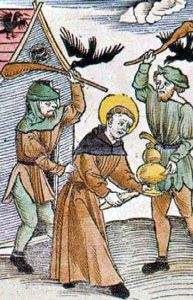
P

Faithfulness to Christ when it cost everything.

Read the essentials →
January 21 · Martyr

St. Patroclus

St. Patroclus

Faithfulness to Christ when it cost everything.

Traditional feast

January 21
1914 / pre-1969 calendar, per Baring-Gould (1914)

Current feast

Not verified yet

Represents

Martyr

Their story

Adapted in modern English from Baring-Gould (1914) · original text below

When the emperor Aurelian came to Troyes in Gaul, he heard there was a Christian there named Patroclus and had him brought in. Patroclus said he worshipped the living and true God who dwells in heaven and knows all things before they happen. Told to drop this nonsense and serve the gods for honour and riches, he said he would worship only the Creator of all things. Threatened with burning, he said he offered God praise and himself as a living sacrifice.

Aurelian had him fettered, his hands put in hot manacles, beaten, and locked in a cell under a guard named Elegius. Three days later the emperor asked if he was ready to sacrifice. Patroclus offered to give Aurelian something from his treasures, for "thou art poor" in faith. When Aurelian named Apollo, Jove and Diana as mighty gods, Patroclus mocked them from their own myths: Apollo herded sheep for Admetus and Jove died of a bellyache.

Enraged, Aurelian ordered him executed in a marsh. On the way, by the flooded Seine, Patroclus escaped across the river and hid on a hill used for pagan worship. A woman saw him and told the soldiers, who beheaded him. In France he is called St. Parre, and he is one of the patrons of Troyes.

Early life

Selected sentences from the original account, unaltered.

Patroclus —"I adore the living and true God, who inhabits heaven, and regards the humble, and knows all things or ever they are done."

What they represent

How they teach us to live

Drawn from themes in the original account

Give to people in need. The account records care for the poor.

Learn from the kind of life it was. Faithfulness to Christ when it cost everything.

Read more

The full original · 477 words

Read Baring-Gould’s full account

Baring-Gould’s sources: From the Acts published by Bollandus, an early recension of the original Acts.

When the Emperor Aurelian [Roman emperor 270–275] was in Gaul [roughly modern France and Belgium], he came to Troyes, and hearing that there was a Christian there, named Patroclus, he ordered him to be brought before him, when the following examination was had of him:—

Aurelian —"What is thy name?" He answered, "I am called Patroclus."

Aurelian —"What is thy religion, or, what God dost thou worship?"

Patroclus —"I adore the living and true God, who inhabits heaven, and regards the humble, and knows all things or ever they are done."

Aurelian —"Give up this nonsense, and adore and serve our Gods, from whom you will derive honour and riches."

Patroclus —"I will adore only the true God, who made all things visible and invisible."

Aurelian —"Dispute of those things which you say are true."

Patroclus —"Those things which I declare are true and probable; but I know why falsehood hates the truth."

Aurelian —"I will burn you alive if you will not sacrifice to the gods."

Patroclus —"I offer the sacrifice of praise, and myself as a living victim to God who has deigned to call me to martyrdom."

Then Aurelian commanded—"Put fetters on his feet, and hot manacles on his hands, and cudgel him on the back, and then shut him up in a privy cell, until I make up my mind what is to be done with him."

Then Patroclus was given into custody to one Elegius until the third day. And when he was brought forth again to be examined, Aurelian greeted him with, "Well, despiser, hast thou thought better of it, and art thou ready to sacrifice?"

Patroclus —"The Lord delivereth the souls of his servants, and will not forsake them that hope in Him. If thou desirest anything out of my treasures, I will freely give it thee, for, believe me, thou art poor."

Aurelian —"I, poor!"

Patroclus —"Thou hast earthly wealth, but art poor in faith of our Lord Jesus Christ."

Aurelian —"Enough of this. Our gods are mighty."

Patroclus —"Who are they?"

Aurelian —"First Apollo, the chief; [105] then Jove, the great god; and Diana, the mother of the gods." [106]

Patroclus —"Why, how can they be almighty, when Apollo kept sheep for Admetus, and Jove died of a pain in his belly; and as for your Diana, every one knows she is the noon-tide demon."

Then Aurelian, inflamed with rage, ordered Patroclus to be taken to a marshy place, and to be there executed. But when the soldiers led him to the bank of the Seine, which had overflowed, Patroclus escaped from them across the river, and took refuge on a hill dedicated to idol worship. Here a woman saw him, and she went straightway and told the soldiers. Then they came upon him, and smote off his head.

S. Patroclus in France is called S. Parre . He is one of the Patrons of Troyes.
Feast days

Feast: January 21

Nine days · Free

Pray the novena
with us.

One short email a day for nine days. The day's prayer, a line from St. Patroclus's story, and a nudge to keep going.

Also on January 21
Sts. Fructuosus, Augurius and Eulogius

Sts. Fructuosus

January 21 · Bishop, Martyr, Doctor, Martyrs
A

St. Agnes

January 21 · Virgin, Martyr
St. Meinrad

St. Meinrad

January 21 · Hermit, Martyr
← All 1726 saints in the library
Sources & notes

Feast-day sources

Story sources

Sources

Credits

From Sabine Baring-Gould, The Lives of the Saints, new and revised edition (Edinburgh: John Grant, 1914; first edition 1872). Public domain.

From Sabine Baring-Gould, The Lives of the Saints, new and revised edition (Edinburgh: John Grant, 1914; first edition 1872). Public domain in the United States. Reproduced unedited, except for short bracketed notes in grey that we added to explain names and terms (“S.” is the old abbreviation for Saint). Some history and judgments reflect 19th-century scholarship.