Baring-Gould’s sources: S. Paul died on Jan. 10th, on which day he is commemorated in most ancient Martyrologies, as the Roman, that of Cologne, Bede, &c. But both Greeks and Latins have transferred his feast to Jan. 15th, so as not to interfere with the celebration of the Octave of the Epiphany. The York Breviary and those of Paul III., and of the Dominican Order, commemorate him on the 29th Jan. His life, written by S. Jerome, is perfectly authentic. The following is a translation, much abridged, from the original.
Under the persecuting Emperors Decius [Roman emperor 249–251, who ordered everyone to sacrifice to the gods] and Valerius, at the time that Cornelius was Bishop at Rome, and Cyprian, Bishop at Carthage, were condemned to shed their blessed blood, a cruel tempest swept over the Churches in Egypt and the Thebaid [the desert region of Upper (southern) Egypt].
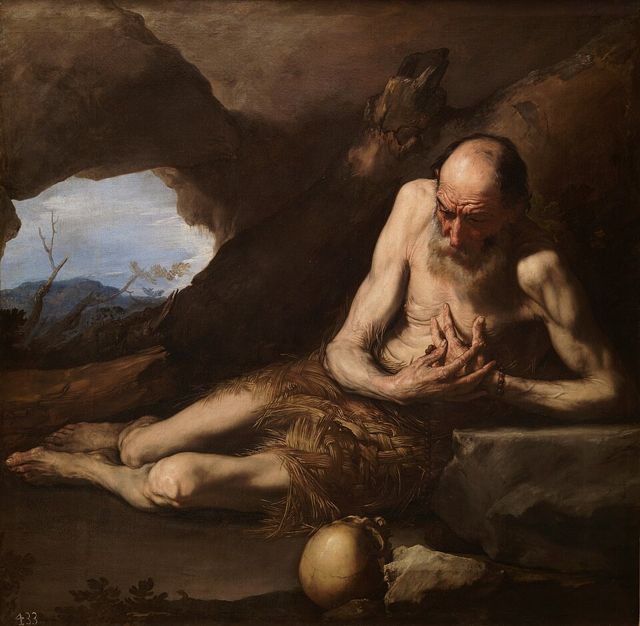
"In those days, in the Lower Thebaid, was Paul, to whom had been left a rich inheritance, at the death of both his parents, with a sister already married. He was then about fifteen years old, well taught in Greek and Egyptian literature, gentle tempered, and loving God much. When the storm of persecution burst, he withdrew into a distant city. But his sister's husband purposed to betray him, notwithstanding the tears of his wife; however, the boy discovered it, and fled into the desert hills. Once there, necessity became a pleasure, and going on, and then stopping awhile, he reached at last a stony cliff, at the foot of which was a great cave; its mouth closed with a stone. Having rolled this away, and exploring more greedily, he saw within a great vault open to the sky above, but shaded by the spreading boughs of an ancient date-palm; and in it a clear spring, the rill of which, flowing a short space forth, was sucked up again by the soil.
"There were, besides, not a few dwellings in that cavernous mountain, in which he saw rusty anvils and hammers, with which coin that had been stamped of old. For this place was an old workshop for base coin.
"Therefore, in this beloved dwelling, offered him as it were by God, he spent all his life in prayer and solitude, while the palm-tree gave him food and clothes.
"When the blessed Paul had been leading the heavenly life on earth for 113 years, and Antony, ninety years old, was dwelling in another solitude, this thought (so Antony was wont to assert) entered his mind—that no monk more perfect than himself had settled in the desert. But as he lay still by night, it was revealed to him that there was another monk far better than he, to visit whom he must set out. So when the light broke, the venerable old man, supporting his weak limbs on a staff, began to go he knew not whither. And now the mid-day, with the sun roasting above, grew fierce; and yet he was not turned from the journey he had begun, for he said 'I trust in my God, that he will show His servant that which He has promised.' Antony went on through that region, seeing only the tracks of wild beasts, and the wide waste of the desert. What he should do, or whither turn, he knew not. A second day had now run by.
One thing remained, to be confident that he could not be deserted by Christ. All night through he spent a second darkness in prayer, and while the light was still dim, he saw afar a she-wolf, panting with heat and thirst, creeping in at the foot of the mountain. Following her with his eyes, and drawing nigh to the cave when the beast was gone, he began to look in: but in vain; for the darkness stopped his view. However, as the Scripture saith, perfect love casteth out fear; with gentle step and bated breath the cunning explorer entered, and going forward slowly, and stopping often, watched for a sound. At length he saw afar off a light through the horror of the darkness; then he hastened on more greedily, struck his foot against a stone, and made a noise, at which the blessed Paul shut and barred his door, which had stood open.
"Then Antony, casting himself down before the entrance, prayed there till the sixth hour, and more, to be let in, saying, 'Who I am, and whence, and why I am come, thou knowest I know that I deserve not to see thy face; yet, unless I see thee, I will not return. Thou who receivest beasts, why repellest thou a man? I have sought, and I have found. I knock that it may be opened to me: which if I win not, here will I die before thy gate. Surely thou shalt at least bury my corpse.'
"'No one begs thus to threaten. No one does injury with tears. And dost thou wonder why I do not let thee in, seeing thou art a mortal guest?' Thus spake Paul, and then smiling, he opened the door. They mutually embraced and saluted each other by name, and committed themselves in common to the grace of God. And after the holy kiss, Paul, sitting down with Antony, thus began—
"'Behold him whom thou hast sought with such labour; with limbs decayed by age, and covered with unkempt white hair. Behold, thou seest but a mortal, soon to become dust. But, because charity bears all things, tell me, I pray thee, how fares the human race? whether new houses are rising in the ancient cities? by what emperor is the world governed? whether there are any left who are led captive by the deceits of the devil?' As they spoke thus, they saw a raven settle on a bough; who, flying gently down, laid, to their wonder, a whole loaf before them. When he was gone, 'Ah,' said Paul, 'the Lord truly loving, truly merciful, hath sent us a meal. For sixty years past I have received daily half a loaf, but, at thy coming, Christ hath doubled his soldiers' allowance.' Then, having thanked God, they sat down on the brink of the glassy spring.
"But here a contention arising as to which of them should break the loaf, occupied the day till well-nigh evening. Paul insisted, as the host; Antony declined, as the younger man. At last it was agreed that they should take hold of the loaf at opposite ends, and each pull towards himself, and keep what was left in his hand. Next they stooped down, and drank a little water from the spring; then, offering to God the sacrifice of praise, they passed the night watching.
"And when day dawned again, the blessed Paul said to Antony, 'I knew long since, brother, that thou wert dwelling in these lands; long since God had promised thee to me as a fellow-servant: but because the time of my falling asleep is now come, and (because I always longed to depart, and to be with Christ) there is laid up for me, when I have finished my course, a crown of righteousness; therefore thou art sent from the Lord to cover my corpse with mould, and give back dust to dust.'
"Antony, hearing this, prayed him with tears and groans not to desert him, but take him as his companion on such a journey. But he said, 'Thou must not seek the things which are thine own, but the things of others. It is expedient for thee, indeed, to cast off the burden of the flesh, and to follow the Lamb: but it is expedient for the rest of the brethren that they should be still trained by thine example. Wherefore go, unless it displeases thee, and bring the cloak which Athanasius the bishop gave thee, to wrap up my corpse.' But this the blessed Paul asked, not because he cared greatly whether his body decayed covered or bare (for he had long been used to clothe himself with woven palm leaves), but that Antony's grief at his death might be lightened when he left him. Antony astounded that he had heard of Athanasius and his own cloak, dared answer nothing: but keeping in silence, and kissing his eyes and hands, returned to the monastery. Tired and breathless, he arrived at home. There two disciples met him, who had been long sent to minister to him, and asked him, 'Where hast thou tarried so long, father?' He answered, 'Woe to me a sinner, who falsely bear the name of a monk. I have seen Elias; I have seen John in the desert; I have truly seen Paul in Paradise;' and so, closing his lips, and beating his breast, he took the cloak from his cell, and when his disciples asked him to explain more fully what had befallen, he said, 'There is a time to be silent, and a time to speak.' Then going out, and not taking even a morsel of food, he returned by the way he had come. For he feared—what actually happened—lest Paul in his absence should render up his soul to Christ.
"And when the second day had shone, and he had retraced his steps for three hours, he saw amid hosts of angels, amid the choirs of prophets and apostles, Paul shining white as snow, ascending up on high. The blessed Antony used to tell afterwards, how he ran the rest of the way so swiftly, that he seemed to fly like a bird. Nor without cause. For entering the cave he saw Paul on bended knees, erect with hands spread out on high,—a lifeless corpse. And at first, thinking that it still lived, he prayed in like wise. But when he heard no sighs come from the worshipper's breast, he gave him a tearful kiss, understanding how the very corpse of the Saint was praying to that God to whom all live.
"So, having wrapped up and carried forth the corpse, and chanting hymns, Antony grew sad, because he had no spade, wherewith to dig the ground; and thinking over many plans in his mind, said, 'If I go back to the monastery, it is a three days' journey. If I stay here, I shall be of no more use. I will die, then, as it is fit; and, falling beside thy warrior, O Christ! breathe my last breath.'
"As he was thinking thus to himself, two lions came running from the inner part of the desert, their manes tossing on their necks. Seeing these, he shuddered at first: but then, turning his mind to God, he remained without fear. They came straight to the corpse of the blessed old man, and crouched at his feet, wagging their tails, and roaring with mighty growls, so that Antony understood them to lament, as best they could. Then they began to claw the ground with their paws, and, carrying out the sand eagerly, dug a place large enough to hold a man: then at once, as if begging a reward for their work, they came to Antony, drooping their necks, and licking his hands and feet. But he perceived that they prayed a blessing from him; and at once, bursting into praise of Christ, because even dumb animals felt that He was God, he said, 'Lord, without whose word not a leaf of the tree drops, nor one sparrow falls to the ground, give to them as thou knowest how to give.' And, signing to them with his hand, he bade them go.
"And when they had departed, he bent his aged shoulders to the weight of the holy corpse; and laying it in the grave, heaped earth on it, and raised a mound as is the wont. And when another dawn shone, lest the pious heir should not possess aught of the goods of the intestate dead, he kept for himself the tunic which Paul had woven out of the leaves of the palm; and returning to the monastery, told his disciples all throughout; and, on the solemn days of Easter and Pentecost, he always clothed himself in Paul's tunic."