Read Baring-Gould’s full account
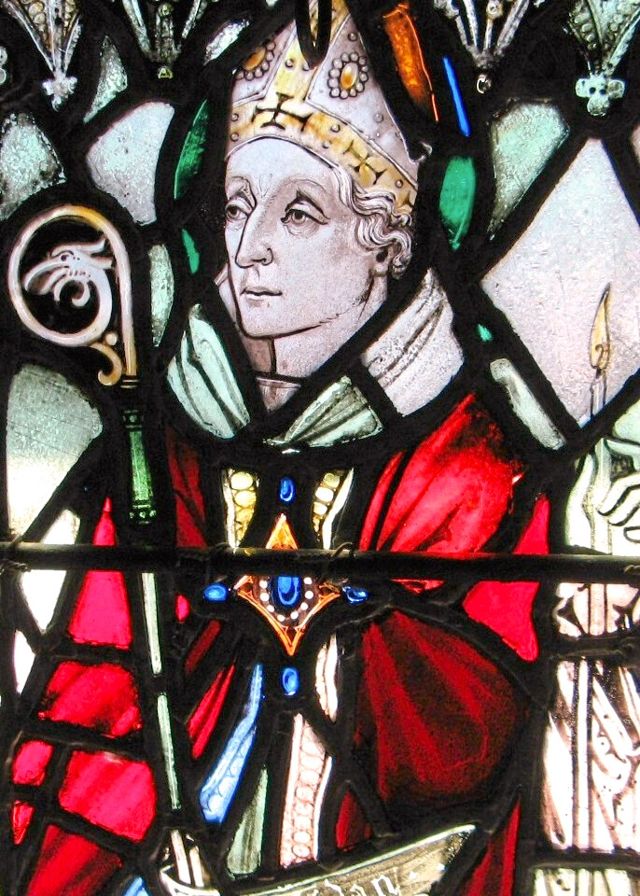
Baring-Gould’s sources: Roman and Gallican Martyrologies, Ado, Usuardus, Wandelbert. Authorities; — Various incidental notices collected by the Bollandists.] _ AINT PAULINUS, a disciple of S. Maximian of Treves, succeeded to the pastoral charge of that great and important city, the capital of Belgic Gaul, on the death of S. Maximian, in a.d. 349. When the great Athanasius was banished to Treves, he was received with open arms by Paulinus. The bishop was summoned to Arles by Constantius, bent onArianizing the Church. Constantius had convened a council at Arles, in which he hoped to force the bishops to renounce the communion of Athanasius. The aged Vincent, who had represented Pope S. Sylvester at Nicaea, unhappily yielded, in the vain hope that Valens and his friends would, on their side, condemn the Arian heresy. Vincent appears to have thought it necessary to sacrifice one man, in order to secure the Creed. But Paulinus of Treves saw that in this one man the whole canse of the faith was represented. To abandon Athanasius was, in fact, to abandon Niaea. He therefore withstood threats and persuasions, and bravely refused to accede to the wishes of the Emperor. Early in 355 a new council met at Milan, where Dionysius was metropolitan. About three hundred Western bishops were present; of the Eastern, only a small number. A letter which spoke of Athanasius, not as heretical, but as sacrilegious, was sent to Eusebius of Vercellae, to urge his attendance. On reaching Milan he was excluded for ten days from the sitting in the cathedral. When he was admitted, the Arianizers desired him to sign a condemnation of Athanasius. With a diplomatic subtlety which marred his nobleness, Eusebius held out the Nicene Creed, saying, “ First let us make sure of the faith. Sign this, and I will sign what you please.’' A great agitation ensued; the people, who could hear in the nave what was passing in the choir, began to murmur. The meeting was adjourned to the palace. There Court influence was brought to bear on the bishops. Constantius had written a letter full of Arianism, which his agents attempted to pass off. They were asked to sign this paper; Constantius skulking behind a curtain, overhearing their answers.
“ The letter is rank Arianism [followers of Arius, who taught that the Son is a created being, not fully God],” shouted Lucifer of Cagliari; “ there is no faith beside the Nicene, and all the soldiers of the Emperor will not prevent me from abhorring blasphemy.”
“ Insolent man !” said Constantius, bursting with unblushing brow from behind his screen; “ is it your duty to school an Emperor?”
The presence and tones of an Arian despot capable of any barbarity intimidated the majority of the bishops. They yielded, not only to sign the decree against Athanasius, but formally to profess union with the Arians. Dionysius, in a moment of weakness, yielded the first point in order to secure from the opponents a corresponding •S'. Eanswitha.
concession, which should leave the faith undisturbed. It is said that he repented of having yielded at all, and that Eusebius [Eusebius of Caesarea (d. c. 339), the first historian of the Church] “ very ingeniously" contrived to efface his signature. There is no doubt that Eusebius, Lucifer, and Paulinus were steadfast, and when Constantius answered their appeal to the canons by saying, “ Let my will serve you for a canon,” they lifted up their hands, protesting against his bringing his authority to bear on ecclesiastical affairs, and reminding him of the account he must render at the Day of Judgment.
They were instantly condemned to exile. Dionysius, who now cast in his lot with them, shared their sentence. S. Hilary was cruelly beaten and banished. Maximus of Naples, though weak from illness, stood firm, and died in exile. A pious bishop, Rufinianus, was compelled by a young Arian prelate, Epicetus of Centumcellse, to run before his chariot, until he died by bursting a blood-vessel. Lucifer was kept in a dark dungeon at Germanicia; Eusebius, at Scythopolis. Paulinus was banished to Phrygia, and died in exile.
His body was brought thence to Treves [Trier in Germany], where it received honourable burial, and the church of S. Paulinus, outside the Porta Nigra, was erected in the ninth century in his honour, and above his remains.