Baring-Gould’s sources: Roman Martyrology. S. Raymund is thought to have been canonized by the Anti-Pope Benedict XIII. The recitation of an office and mass in his honour on his festival was sanctioned by Urban VIII. and Alexander VII., under the latter of whom his name was inserted in the Roman Martyrology. Authority: — A life by Ciconius in his Vitae et res gestae Pont. Romanorum et S. R. E. Cardin alium, t. ii. col. 90.] As no contemporary life of this Saint exists, as indeed some three or four hundred years elapsed before his legend was committed to writing, ample time had been given for the popular fancy and the zeal of his religious Order to transform the sober facts of his history into a fantastic romance. It is difficult — it is indeed impossible to say what truth there is in the story as it is given us by writers of the 17th century, whether they had any authentic records on which to frame their biography, or whether it is only the crush of the rich fruit of the Catalonian imagination. There lived in the diocese of Urgel in Catalonia a reduced nobleman of the family of the Counts of Cerdagne, named Sarroi. His wife died when she was expecting her confinement. She was about to be buried. Her husband refused to allow the ceremony to proceed till he was sure that the child in her womb was dead also. A friend with his dagger cut open her side, and extracted a living, beautiful babe. It was ^baptized by the name of Raymund, and was called Nonnatus, or the “ Unborn.”
The child grew up with an ardent devotion to the Blessed Virgin, whom he adopted as his mother, having lost her who had borne him seven months in her womb, but had never given birth.
He was employed as a shepherd. (The story is not very consistent — we should not look to see a nobleman’s son tending sheep.) He found a cave in which was an image of S. Mary, and retired into it frequently to pray. The shepherds complained to his father that Raymund neglected the sheep. The father came to see, and lo ! there stood a youth of angelic countenance in the midst of the flock, in glittering raiment, with a shining staff like a sunbeam, guiding the sheep to green pastures, warding off danger. Whilst Raymund prayed in the grotto an angel watched his flock.
One day the devil in the form of a shepherd visited the youthful Raymund in the cave, and remonstrated with him. He was not bom to tend sheep, to do menial work. Let him go into military service like his ancestors. Raymund, feeling this to be a temptation, cried to Mary to save him. No sooner had he pronounced her name than the shepherd vanished in a puff of smoke and a most intolerable smell.
Raymund went to Barcelona and joined the Order of Mercy for the redemption of captives, and received the habit from the hands of S. Peter Nolasco. He was sent into Africa with money to buy back slaves taken by pirates, and then in captivity in Algiers. He found the sum confided to him insufficient to liberate all. He therefore gave himself up in exchange for one more captive, when he had exhausted the fund at his disposal. As a slave he laboured at the hardest tasks, and was cruelly bastinadoed. He spoke to his fellow captives, consoled them in their affliction, prevented the wavering from renouncing their faith, and was so zealous in his proclamation of the faith, that his masters put a padlock through his lips, the key of which was kept by the Cadi, and it was only unlocked to allow him to eat.
One day he was found in the moat of Algiers, on which he A was employed, in an ecstacy, pointing with his hand to the words of the 108th Psalm, l£ Take not the word of thy ' truth utterly out of my mouth,” in his Psalter. The Moors [the Muslims of North Africa and Spain] shook him, and tried to restore him to consciousness. Then, slowly coming to himself, he said, padlocked though his lips were, “ Thy Word, O Lord, endureth for ever.” Pope Gregory IX. heard of his captivity and sufferings. Money was sent for his release, and his heroic confessorship was rewarded with a cardinal’s hat. But Raymund, indilferent to the honours accorded him, returned to his convent at Barcelona. There he had a notable vision. The Blessed Virgin appeared to him in dazzling light, bearing a crown of flowers which she sought to place on his brow. He refused to submit his head to the honour; then Our Lord appeared, and laid on his temples the crown of thorns.
He was ordered to Rome by Gregory IX., curious to see the Saint, but fell ill on his way thither, at the castle of the Count of Cerdagne, two days’ journey from Barcelona. Death approached. The priest of the parish was absent. Raymund feared lest he should die without the Sacraments.
Suddenly the door of the chamber flew open, and in swept a mysterious procession of unknown men, in white robes, the habit of the Fathers of Mercy, but white and shining as no fuller on earth could whiten them. Each bore a burning taper in his hand, and all chanted in solemn tones the “ De profundis.” After these forms had passed in and ranged themselves in an avenue from the bed to the door, there entered One in sacrificial vestments, crowned with thorns, and with wounds in his hands and feet. From beneath his chasuble on the right side welled out red blood, which flowed down his shining alb. There was a great light, and a fume of rising incense, and a bell ringing, sweet and clear. And in the blaze, and fragrance and chanting and pealing of the silver bell, the dying man was communicated. As mysteriously as the procession had entered so did it depart. The door closed. The Count of Cerdagne and those present rushed to the window, and saw the awful procession pass the river at the foot of the castle, dry shod, and then disappear.
Then those who had seen this marvellous sight turned to the bed — Raymund was no more. The body of the Saint is shown at the Hermitage of S. Nicolas at Portel in Catalonia.
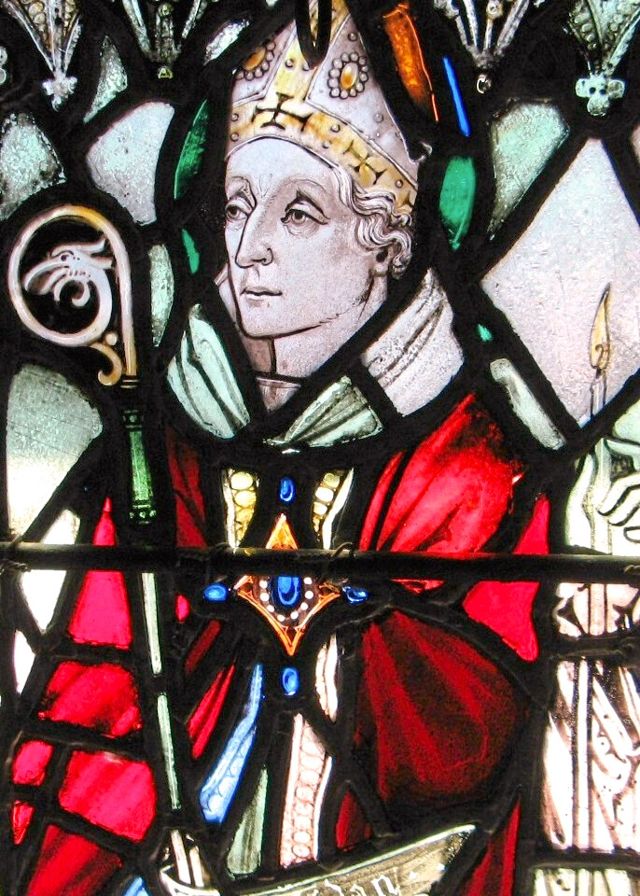
In art he is represented with padlocked mouth, in the habit of his Order, sometimes crowned with thorns. END OF VOL. IX. Printed by Ballantyne, Hanson & Co.