Faithfulness to Christ when it cost everything.
Read the essentials →Faithfulness to Christ when it cost everything.
July 14
March 5 (also listed: July 3, September 22)
Bishop
Martyr
Thin entry · the 1897 book gives only 106 words. We have not filled the gap with invented detail.
July M-l.S'. Cyrus. The relics of S. Phocas were, at an early period, thought to be preserved at Vienne, in Gaul, and devotion to them was indulgenced by Pope Innocent S. CYRUS, B. OF CARTHAGE.
Learn from the kind of life it was. Faithfulness to Christ when it cost everything.
Keep their day. Remember them on July 14 with a short prayer, and ask for their help.
July M-l.S'. Cyrus. The relics [the bodily remains of a saint, or objects they used, kept with honor] of S. Phocas were, at an early period, thought to be preserved at Vienne, in Gaul [roughly modern France and Belgium], and devotion to them was indulgenced by Pope Innocent S. CYRUS, B. OF CARTHAGE.
(date uncertain.) [Modern Roman Martyrology. An insertion of Baronius [Cardinal Baronius (d. 1607), church historian who edited the Roman Martyrology].] Baronius put this name into the Roman Martyrology because “ Possidius, in his Indiculum, c. 8, relates that S. Augustine spoke of him to the people.” Absolutely nothing more is known of him, nor do we know whether Possidius had any authority for his statement. That Baronius should have been guilty of inserting a name on such slender grounds is indeed marvellous.
Feast: March 5
Traditional: July 14
One short email a day for nine days. The day's prayer, a line from St. Phocas's story, and a nudge to keep going.
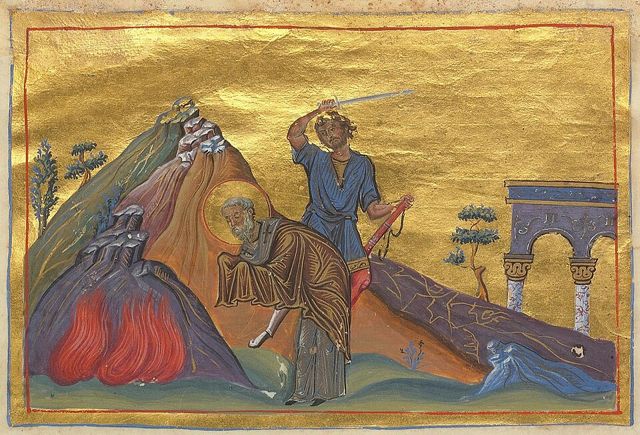
Image: Phocas the Gardener of Sinope (Menologion of Basil II).jpg · Authors of Menologion of Basil II (circa 985 AC, Constantinople), Byzantine manuscript illuminators[1]: Pantoleon with G · Public domain, via Wikimedia Commons
From Sabine Baring-Gould, The Lives of the Saints, new edition in 16 vols. (London: John C. Nimmo, 1897–98); text from the Internet Archive scan (OCR, lightly cleaned; errors possible). Public domain.
Image: Authors of Menologion of Basil II (circa 985 AC, Constantinople), Byzantine manuscript illuminators[1]: Pantoleon with G, Wikimedia Commons (Public domain)
From Sabine Baring-Gould, The Lives of the Saints, new edition in 16 vols. (London: John C. Nimmo, 1897–98); text from the Internet Archive scan (OCR, lightly cleaned; errors possible). Public domain in the United States. Reproduced unedited, except for short bracketed notes in grey that we added to explain names and terms (“S.” is the old abbreviation for Saint). Some history and judgments reflect 19th-century scholarship.
