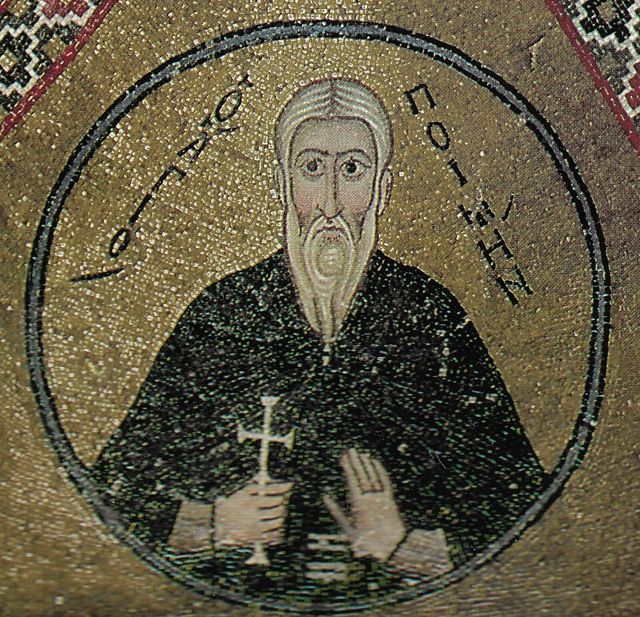
Baring-Gould’s sources: Greek Menology and Menasa, Modern Roman Martyrology. Authorities: — A life by Laurence, monk of Ruti in Calabria; his apophthegms, and mention of him in the Lives of the Fathers of the Desert.] “There is not a more celebrated name in the history of the Fathers of the Desert than that of Poemen or Pastor,” says Tillemont. The Greeks lavish on him the loftiest praise in their Menseas and Synaxarium. They call him the fellow citizen of angels, the chief of the solitaries, the 1 Written evidently after the Council of Nicsea, a.d. 325. The martyrs could not have used the expression.
.S'. Poemen. prince of the desert. They say that he was a lamp of discretion lightening along the dark path of men, leading between the pitfalls and snares to the gates of heaven. Poemen was an Egyptian, fifteen years old when he deserted the world. When he went out into the desert he drew with him his six brothers, of whom one was certainly older, the rest must have been mere children. Why they fled the world we know not. Perhaps the boys were suddenly left orphans, and finding the world's heart closed to them, fled it in disgust to live in the desert with God. The elder brother of Poemen was named Anub or Ruph, and the younger one Paes.
So these seven youthful anchorites grew up together in the solitude of Scete. Poemen fasted twice a week; as he grew to man’s estate he made his fasts five in the week; as his age declined he reduced their severity, and ate one little meal every day, always observing the golden rule for health and manners, to leave off with an appetite. “ This,” said he, “is the royal road that leads to salvation.” “We do not fast,” said he, “to kill our bodies, but our passions.” “ Let a monk eat once a day, but without gorging himself; that is better than severe fasting; for he who makes long fasts often gets proud of his achievements, and a small dinner prevents that, and also lets him feel hunger in his entrails.”
The seven brothers, under the direction of the eldest, Anub, lived in Scete till an irruption of the Mazics, or Bedouins, drove them to Terenuth, where they found an old temple, and took up their abode in it, under the shadow of its painted columns and gigantic grave-faced images. Anub occupied himself every morning with throwing stones at one of the idols, and in the evening he bowed his knee to it, and apologized for the insult and injury he had done it.
This went on for seven days, and then the curiosity of his brothers broke through all restrai^, and they asked him the meaning of his extraordinary conduct.
“ I threw stones at the face of the image. Did it scowl or look sulky, or utter words of anger ? ” “ And when I bowed the knee to it, and showed it profound respect, did it smile and look pleased ? ” “ Then,” said Anub, “ here are we seven brothers. If we purpose in our hearts to be like that image, unmoved by what we say or do to one another, then by all means let us dwell here together. But if we are going to resent wrongsor bitter speeches, or be pleased with flattery, here are four doors, and let us separate.”
Poor little Paes gave the elder brothers trouble. He would frolic about, laugh and shout in the ghostly courts of the old temple, rob nests, amuse himself with the pictures in blue and red and yellow on the long walls, and huge drums of columns, objected to fasting, preferred a romp to a prayer, could not meditate, and fell fast asleep when he ought to be reciting psalms.
Two of the brothers could not endure this. The innocent child’s mirth and unmonkish levity distracted them, and they took their staffs and wallets to depart. But little Paes ran over the desert after them, flung himself at their feet, and implored them to return, promising amendment. In time all light-heartedness and natural spirits were crushed out of him, and he grew up as grim and austere as they could desire.
In after years Poemen softened to childish noise and lightness of heart, and when, at Diolchus near Pelusium, his brothers grumbled that they could neither meditate nor pray near the monastery because of the chirping and chattering of children in it,1 “ I love to hear angels’ voices,” said Poemen. “Voices that speak of innocence come out of Paradise, and cannot distract.”
A painful story is told of the brothers. Their aged mother yearned to see her sons, and came to the door, and knocked. This was not when they haunted the old temple, but inhabited a monastery, when and where cannot be exactly decided, but it was probably when they were at Diolchus. She went to their retreat and strove to see them, but all in vain, their doors were shut against her. She waited till Sunday, when she knew that they would come forth to go to church. When they issued from their cells, they saw their old mother waiting for them, and instantly drew back and fastened the door. She ran after them, and beat at the door, wailing, “ My sons, my sons ! do not refuse me the joy of seeing your faces once more ! ” And through the door they heard her sobbing. Anub, moved at the tears of his mother, said to Poemen, “ What is to be done ? Our mother is weeping.” Poemen went close to the door and said, “ Why, mother, dost thou cry ?”
She recognised his voice at once, and exclaimed, “ O, my children ! I long to see you again. Why should my old eyes and heart be denied this satisfaction ? Am I not your mother, did I not nourish you at my breasts ? I am very old. When I heard your voice, my heart leaped up within me, and I yearn, I yearn to see you.”
“ My mother,” coldly answered Poemen “ which do you prefer — to see us now for one glimpse, or to behold us with uncowled heads in the unclouded light of eternal day ? ” “ If I were but sure I might see you hereafter, I should perhaps be content.”
1 It was customary for very young boys to be taken into the monasteries and trained from infancy to become monks. “ Doubt not,” said Poemen. “ Make now this sacrifice of your heart’s wish to God, and yon will enjoy our society hereafter for ever.”
“ So let it be, then,” said the old woman with a sigh; and with drooping head, and tears flowing down her wrinkled cheeks, she withdrew. In this life she never saw her sons again. When she died, other hands closed her eyes; her sons were too dead to the world to remember their natural duties.
The Governor of Lower Egypt, anxious to see Poemen, arrested his nephew, the son of a married sister; and the sister wrote to Poemen imploring him to intercede with the governor to spare the life of her son.
Poemen, with icy indifference, replied, “ If he is guilty of a crime, let him die; if he is innocent, he will obtain his discharge.”
The lad was released. Another anecdote exhibits an intensity of selfishness most repulsive. When the governor was at Diolchus, he had imprisoned a man on some charge or other. The people of the neighbourhood went to Poemen with tears, entreating him to obtain for them the liberation of the prisoner, thinking that the governor would refuse him nothing. Poemen was forced to intervene, but not before he had spent three days in prayer that God would induce the governor to refuse his request, knowing that if this one were acceded to, his time would be broken into by the people urging him to interfere in other cases. When he made his request, it was with such indifference that the governor refused it.
But as years passed, Poemen’s character changed. All traces of harshness disappeared, it softened and sweetened, till none of the solitaries surpassed him in tenderness and beauty of mind and action, in deeper insight into God’s will and greater charity towards others.
Anub remained head of the community of brothers till his death, and the eight were knit together in bonds of the warmest affection. “We lived together,” said Poemen in his old age, “ till death broke up our companionship, in the greatest unity, tasting its fruits of peace without ceasing. We followed the rule Anub imposed on us; one of us was made steward by Anub, and he had the care of providing for our table. We ate whatever was set before us, and no one said, Give me something else, I cannot eat this.” One day Poemen went a long trudge over the barren desert to visit an aged solitary, who he heard was much distressed in conscience. Poemen had thought of three things to say to the old man, which be believed would rest his troubled soul, but when he got to his cave ■ he had forgotten one of them. On his return home, when his hand was on the lock of the door, the third point of consolation recurred to him. Without entering his house he turned back, and retraced his journey to the old hermit’s cell, to pour into his ear this third motive why his uneasy spirit should lie down and rest. The aged solitary was moved by this token of solicitude for souls, and said to him, “Thou art indeed a Poemen- — a shepherd of the flock of Jesus.”
The priest of Pelusium, hearing that some of the solitaries of Diolchos were wont to come into the city and take baths1, was indignant at their self-indulgence, and going to the monastery pulled their habits off eleven of them; then went to Poemen, and asked if he had done well. “ Had you divested yourself of the old man before you exercised your 1 These baths were not so much for cleanliness as for luxury: like the Turkish baths, they consisted in exposing the bather to hot air; he was shampooed, rubbed with scented oils, and his hair dressed with aromatic ointments. zeal in unfrocking these monks ?” asked Poemen. The priest was ashamed of himself, went back to the monastery, and restored their habits to the eleven. An anchorite [a hermit, sometimes walled into a cell beside a church] having heard that a monk had committed a fault, exhorted the abbot to turn him out of the monastery. The expelled monk cast himself into a ditch near the gate, and wept there, refusing food. Some of Poemen’s disciples told him that the man was broken-hearted at his expulsion, and would starve himself to death. Poemen ordered him to be removed to his cell, and then sent to the anchorite by whose advice the monk had been driven out, and asked him to break bread with him. The anchorite came. Poemen said, “ Two persons had each a dead man in his house, and yet one had the compassion to leave his, and come to his neighbonr to bewail with him his corpse.’' The anchorite applied the parable to himself, and blushed, and exclaimed, “ Poemen is high as heaven; I am base as the earth.”
A solitary said to Poemen, “ When a brother comes to see me who is a pious man, I receive him with joy; but if another comes who has fallen in any way from his high profession, I shut the door in his face.” “ You do wrong,” said Poemen. “ The sick soul needs the gentle hands of the nurse, and the tender care of the hospital; throw open the door, spread your arms to the sinner.” A young monk came often to visit Poemen, but Poemen could see by the wistful face and troubled brow of his j visitor that the youth wanted something, but was ashamed to speak. After several of these visits without their leading to anything, Poemen broke the ice with, “ My brother, I see there is something troubling your soul; tell me your heart, and I will give you what medicine I think yon need.” Then the young man broke silence, and related to him his secret trouble, thoughts of blasphemy. S. Poemen.
“ Do you take pleasure in these thoughts ?” asked the Abbot Poemen. “ I hate and detest them,’’ answered the young monk. “ Be of good cheer,” said Poemen; “ if you cast them out without giving them consent, they cannot hurt, though they may distress yon.”
Another monk said to him, “ Father, what am I to do ? I have impure thoughts rising in my mind.” “ Don't think of them,” said Poemen.
“ And ill-natured thoughts of others rise up.” “ Don’t think of them,” said Poemen. Another monk again came to him. The burning of impure imaginations pained him.
“ What shall I do, my father, my father ?” The abbot led him out of the door of his cell. The flat, glaring desert lay before them, a mirage quivering over the burning sand. A hot breath like that from a kiln swept towards them.
“ Open the breast of your habit,” said Poemen. The burning blast fanned the bared breast of the monk. “ Fold your robe over you again,” said the abbot. “ And now tell me, have you enclosed the hot wind in your bosom ?” “ So let passion sweep by, like a scorching breath, fanning you. You cannot help that. Let it pass. Do not take it in and harbour it.”
“Temptations,” said another abbot, Sisoes, “are like an axe. They may cut down your hopes of salvation and lop off your virtues, but they can do nothing against you unless you take them up by an act of will, and give consent to them.”
Some touching instances of the gentleness of Poemen are recorded. A monk said to him, “ Those young novices do not keep awake during the offices in the church at night. I see their heads nodding. Shall I not go round and shake them?”
" Poor fellows,” said Poemen. “ Do nothing of the kind. When I see their sleepy heads droop, I wish I might spread out my lap, and let the heads lie easy on it, that they might sleep in peace.”
The Abbot Nesteros was reproved by some for being so indulgent to his disciple that he allowed him a pillow. “ I should like to put another pillow under his head,” said Poemen.
It was told him that there was a woman in a neighbouring town who was a sinner. “ Yet,” said the Abbot Timothy, who told him of her, “the woman has elements of good in her. She is spoken of as very charitable to the poor.” “ Be at rest,” said Poemen. “ If there is a rent in the clouds the sun will shine through.”
Some time after, he heard from Timothy’s mother about the same woman, that she was going on in the same way, charitable, but still living in sin. “ Do not be afraid; she will serve God in the end.”
At last the poor woman was somehow or other induced to' visit Poemen. The dove-like gentleness of the good old man, his overflowing charity, completely won her heart. She broke into floods of tears, fell at his feet, and resolved to abandon her sins, and live to God alone. She afterwards entered a convent, and lived a holy life. “ I cannot endure my present cell,” said a monk to him one day. “ In my neighbourhood is another monk of whom all sorts of scandalous stories circulate.” “ Are they true ?”
“ I have had the stories on the best authority, on the word of a monk.” “ A monk !” exclaimed Poemen, “ Telling scandalous stories. I should not call that good authority at all. A ■S'. Poemen.
monk who tells such tales has fallen from his profession, and is unworthy of belief.” “ But if the stories be true ?” Poemen stooped down and picked up a straw, then looked up at a beam over his head. “ This straw is my neighbour’s sin which I trample on with such scorn; that log is my sin which I rarely notice, but which may one day fall and crush me.”
When the Abbot Sisoes heard of this answer of Poemen, he is said to have exclaimed, “ Words precious as a goodly gem and quite as shining.”
It is said of Poemen, but the story is also told of Sisoes,1 that a solitary came to him, and said, “ My father, I have committed a grievous fault, and must do penance for it for three years.”
“ Three years !” echoed Poemen; “that is a very long penance.” “ What ! is that too long ? At least for a year then.” Too long, too long !” said Poemen.
Those who were present, seeing the solitary full of surprise, and unable to speak, interfered, and said, “ How long would you have him punish himself for his fault? During forty days ?”
“ That is too much,” said the abbot. “ A broken and a contrite heart God will not despise, with only three days of penance.”
A monk who suffered from violent temptations to which he had too often yielded, was advised by Poemen to go far into the desert for a while, and wrestle with his bad temper, and conquer it, before he returned to dwell among others. “ But, my father,” said the monk, “ how if I were to die without sacraments in the wild wastes ?” “ Do you not think God would not receive you, coming from the battle-field where you have been striving -against your passions, even should that happen ?” Another monk asked him, “ Where shall I settle down ? What place will be most suitable to me ?” “ Any place will be suitable/' said Poemen, “where you do not cause annoyance to other people.” “ Had I better live in community or in solitude ?” asked another.
“ Wherever you find yourself humble-minded there you may dwell with security,” answered Poemen. “ But if you have a great opinion of yourself, nowhere is fit for you.” “Silence,” said Poemen, “is an excellent thing. But people who hold their tongues should not always account themselves as silent. If their minds are occupied with their neighbours’ shortcomings, their silence is as bad as senseless chattering.”
“ Do not trouble others by asking advice where no advice is necessary. If a course of conduct be wrong, do not adopt it, but don’t waste the time and distract the attention of the aged solitaries by asking advice about it.” Once a hermit came from a long way off to pay a visit to Poemen. He was a man held in great esteem in his own country for his profound theological knowledge. On his arrival he sat down with Poemen, and opening his mouth began to talk about abstruse theological questions. Poemen turned his head away, and looked out of the door at the hot sand, and the date-palms motionless on the horizon. The anchorite could get nothing out of Poemen, and went away in disgust, saying, “ I wish I had not taken the trouble to come so far and see this ignorant old fellow.” This was reported to Poemen.
“ This- anchorite flies far above my reach,” he said; “ he sails up in heaven, but I am of the earth. If he would talk about our passions and infirmities, and how to overcome S. Poemcn.
them, then we should have some subject in common on which I could speak.” When any one complained to Poemen of the devil tormenting him with discouraging thoughts, he used to say, “ Ah ! Isidore of Scete used, under those circumstances, to say, Well, devil, suppose I be lost? You will always be below me.” But to some he said, “ Devils, devils ! it is always devils that are complained of. I say, self-will, self-will.” A Syrian solitary came to him once, lamenting the hardness of his heart. “ Read the Word of God,” said Poemen; “ the drip of a fountain pierces the stone, and the gentle word falling softly day by day on the dead hard heart after a while infallibly melts it”
“ What am I to do ?” asked a monk of Poemen. “ I have got a neighbour, and I am continually doing him little acts of kindness, yet I always find that there is self-satisfaction or some mean unworthy motive mixed up with my intent. Shall I forbear ?”
“There were two men who had fields,” said the abbot in reply. “ The one sowed corn, and with it tares, the other sowed nothing in his field, and it grew up covered with weeds. But he who had sowed corn and tares reaped a mixed crop, some good, some bad; but he took pains to sort the corn from the tares. Which acted best ?” There was but one answer.
“Fly from all occasions of temptation,” said Poemen. “ If still tempted, fly further still. If there is no escape possible, then have done with running away, show a bold face, and take the two-edged sword of the Spirit.” “ Some temptations,” he advised on another occasion, “ must be taken by the throat, as David killed the lion. Others must be stifled, as David hugged the bear to death. Some you had better keep to yourself, and don’t give them air. Shut them up, as scorpions in a bottle. Scorpions in such confinement soon die; but if allowed out for a crawl, and then put back in their bottles and corked down, they will live a long while and give trouble. Keep the cork down on some temptations and they die of themselves.'' A brother was remarking to Poemen of a hermit who, h£ said, held evil in abhorrence.
“What do you mean by that expression?” asked the abbot. The monk lapsed into generalities. “ Do not talk so vaguely,” said Poemen. “Say that he hates all the bad habits, bad tempers, bad thoughts which he finds in himself, and then I can understand you. I do not like to think of monks learning about evil in order to acquire an abhorrence of it.”
The superior of a monastery asked him how to acquire the fear of God. Poemen knew probably that in this monastery the monks made good cheer.
“ Nabuzaradan, chief cook1 of the King of Assyria, took Jerusalem,” said Poemen. “ Many a peaceful Jerusalem is despoiled by cooks and cookery.”
“ Inconveniences always swell to double their size when grumbled over.” “ What is a living faith ?” was a question put to Poemen one day. “ A living faith,” he answered, “ consists in thinking little of oneself, and showing tenderness towards others.”
“ Do not contemplate self too long,” was one of Poemen’s sayings. “ He who does so is like one standing at the brink of a pond looking at his reflection. He is just in the position for the devil with a push to tumble him into destruction.” Another of his sayings, “ A warm heart, boiling with charity to God and man, is not tormented with temptations; 1 So the LXX., apxifiay eipos (2 Kings xxv. 3). But the Vulgate, more correctly, magistermilitum: that is “ captain of the guard,” or “chief executioner." There is frequent use of S. Poemen's remark in niedieeval exegesis. they swarm round a cold one. You see no flies hovering about the caldron boiling on the fire. Set it down and let it grow cold, and it is black with flies.” It is not known with certainty when Poemen died, but it was probably at the advanced age of a hundred and ten.