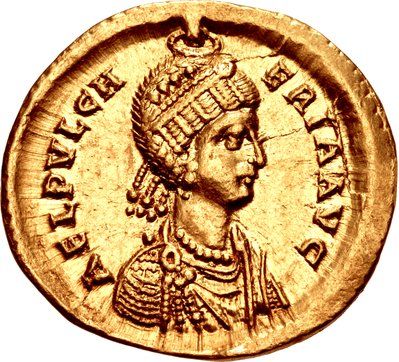
Baring-Gould’s sources: By the Greeks on Aug. 7. Inserted by Baronins in the Roman Martyrology on Sept. 10. By the Greeks, also Pulcheria and Marcian, her husband, on Feb. 17. Authorities Sozomen, Philostorgius, Nicephorus, Zonaras, &c.] After the death of Arcadius, Emperor of the East (a.d. 408), the imperial throne fell to the lot of his son Theodosius II., a child of seven years old. The wise Anthemius held the reins of government for the infant Emperor for six years, till a.d. 414, and then resigned his office to Pulcheria, the sister of the Emperor, aged sixteen; a girl, however, of no ordinary merit and force of character. Of all her family, Pulcheria alone inherited the spirit and administrative power of the great Theodosius. Beautiful in face and person, and with remarkable intelligence, she was one of the few women of that age on whom the eye can rest with satisfaction and admiration.
It was clear to her that the welfare of the State demanded a sacrifice on her part, and that of her sisters; there must be no competitors for the regency. She enforced her view of the situation on her sisters Arcadia and Marina, and the three maidens generously together took the vow of celibacy i S. Pulcheria.
for the sake of the welfare of the State. The three sisters lived together in the exercise of works of charity, of prayer, and of domestic duties. Their labours to relieve distress, to raise, the poor, alleviate sickness, and console the bereaved, were unflagging. Constantinople was speedily filled with churches and religious houses, endowed from the private purse of Pulcheria.
But her especial duty lay in the education of her brother, in the development of a character naturally feeble, and in protecting him from the influence of intriguing and corrupt courtiers. She taught him herself, laid a foundation of religious instruction, and surrounded him with blameless playfellows. Active bodily exercises she prescribed, to enable the future sovereign to become a bold and vigorous commander of his soldiers; and to train him for the responsibilities of supreme authority, she made the boy attend at the meetings of councillors, and subscribe decrees. The fruits which she had hoped to develop showed themselves but very imperfectly. Theodosius [name of Roman emperors; Theodosius I (379–395) made Christianity the state religion] grew up superstitious, if not pious, and superficially accomplished, if not well educated; From childhood his feeble mind showed impatience of the cares and thought involved in government, and he gladly resigned the responsibility to the hands of his sister, that he might indulge himself in pleasure. The elegant and familiar use which Pulcheria had acquired both of Greek and Latin was readily applied to the various occasions of speaking or writing on public business; her deliberations were maturely weighed; her actions were prompt and decisive; and, while she moved without noise or ostentation the wheel of government, she attributed with modesty to the genius of the Emperor the long tranquillity of his reign. Theodosius the Younger found no active pursuit more congenial to his taste than hunting. And when he returned to his palace, his favourite occupation was transcribing [Sept. io.
books in a neat, perhaps feminine hand, thus acquiring for himself the epithet of Calligrapher, the fair writer. Ambition has been attributed to Pulcheria because of her having thus for forty years held the reins of government, and it has been asserted that she purposely enfeebled the mind of her brother, lest he should divest her of her conduct of affairs. But such a charge is as cruel as it is false. She could not give to Theodosius what, it is abundantly clear, he did not naturally possess. If she had not acted as regent, the feeble prince would have fallen, as he afterwards did, into designing hands ready to work both his ruin and that of the empire. Had Theodosius possessed the smallest grain of manliness or independence of character, he would have speedily shaken himself free from petticoat government.
Pulcheria did her utmost to spur her brother on to manly energy, and it is said that she once laid before him a sentence of death against herself, and when he heedlessly signed it, without examining its purport, made it an occasion for reading him a salutary lesson. A number of wise laws and useful improvements marked the rule of the “ Augusta.”
The news of the death of Ataulf in a.d. 414, were speedily followed by those of the ill treatment ot his wife Placidia, the sister of Arcadius and Honorius, aunt of the young Emperor Theodosius. Placidia, the widow of the WestGothic king, married the consul Constantius, in Rome. He was a man of low birth, an Illyrian, but a bold general. Placidia was very reluctant to contract this marriage, but was forced into it by her brother Honorius; and eventually Honorius nominated Constantius emperor beside him, without, however, the consent of Theodosius. Shortly after, in 421, Constantius died at Ravenna, leaving the ambitious and avaricious Placidia again a widow, in charge of their Sept. io.] S. Pulcheria.
infant son Valentinian. Placidia, turning naturally for support to her brother Honorius, was by him rejected, and driven from court. She fled with her two children to Theodosius II. Not long after (a.d. 423) the Emperor of the West died, at the age of thirty-eight. Now that her brother was twenty years old, Pulcheria looked about for a maiden suitable for him as a wife, one with force of character and virtue, to guide the feeble puppet Emperor.
One day a young Greek flung herself at her feet for protection. Her name was Athenais, the orphan daughter of Leontius, an Athenian sophist. Her brothers, on the death of their father, had divided the inheritance between them, and excluded her from her share therein. She went to Constantinople to appeal to Pulcheria against their injustice. The latter, charmed with the vivacity and intelligence of the young heathen, with penetrating eye saw that there was talent in her character, much vigour and discretion, and having learned that she was eminently modest and virtuous, Pulcheria resolved to elevate Athenais to share the imperial throne with Theodosius.
She easily excited the curiosity of her brother by an interesting picture of the charms of the suppliant, large eyes, a straight nose, a fair complexion, golden locks, a slender person, a graceful demeanour, an understanding improved by study, and a virtue tried by distress. Theodosius, concealed behind a curtain in the apartment of his sister, was permitted to behold the Athenian virgin; the modest youth immediately declared his honourable love; and the royal nuptials were celebrated amidst the acclamations of the capital and the provinces. Athenais, who was easily persuaded to renounce the errors of Paganism, received at her baptism the Christian name of Eudoxia (II.). The new Empress generously forgave her brothers the Lives of tJie Saints.
[Sept. io. wrong they had done her, and obtained for them honourable consular and prefectorian appointments. In course of time the Empress gave birth to a daughter, Licinia Eudoxia, and then Pulcheria gracefully resigned to the young wife of Theodosius her title and authority as “ Augusta/3 On the death of Honorius, Placidia had returned to Rome, and ruled the West in the name of her infant son Valentinian. She was a very different woman from Eudoxia or Pulcheria; ambitious, married in succession to two men of great ability and military skill, she learned neither from her ambition nor from her experience how to govern; and in her long reign of twenty-five years the West sank to its lowest level of helpless degradation.
Theodosius II. was troubled with domestic evils. Earthquakes, conflagrations, bad harvests, and incursions of barbarians had reduced many portions of the Eastern Empire to distress, and had occasioned discontent. There were some partial risings of the people, which were, however, easily quelled. Added to these troubles was the rise of the Nestorian [Nestorius (d. c. 451), whose teaching split Christ into two persons; condemned at Ephesus in 431] heresy, and the strife and bitterness of conflicting religious factions. The Council of Ephesus (a.d. 431) denounced Nestorianism; but no sooner was Nestorius condemned, than orthodoxy was threatened from an opposite quarter by Eutyches, and the rise of the Monophysite heresy.
The pseudo-Council of Ephesus (a.d. 447) gave Eutyches a brief triumph, and caused troubles which for long after afflicted the Church.
The family happiness of Theodosius was likewise disturbed. The unexpected appearance of Honoria, daughter of Placidia, and sister of the young Valentinian, Emperor of the West, was the first to disconcert the tranquillity of the Byzantine court. Honoria, aged sixteen, inherited her Sept. io.] mother’s ambition and lack of prudence. She was vivacious, and bent on making for herself a magnificent marriage. Her lively imagination saw in Attila, King of the Huns [nomadic invaders from Central Asia, led in the 5th century by Attila], a hero and a conquering monarch. She sent him privately her love, and a ring, and a promise to be his. But Attila was not an impatient bridegroom, and long ere he arrived before the walls of Rome, she had formed a less honourable tie, and had been driven with disgrace from Rome by her mother. She made her way to Constantinople, and the virtuous women there, though incensed at her conduct, did i their best to hush up and cover over her disgrace. In fulfilment of a vow, the Empress Eudoxia made a pilgrimage to Jerusalem (a.d. 439). The journey was one of uninterrupted triumph; she was greeted in every city with rejoicings and adulation, and lavished on all sides alms and benefactions. At Antioch, from a golden throne, she pronounced a Greek speech, which was loudly applauded by an obsequious audience. She declared her royal intentions of enlarging the walls of the city, bestowed a donation of two hundred pounds of gold to restore the public baths, and accepted the statues which were decreed by the gratitude of the senate. In the Holy Land her alms and pious foundations exceeded the munificence of the great Helena; and though the public treasury might be impoverished by this excessive liberality, she enjoyed the exquisite satisfaction of returning to Constantinople laden with the chains of S. Peter, the right arm of S. Stephen, and an undoubted portrait of the Virgin, painted by S. Luke. But this pil• grimage was the fatal term of the glories of Eudoxia. It is not possible to unravel the web of court intrigue which involves the fall of Eudoxia. Some historians assert that, puffed up with pride by the results of her pilgrimage, she endeavoured to make herself mistress of the reins of government, unmindful of her obligations to Pulcheria; that the palace was distracted by female discord, and that the superior power of Pulcheria wrought the ruin of her rival by instilling into her brother’s mind suspicions of the fidelity of his wife.
But it is unnecessary to adopt such a theory. The facts are simply these — the motives of the actors lie under an impenetrable veil: — Theodosius loved Eudoxia passionately, and saw, first with suspicion, and then with savage jealousy, the favour accorded by Eudoxia to Paulinus, the friend of the Emperor from childhood, a youth who had been his bosom companion. A mean, petty mind, such as that of Theodosius, is always open to jealousy, prone to suspicion. Paulinus suddenly disappeared from the palace, and none could tell the Empress what had become of him.
Eudoxia, irritated at the injustice to a faithful friend, and at the aspersion on her own honour, rebuked her husband with bitterness; and when discord became furious, she asked permission to make another pilgrimage to Jerusalem, and the leave she asked was at once granted; but the jealousy of Theodosius pursued her in her last retreat; and Saturninus, count of the domestics, was directed to punish with death two ecclesiastics of her most favoured servants. Eudoxia instantly revenged them by the assassination of the count. The remainder of her life, about sixteen years, was spent in exile and devotion, if we may trust some historians; others assert that she returned for a while to Constantinople, and only went finally to live at Jerusalem in a.d. 450, after the death of her husband. The death of Theodosius, the misfortunes of her only daughter, who was led a captive from Rome to Carthage, and the approach of age, insensibly confirmed the religious temper of her mind. After a full experience of the vicissitudes of fortune, the daughter of Leontius expired (a.d. 460) at Jerusalem, in the sixty-seventh year of her age, amidst the tears of the poor whom she had relieved, and the lamentations of the clergy whom she had benefited by her largesses. With her dying breath she solemnly protested that the stories which had been raised to blacken her character, and turn away from her the love of her husband, were without foundation malignant calumnies.
The influence of Pulcberia is scarcely perceptible during the last years of the reign of Theodosius, and the fact that already, when Eudoxia was banished, he had fallen under the influence of the eunuch Chrysalphus, makes it probable that she was innocent of having separated her brother from his wife by base insinuations or open charges against her honour.
Chrysalphus by degrees made himself complete master of the mind of the feeble Emperor. Another of his friends, Cyrus, who was an honourable man, especially beloved by the people, was by the machinations of the crafty eunuch banished from court. Cyrus became priest, then bishop. j but was even then pursued by the malice of Chrysalphus or the suspicions of Theodosius. False accusations were raised against him, and he was driven into complete retirement.
Pulcheria’s name is no more mentioned; she remained in voluntary or compulsory obscurity, and some state that she was banished from court Her two sisters had died, and a brazen tablet in the church of S. Sophia announced to posterity that the granddaughters of the great Theodosius had remained faithful to their vow of celibacy. Forty-two years had elapsed since Theodosius II. had ascended the throne. Anthemius and Pulcheria had supported his throne, Eudoxia had adorned it; disastrous influences, unworthy confidants, tended to drag it into the mire. One day in July, 450, the Emperor fell from his horse into a little stream, whilst hunting, broke his spine, and died a few days after. Unregretted, he was laid in the grave between his parents, Arcadius and Eudoxia I. On the death of Theodosius, Pulcheria resumed the reins of government. But she was now a woman of fifty-one years. The Western Empire was falling to pieces, a prey to internal dissension and external aggression. Northern Africa was lost; it had been devastated by the Vandals, who settled there, and there established their kingdom. Pulcheria was unable alone, at her advanced age, to make head against all the difficulties that beset the empire. She was constrained by stress of circumstances to call a man to her side. She chose Marcian, a gallant soldier of sixty years, and made him her husband in name, whilst she associated him with her in the government of the empire. The first duty which Marcian undertook was the reestablishment of peace in the Church. As Constantine the Great, Theodosius the Great, and Pulcheria had summoned councils to condemn the heresies which grew up and threatened the faith once delivered to the saints, so Marcian now convened a council at Chalcedon, a.d. 451, to rectify the mischief wrought by the heretical canons of the Robber Synod of Ephesus, a.d. 449. Marcian himself attended this, the fourth oecumenical council, which met against Eutychianism [followers of Eutyches, who said Christ had only a divine nature; condemned at Chalcedon in 451]. But other cares drew him speedily from the settlement of ecclesiastical disputes.
After the field of Chalons, in which Aetius had defeated Attila and his Huns with tremendous loss, the King of the Huns had returned to his native land, burning with revenge, to collect fresh hosts, wherewith to pour down on and overwhelm the trembling Empire. He burst through the Alps, and threatened Rome. But in the meantime, the troops of Marcian had defeated the Huns on the Lower Danube. Attila made peace with Valentinian (a.d. 452), amidst the murmurings of his barbarians, who growled out that two wild beasts had bewitched him, the Wolf and the Lion — i.e., Bishop Lupus (Wolf) of Troyes, and Pope Leo (Lion) of Rome. Attila turned back, to protect Hungary against Marcian; but his days were numbered. He died of a broken blood-vessel, whilst celebrating his wedding feast, in Illyria.
In 453 died Pulcheria, a princess who had been a pillar to the Church, the mother of the poor, an ornament to her sex.