St. Quirinus

The Catholic Encyclopedia (1913) notes that several early martyrs bore the name Quirinus.

Read the essentials →
March 25 · Martyr

St. Quirinus

St. Quirinus

The Catholic Encyclopedia (1913) notes that several early martyrs bore the name Quirinus.

Traditional feast

March 25
1914 / pre-1969 calendar, per Baring-Gould (1897)

Current feast

March 25 (also listed: June 16)
Secondary source · Wikipedia

Represents

Martyr

Their story

Adapted in modern English from the Catholic Encyclopedia (1913) · original text below · little is known

The Catholic Encyclopedia (1913) notes that several early martyrs bore the name Quirinus. This one is the Roman martyr Quirinus (also written Cyrinus), who, according to the legendary Acts of the martyrs St. Maris and St. Martha, was buried in the Catacomb of Pontian. The Itineraries to the graves of the Roman martyrs do not mention him.

His feast is kept on 25 March. He may be the martyr meant by the words "Romæ sancti Cyri" in the Martyrologium Hieronymianum on 24 March. In the eighth century his relics were moved to the Benedictine (monks following the Rule of St. Benedict) abbey of Tegernsee in Bavaria.

The Catholic Encyclopedia gives no year for his death; Baring-Gould gives 269.

Early life

Selected sentences from the original account, unaltered.

Thin entry · the 1897 book gives only 227 words. We have not filled the gap with invented detail.

Quirinus is said, but the statement is palpably false, to have been the son of the emperor Philip, and to have been converted by his Christian mother, Severa. This S. Quirinus is often represented with a falcon, which circumstance has been said to indicate his high birth, and has also led to his being reputed to have been of the Imperial family, and so being identified with the S. Quirinus commemorated on March 25th.

What they represent

How they teach us to live

Drawn from themes in the original account

Share your faith, in words and by example. Preaching and conversion are central here.

Build up the community you belong to. This life was lived with and for a community.

From the Catholic Encyclopedia

1913 · 615 words

Several martyrs of this name are mentioned in the "Martyrologium Hieronymianum" and in the historical Martyrologies of the early Middle Ages, and the feasts of these saints are still to be found in the catalogue of saints of the Roman Church.

(1) According to the legendary Acts of the martyrs St. Maris and St. Martha, a Roman martyr Quirinus (Cyrinus) was buried in the Catacomb of Pontian. However, the Itineraries to the graves of the Roman martyrs do not mention him. His feast is celebrated on 25 March. Perhaps this Quirinus is meant by the expression "Romæ sancti Cyri" found in the "Martyrologium Hieronymianum" of 24 March (cf. "Acta SS.", III, March, 543 sqq.; Dufourcq "Les Gesta martyrum romains", I, 240). In the eighth century the relics [the bodily remains of a saint, or objects they used, kept with honor] of the martyr were translated to the Benedictine [monks following the Rule of St. Benedict] abbey of Tegernsee in Bavaria.

(2) Another Roman martyr named Quirinus was buried in the Catacomb of Prætextatus on the Via Appia. Both the name and the place of burial are mentioned in the "Martyrologium Hieronymianum" (ed. De Rossi-Duchesne, 52), as also in the Itineraries to the graves of the Roman martyrs (De Rossi, "Roma sotterranea", I, 180-1). His name undoubtedly appeared in the catalogue of Roman martyrs of the fourth century under date of 30 April, which is the day that the Martyrology of Jerome assigns him. He is introduced into the legendary Acts of Sts. Alexander and Balbina, where it is said he was a tribune (Dufourcq, loc. cit., 175). Ado took the name from these Acts and put it in his Martyrology under date of 30 March, on which day it is now also found in the Roman Martyrology (Quentin, "Les martyrologes historiques", 490). In 1050 the relics of Quirinus were given by Leo IX to his sister Gepa, Abbess of Neuss. In this way the relics came to the beautiful Romanesque Church of St. Quirinus at Neuss which still exists.

Read the rest of the article

(3) The relics of a third St. Quirinus, now in Rome, were brought thither from Pannonia [a Roman province roughly covering western Hungary and parts of Austria and Croatia]. This St. Quirinus was Bishop of Siscia, now Sissek in Croatia, and suffered martyrdom in 309. He was thrown into the water with a millstone about his neck and drowned. The genuine Acts of the martyrdom of the saint are still in existence (Ruinart, "Acta mart.", Ratisbon [Regensburg in Bavaria], 522), also a hymn in his honour by Prudentius (loc. cit., 524). Upon the incursion of the barbarians into Pannonia at the beginning of the fifth century the inhabitants fled to Italy and took the bones of St. Quirinus with them. The remains were taken to Rome and interred in a vaulted chamber near the Church of St. Sebastian on the Via Appia (De Waal, "Die Apostelgruft ad Catacumbas an der via Appia", Rome, 1894). His feast is observed on 4 June.

(4) The name of a martyr Quirinus, who is venerated in Tivoli, is found in the present Roman Martyrology under the same date of 4 June. There is no historical account of him; he is, perhaps, identical with one of the martyrs of this name who are mentioned in the Martyrology of Jerome among groups of martyrs under the dates of 12 March, 3 and 4 June. Under 4 June a Quirinus is mentioned with a statement of the place "Nividuno civitate" (Mart. Hieron., 31, 73, 75).

(5) At Malmedy, in Rhenish Prussia, is venerated a St. Quirinus. It is related that at the beginning of the ninth century his relics were translated to the abbey church there. According to the legend he was put to death, together with a companion Nicasius, in the pagus Vulcassinus (Vexin). No trustworthy historical reports of him exist. His feast is observed on 11 October.
Read more

The full original · 227 words

Read Baring-Gould’s full account

Baring-Gould’s sources: Roman Martyrology. Another S. Quirinus on March 30th, and another on June 4th. The Quirinus on this day, March 25th, is mentioned in the Acts of SS. Maris, Martha, Andifax, and Habakkuk (Jan. 19th), which are genuine. All other accounts of Quirinus are fabulous.

Quirinus is said, but the statement is palpably false, to have been the son of the emperor Philip, and to have been converted by his Christian mother, Severa. Putting this idle fable aside, we know of Quirinus only that he was executed with the sword in prison in 269, and the body was thrown into the Tiber, but was recovered by a priest named Pastor, who buried it in the Pontiani cemetery, whence it was removed in the pontificate of pope S. Zacharias (March 15th), and it found a shrine and resting-place eventually in the monastery of Tengern-see, in Bavaria. A spring of naphtha rising there goes by the name of Quirinus-oil.

The S. Quirinus of Rome commemorated on March 30th, according to the Roman Martyrology, is supposed to have been a military tribune, chiefly from the fact that he has been represented in armour seated on horseback. He is the patron Saint of Cologne, Correggio, and Neuss. This S. Quirinus is often represented with a falcon, which circumstance has been said to indicate his high birth, and has also led to his being reputed to have been of the Imperial family, and so being identified with the S. Quirinus commemorated on March 25th. The real reason for the falcon's presence seems, however, to lie in the story related of his martyrdom (see page 504).

March 25.

Feast days

Feast: March 25

Nine days · Free

Pray the novena
with us.

One short email a day for nine days. The day's prayer, a line from St. Quirinus's story, and a nudge to keep going.

Also on March 25
A

The Annunciation of S.…

March 25 · Feast
M

Memorial of the…

March 25 · Feast
P

The Penitent Thief

March 25 · Feast
← All 1726 saints in the library
Sources & notes

Feast-day sources

Story sources

Sources

Credits

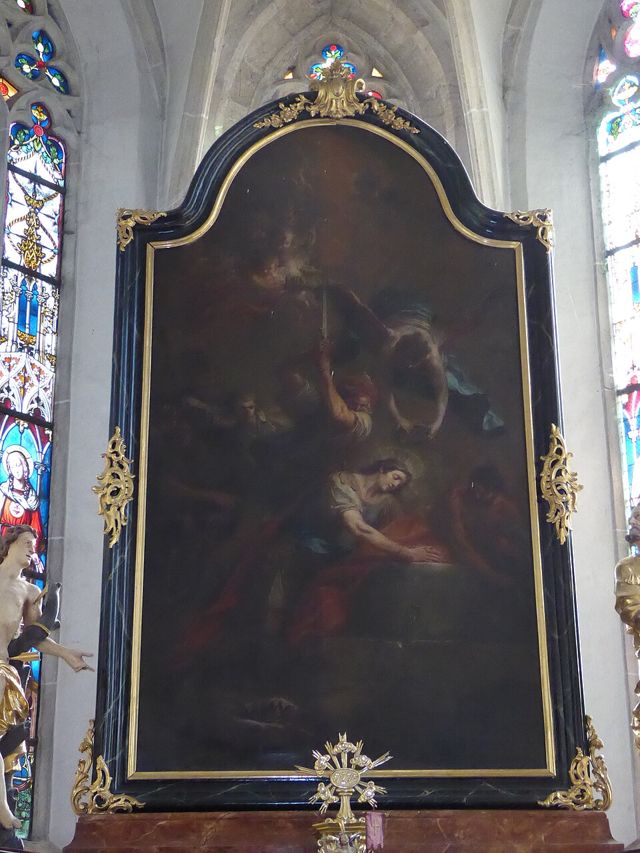
Image: Unterloiben Kirche7.jpg · BSonne · CC BY-SA 3.0, via Wikimedia Commons

From Sabine Baring-Gould, The Lives of the Saints, new edition in 16 vols. (London: John C. Nimmo, 1897), digitized text from Project Gutenberg. Public domain.

Image: BSonne, Wikimedia Commons (CC BY-SA 3.0)

From “Catholic Encyclopedia (1913)/Sts. Quirinus,” The Catholic Encyclopedia (New York: Robert Appleton Company, 1907–1914), via Wikisource. Public domain. Matched by name and feast date; text unedited except for our bracketed notes in grey.

From Sabine Baring-Gould, The Lives of the Saints, new edition in 16 vols. (London: John C. Nimmo, 1897), digitized text from Project Gutenberg. Public domain in the United States. Reproduced unedited, except for short bracketed notes in grey that we added to explain names and terms (“S.” is the old abbreviation for Saint). Some history and judgments reflect 19th-century scholarship.