St. Richard

Richard was an English prince of the West Saxons, and the father of three saints: Winebald, Willibald and Warburga.

Read the essentials →
February 7 · Confessor

St. Richard

St. Richard

Richard was an English prince of the West Saxons, and the father of three saints: Winebald, Willibald and Warburga.

Traditional feast

February 7
1914 / pre-1969 calendar, per Baring-Gould (1897)

Current feast

Not verified yet

Represents

Confessor

Their story

Adapted in modern English from Alban Butler's Lives of the Saints · Baring-Gould original below · little is known

Richard was an English prince of the West Saxons, and the father of three saints: Winebald, Willibald and Warburga. Earlier, when the young Willibald lay dying, Richard laid him at the foot of a great crucifix and prayed, and the child recovered.

Taking his two sons, he sailed from Hamble haven on a pilgrimage, stayed at Rouen, and travelled toward Rome, but died suddenly at Lucca. He was buried in St Fridian's church, where his relics are still honoured. Butler gives about 722; Baring-Gould, the text on this page, gives 719. The sources differ.

Early life

The book says little or nothing about early life. This is how the account begins.

Thin entry · the 1897 book gives only 133 words. We have not filled the gap with invented detail.

This saint was, according to the belief of the people of Lucca, a prince in Wessex; but there is not only no evidence that he was of royal rank, but there is strong contemporary evidence that he was merely a petty noble. Taking with him his two sons, Willibald and Wunibald, he undertook a pilgrimage to Rome; and sailing from Hamblewich, i.e. Southampton, landed in France.

What they represent

How they teach us to live

Drawn from themes in the original account

Keep their day. Remember them on February 7 with a short prayer, and ask for their help.

Read more

The full original · 133 words

Read Baring-Gould’s full account

Baring-Gould’s sources: Roman Martyrology. German Mart., and that of Sarum by Wytford. His life is to be gathered from the Acts of his sons SS. Willibald and Wunibald; the life of S. Willibald was written by his cousin, a nun of Heidenheim.

This saint was, according to the belief of the people of Lucca, a prince in Wessex [the Anglo-Saxon kingdom of southern England]; but there is not only no evidence that he was of royal rank, but there is strong contemporary evidence that he was merely a petty noble.

Taking with him his two sons, Willibald and Wunibald, he undertook a pilgrimage to Rome; and sailing from Hamblewich, i.e. Southampton, landed in France. He made a brief stay at Rouen, and paid his devotions at all the principal shrines on his way through France. On his arrival at Lucca, in Italy, he was taken ill and died. He was buried in the Church of S. Fridian, there, where his relics [the bodily remains of a saint, or objects they used, kept with honor] are still preserved; and his festival is kept with singular devotion. See further the life of S. Willibald (July 7).

Feast days

Feast: February 7

Nine days · Free

Pray the novena
with us.

One short email a day for nine days. The day's prayer, a line from St. Richard's story, and a nudge to keep going.

Also on February 7
C

St. Chrysolius

February 7 · Bishop, Martyr
A

St. Augulus

February 7 · Bishop, Martyr
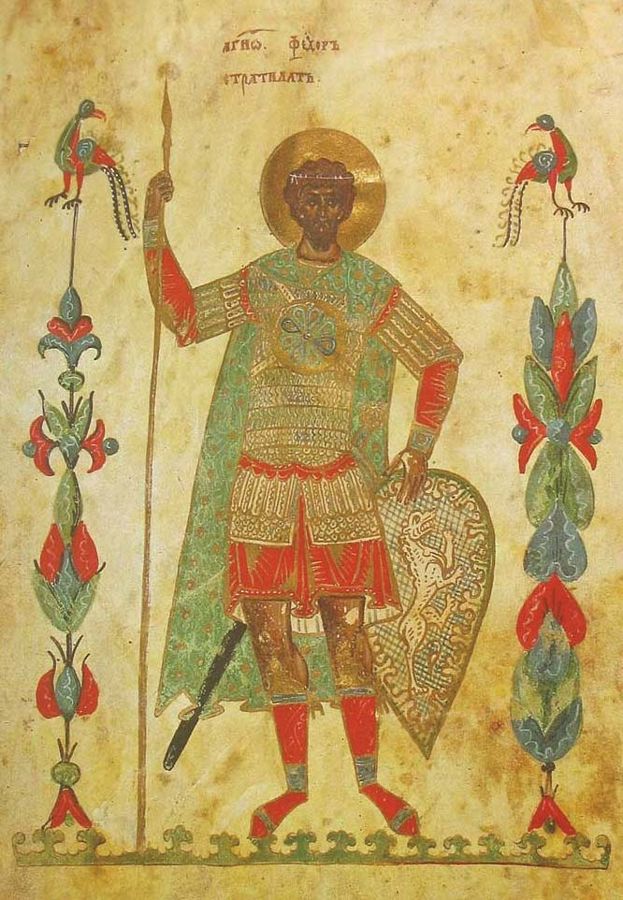
St. Theodore of Heraclea

St. Theodore of Heraclea

February 7 · Martyr
← All 1726 saints in the library
Sources & notes

Feast-day sources

Story sources

Sources

Credits

Image: Prince Richard, Duke of Gloucester (2023) (cropped).jpg · Dudley Council · CC BY 2.0, via Wikimedia Commons

From Sabine Baring-Gould, The Lives of the Saints, new edition in 16 vols. (London: John C. Nimmo, 1897), digitized text from Project Gutenberg. Public domain.

Image: Dudley Council, Wikimedia Commons (CC BY 2.0)

From Sabine Baring-Gould, The Lives of the Saints, new edition in 16 vols. (London: John C. Nimmo, 1897), digitized text from Project Gutenberg. Public domain in the United States. Reproduced unedited, except for short bracketed notes in grey that we added to explain names and terms (“S.” is the old abbreviation for Saint). Some history and judgments reflect 19th-century scholarship.