Baring-Gould’s sources: Modern Roman Martyrology: — Venerated greatly at Palermo, especially sluce 1624, when the Invention of her relics took place. No ancient martyrologies mention her, and there are no accounts of her earlier than Valerius Rossi, who wrote about a.d. 1590. Churches dedicated to her date, however, from 1237. Her history is founded on popular legend. " Gesta Sanctse haurienda fuerunt ex traditione, inscriptionibus et pictis tabulis, quae sola supersunt monumenta,” says J. Stilling the Bollandist.] Rosalia of Palermo was the daughter of Sinibald, a knight of noble blood, attached to the court of Roger, King of Sicily.
At the age of fourteen, the pious maiden resolved to leave the temptations and distractions of courtly life, and take refuge in solitude among the rocks. She ascended Monte Quisquina, a rugged mountain, and finding a cavern hid herself in it There she spent some time; how long cannot be told, for tradition in three centuries cannot be relied on. On the rock, she amused herself with engraving the words, “ Ego Rosalia Sinibaldi Quisquine et Rosarum domini filia am ore Domini mei Jesu Christi in hoc antro habitare decrevi.”1 Lower down is 12, apparently the Arabic numerals to indicate her age at the time, or perhaps the beginning of another line of inscription which she never terminated. This inscription, of undoubted genuineness, is a very touching monument of the solitary life of the young girl. Thus, perhaps, she occupied her cold fingers when the snows lay on Monte Quisquina, before the purple soldanella and the white crocus thrust through the turf with the returning sun of spring.
A wooden crucifix with another inscription cut on it in bad Greek is preserved in the Monastery of S. Salvatore at Palermo. It is to this effect: “ I, sister Rosalia (daughter) of Sinibald place this wood of my Lord which I have ever followed, in this monastery.” The genuineness of this inscription has been questioned. It has been thought to have been suggested by that on the rock, and forged, in order to attract pilgrims to the monastery where it is shown. But it is by no means improbable that the fingers which cut on the stone carved also on the wood. It must be remembered that a base Greek lingered on in Sicily as a patois till much more recently. If the inscription be a forgery, it is curious that it should not have been better done, and that the name should not have been given correctly, Rosalia instead of PocroXia. But if this was the vulgar pronunciation of her name in the Greek patois then spoken, the discrepancy is easily explained.
S. Rosalia is said in legend to have been led to her cave by two angel guides. After awhile, disturbed in her retreat, she took her staff, 1 Exactly thus — EGO ROSALIA SINIBAL^I QVISQVI NE ETROSARVM DOMINI FILIA AMORE dm ME1IESV cRISTI INI hoc ANTROHAJITA RI rflCREVI.
S. Rosalia. and went up Monte Pellegrino, again led by angels. Not far from the summit she found a grotto, to which entrance was only obtained by a narrow opening. Within, long stalactites hung white as alabaster from the roof, and mounds of stalagmite were heaped on the damp floor. Rosalia sought a dry corner of this cavern, and there formed her bed of fern and heather. It was a ghastly spot. From without a feeble light entered, and made the white draped stalactites into ghostly figures, standing in the midst of gloom. And all night long the drip of the falling water sounded monotonously.
In this grotto Rosalia passed the remainder of her life, and died about a.d. 1160. But the greatest uncertainty exists relative to her life. Some say that she was for awhile a member of a religious order, and is claimed by the Benedictines [monks following the Rule of St. Benedict] and the Basilians. She is often represented as a Basilian nun with a Greek cross of two arms in her hand.
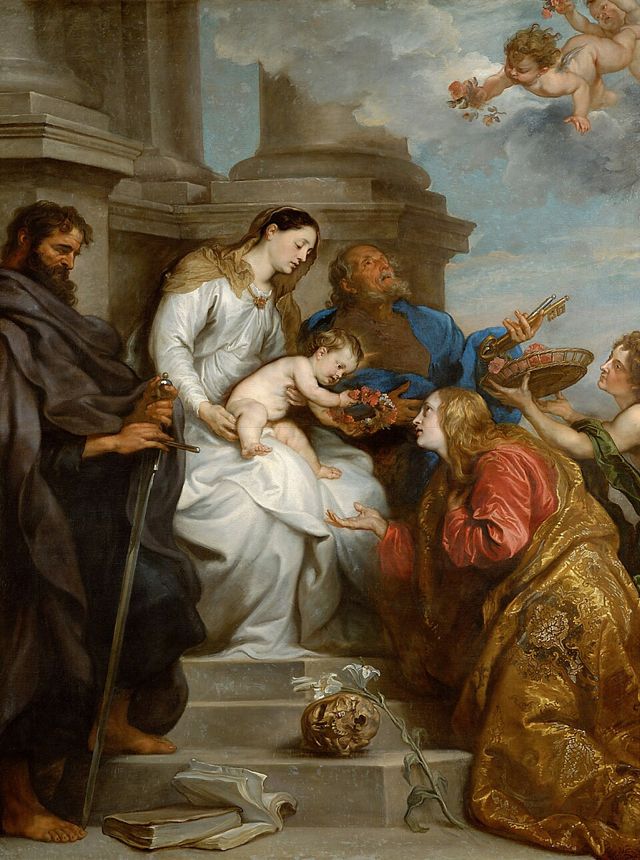
Whilst in her cave she is said to have woven garlands of wild roses and mountain flowers, offered them to God, and hung them round her crucifix. Angels are represented in pictures of the saint as bearing baskets of flowers and presenting them to her, and Our Lord as a little child is shown placing a crown of roses about her head. She died in her cave unknown to men, and the water dripping over her cased her in a film of lime. Year after year passed, and the stalagmitic envelope thickened. In 1 624 the plague was raging in Palermo, when S. Rosalia appeared to one stricken with the disease, and bade him make a pilgrimage to the top ot Monte Pellegrino. He returned cured. Then it was thought that the body of the saint might be found there, and search was made for it. The opening of the cavern was found, and it was entered. A block of stalagmite was broken and it was found to envelop human remains. These, it was concluded, were the bones of the saint.
The relics [the bodily remains of a saint, or objects they used, kept with honor] were translated to Palermo, and on Jan. 22, a.d. 1625, were solemnly exposed. The plague which had been raging since r624 ceased. A church was then erected near the cave.
“ Monte Pellegrino, near Palermo, is a rugged mountain. Not quite at the top, but yet at a great height, is the church of S. Rosalia. The place where the saint usually slept is shown, and where by a miracle her body was found at a later period. The rough damp grotto, in combination with the magnificence of the church, has a peculiarly romantic appearance. Until the great plague in Palermo, nothing certain was known about S. Rosalia; but during that time of terror, a soldier had a vision urging him to search for the body of the saint in a grotto on the mountain, and then to carry it in procession through the city for the removal of the plague. To confirm the truth of the order, the Virgin told the soldier that he would die within three days; die he did, and the body of the saint was found at the spot indicated, and was carried through Palermo with great pomp, after which the plague ceased. Since then the festival of the Saint is annually held in the city with solemn processions. Previous to this “ fiesta/' the Saint, as the Palermitans call her, regularly washes the streets with a beneficial rain, the truth of which is confirmed by many visitors. The pious belief of the people is every year confirmed to their great pleasure.”1 We are told that the clergy did not accept the authenticity of the bones found in the cave without the most satisfactory proof.
With the body were discovered some beads. The rosary was not instituted when S. Rosalia lived, but the use of Emperor Maximilian: Recollections of my Life, ii. p. 28. beads is more ancient than S. Dominic, who only regulated their arrangement. Those of S. Rosalia are thirteen in number — twelve small ones and a large bead, dividing the chain into groups of six. With the body was also a terra cotta crucifix, the head separate and very beautiful; also a little silver cross of equal arms, much injured. In 1663 Francis Castaglia, of the Society of Jesus, lay dying in the Jesuit College at Palermo, when he saw S. Rosalia appear to him. And she said, “ Francis, I have prayed for thee, and thou shalt live.’7 He was healed on the spot. He afterwards had the face of the angelic maiden painted as she appeared to him. The Bollandists [Jesuit scholars who since the 1600s have critically studied the lives of the saints] give an engraving of the picture, it is that of a girl of perhaps eighteen, with long flowing hair, and a dress sown with wild pinks, such as grow on the rocks of her loved mountains. The face is singularly sweet and somewhat sad.