St. Rudesind

A shepherd who stayed with his people through hard times.

Read the essentials →
March 1 · Bishop, Confessor

St. Rudesind

St. Rudesind

A shepherd who stayed with his people through hard times.

Traditional feast

March 1
1914 / pre-1969 calendar, per Baring-Gould (1897)

Current feast

March 1
Secondary source · Wikipedia

Represents

Bishop
Confessor

Their story

Adapted in modern English from Baring-Gould (1897) · original text below · little is known

Rudesind was son of Count Gutierre in Gallicia. A popular legend says the font brought for his baptism went on up the hill after its cart broke. He became bishop of Dumium.

His kinsman Sisnand, bishop of Compostella, neglected his duties, so at King Sancho's request Rudesind took over and Sisnand was jailed. Rudesind raised a force to drive off Norman raiders and then the Moors. After Sancho died, Sisnand escaped and threatened him at sword-point on Christmas night; Rudesind resigned, became a monk, and some years later was chosen abbot. His mother, the story says, had a sign of his holiness before his birth while praying at the church of S. Salvador.

Struggles & surrender

What they wrestled with, and how they gave it to God

  • Driven from office ·
    Source: Baring-Gould, Lives of the Saints. His kinsman Sisnand threatened him at sword-point and forced him to resign the see of Compostella.

Early life

Selected sentences from the original account, unaltered.

The Blessed Rudesind was the son of a Count Gutierre da Mendenez, in Gallicia. His mother is said to have had a foretoken of the sanctity of the child that was about to be given her, whilst praying in the Church of S. Salvador on Mount Corduba. When the child was born, she desired to have him baptised in the church, but as there was no font there, one had to be brought up the hill in a cart.

What they represent

How they teach us to live

Drawn from themes in the original account

Stay faithful when it costs you. This account is about holding firm under pressure.

Pray a little every day. Prayer runs all through this account.

Make time for silence. Solitude and withdrawal to pray shape this life.

Learn from the kind of life it was. A shepherd who stayed with his people through hard times.

Read more

The full original · 272 words

Read Baring-Gould’s full account

Baring-Gould’s sources: Spanish and Benedictine Martyrologies. Office with twelve lections in the Coimbra Breviary. His translation is observed on Sept. 1st. Authority:—A life by Brother Stephen of Cella-nuova, about 1180.

The Blessed Rudesind was the son of a Count Gutierre da Mendenez, in Gallicia. His mother is said to have had a foretoken of the sanctity of the child that was about to be given her, whilst praying in the Church of S. Salvador on Mount Corduba. When the child was born, she desired to have him baptised in the church, but as there was no font there, one had to be brought up the hill in a cart. The cart broke down, says the popular legend, however, the font continued its journey without it. The child grew up to be a good man, and he was appointed to the bishopric of Dumium, a see which has ceased to exist. His kinsman, Sisnand, bishop of Compostella, was a scandal to the Church, "spending all his time in sports, excesses, and vanities, and paying no attention to his duties." Wherefore, at the request of the king, Sancho, and the nobles and people, Rudesind undertook the government of it, and Sancho put Sisnand in prison. During the absence of the king against the Moors [the Muslims of North Africa and Spain], the Normans invaded Gallicia, whereupon the bishop called together an army, marched against them, and drove them back to their ships, and then turned his arms against the Moors, and routed them. On the death of Sancho, Sisnand escaped from prison, attacked Rudesind on Christmas night, whilst engaged with the canons in the sacred offices, and threatened him, sword in hand, unless he resigned the see. Rudesind at once laid aside his office, and retired into a monastery, where he assumed the habit, and after some years was chosen abbot.
Feast days

Feast: March 1

Nine days · Free

Pray the novena
with us.

One short email a day for nine days. The day's prayer, a line from St. Rudesind's story, and a nudge to keep going.

Also on March 1
St. Hesychius

St. Hesychius

March 1 · Bishop, Martyr
St. Eudocia

St. Eudocia

March 1 · Martyr
St. Antonina

St. Antonina

March 1 · Martyr
← All 1726 saints in the library
Sources & notes

Feast-day sources

Story sources

Sources

Credits

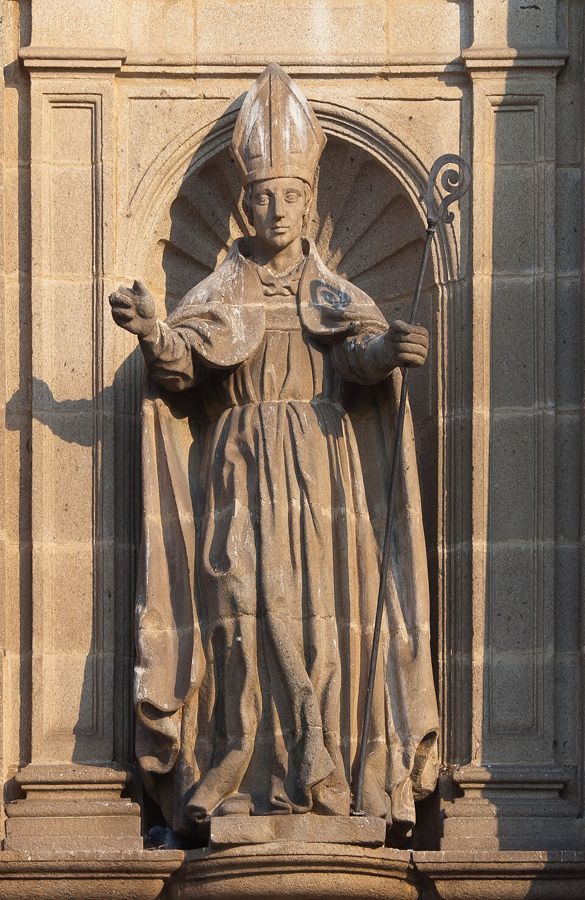
Image: Estatua no frontal do Mosteiro de San Salvador de Celanova - Galiza.jpg · Luis Miguel Bugallo Sánchez (Lmbuga) · CC BY-SA 3.0, via Wikimedia Commons

From Sabine Baring-Gould, The Lives of the Saints, new edition in 16 vols. (London: John C. Nimmo, 1897), digitized text from Project Gutenberg. Public domain.

Image: Luis Miguel Bugallo Sánchez (Lmbuga), Wikimedia Commons (CC BY-SA 3.0)

From Sabine Baring-Gould, The Lives of the Saints, new edition in 16 vols. (London: John C. Nimmo, 1897), digitized text from Project Gutenberg. Public domain in the United States. Reproduced unedited, except for short bracketed notes in grey that we added to explain names and terms (“S.” is the old abbreviation for Saint). Some history and judgments reflect 19th-century scholarship.