Faithfulness to Christ when it cost everything.
Read the essentials →Faithfulness to Christ when it cost everything.
June 26
January 11 (also listed: October 28)
Bishop
Martyr
They even tell us where he was born, and how he passed his youth. “ And how must you obey God in not complying with my request ? ” “I purpose visiting the relics of a great many saints, and I seek them all as intercessors.” Then the servants of the young chief arrested Salvius, and carried him to his castle at Brlvitic. Winegard went before his father, and told him what he had done.
Learn from the kind of life it was. Faithfulness to Christ when it cost everything.
Keep their day. Remember them on June 26 with a short prayer, and ask for their help.
Next day the bishop was waylaid by Winegard and a party of armed servants at Brenne. “ Whither away, sir bishop ?” “I am on my way to Cond£, to the monastery of Our Lady.” “ Stay and follow me. I have a church on my property which I wish to see dedicated.” “Mad1 The Roman Martyrology following other Martyrologies make* him bishop of Angouleme,and modern hagiologists hare depicted in lively colour* the seal of Salvias, insatiable within the narrow limits of his diocese, which forced him to go into Flanders and spread the Gospel. They even tell us where he was born, and how he passed his youth. All this is purely the work of lively bnt common-place imaginations. No Salvius appears in the list of the Bishops of Angouleme, and absolutely nothing is told us, by the ancient writer, of his life previous to the arrival at Valenciennes.
ex auro et gemmls ornata, nec non et cingulum aureum micantibus gem mis et margaritis intextum. Ferebat enim haec omnia vir sanctus coram omnibus. Hoc autem facie bat, qnia cupiebat instant! animo ad palmam martyrii pervenire." It was surely hardly seemly, even with this motive, to have sat down in his pontifical vestments to breakfast after mass, but this he did, according to his biographer. man!” exclaimed the bishop, “I must obey God rather than man.” “Why call you me mad?” asked Winegard. “ And how must you obey God in not complying with my request ? ” “I purpose visiting the relics [the bodily remains of a saint, or objects they used, kept with honor] of a great many saints, and I seek them all as intercessors.” Then the servants of the young chief arrested Salvius, and carried him to his castle at Brlvitic. Winegard went before his father, and told him what he had done. The cool discussion between father and son as given by the chronicler opens up to us the state of feeling when life was of little regard in Europe. “ I do not altogether approve of what you have done,” said the father; “ however, the responsibility is yours.” “What is to be done with the bishop, now I have got him; shall I kill him or let him go?” “To kill so good a man is not right, indeed, I do not recommend it, for he is a very good man; yet if you let him go, you will get into trouble. I really do not know what advice to offer.”
So the young man gave orders for the execution of the bishop and his attendant The bishop remonstrated, the jailor hesitated, but Winegard insisted. Accordingly the jailor struck the bishop on the head with an axe, as he sat on a three-legged stool, and then despatched his attendant.
The bodies of the two martyrs were buried in a stable; three years afterwards they were discovered and transported to the church of S. Martin [St. Martin of Tours (d. 397), soldier turned bishop] at Brenne, which thenceforth assumed the name of S. Sauve (Salvius). S. Pelagius.
& PELAGIUS, M. [Roman and Spanish Martyrologies. Authority: — An account of his Passion by Raguel, priest of Cordova, a contemporary, apparently, for he does not mention the legation of King Sancho, which took place only 35 years later for the recovery of the martyr’s body. About the time of this legation lived Hroswitha of Gandersheim, and she wrote an account of the passion of the martyr. It is instructive to compare the two narratives, and see how completely the facts had been altered in oral transmission from Spain to Germany, and in a space of less than half a century. Hroswitha says that Pelagius was shot by a balista across the river and over the city walls, and the body was found uninjured and entire, then was decapitated and thrown into the river; the body was afterwards washed ashore, and the head was found elsewhere.] In the contest between the Moors [the Muslims of North Africa and Spain] and Christians in Gallicia, it happened that the Christians having been on one occasion routed, a bishop named Hermoygius fell into the power of Abdulrahmanfand was carried in chains to Cordova. The bishop, soon weary of his confinement, offered his cousin, a lad of ten years, named Pelagius, to be hostage in his place, whilst he went among the Christians, and raised the sum necessary for his ransom, or negotiated an exchange of prisoners.
The unfortunate boy languished for three years in prison, and was then drawn forth before Abdulrahman on the report of his great beauty, that he might serve as page to that Moorish king.
The king made flattering offers to the young boy, if he would renounce his religion, and threatened him with a terrible death should he refuse, as Abdulrahman was incensed at what he considered the bad faith of the bishop in having escaped, and left a child in his place, without having effected the proposed ransom, or in lieu of it, returning to imprisonment The boy resolutely refused to listen to the offers made by the king, and answered dauntlessly, “I am a Christian and believe in Christ ! Christ I will never deny.” Pelagius was suspended to an iron gallows by the wrists, but testified no disposition to yield. Accordingly the king ordered him to be taken down, and his legs and arms to be cut ofl^ and cast into the river. This was done, and the brave boy entered into his rest His relics were translated to Leon, where they now rest, in 967, on November 28th, and portions to Oviedo in 975.
Feast: January 11
Traditional: June 26
One short email a day for nine days. The day's prayer, a line from St. Salvius's story, and a nudge to keep going.
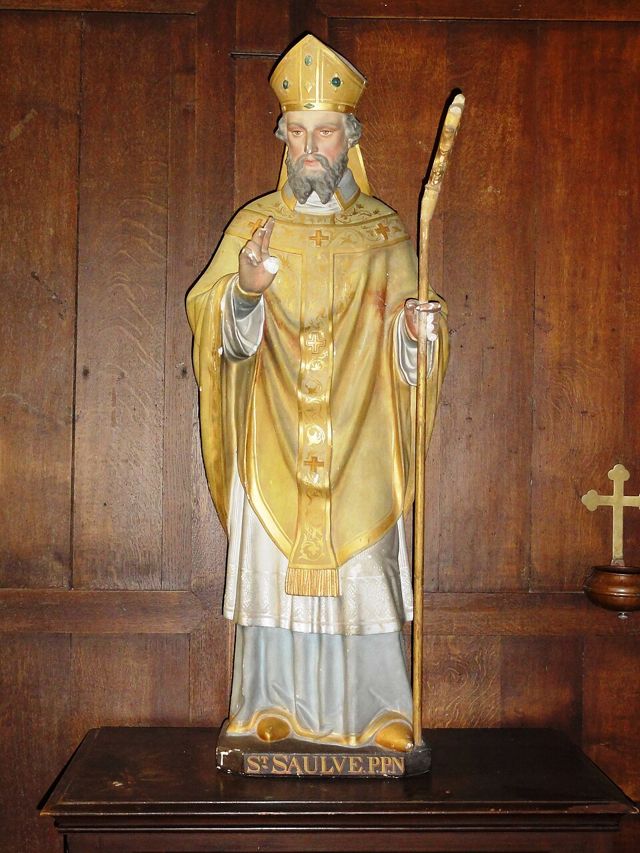
Image: Villers-Pol (Nord,Fr) église Saint-Martin, statue St.Saulve.JPG · Havang(nl) · CC0, via Wikimedia Commons
From Sabine Baring-Gould, The Lives of the Saints, new edition in 16 vols. (London: John C. Nimmo, 1897–98); text from the Internet Archive scan (OCR, lightly cleaned; errors possible). Public domain.
Image: Havang(nl), Wikimedia Commons (CC0)
From Sabine Baring-Gould, The Lives of the Saints, new edition in 16 vols. (London: John C. Nimmo, 1897–98); text from the Internet Archive scan (OCR, lightly cleaned; errors possible). Public domain in the United States. Reproduced unedited, except for short bracketed notes in grey that we added to explain names and terms (“S.” is the old abbreviation for Saint). Some history and judgments reflect 19th-century scholarship.