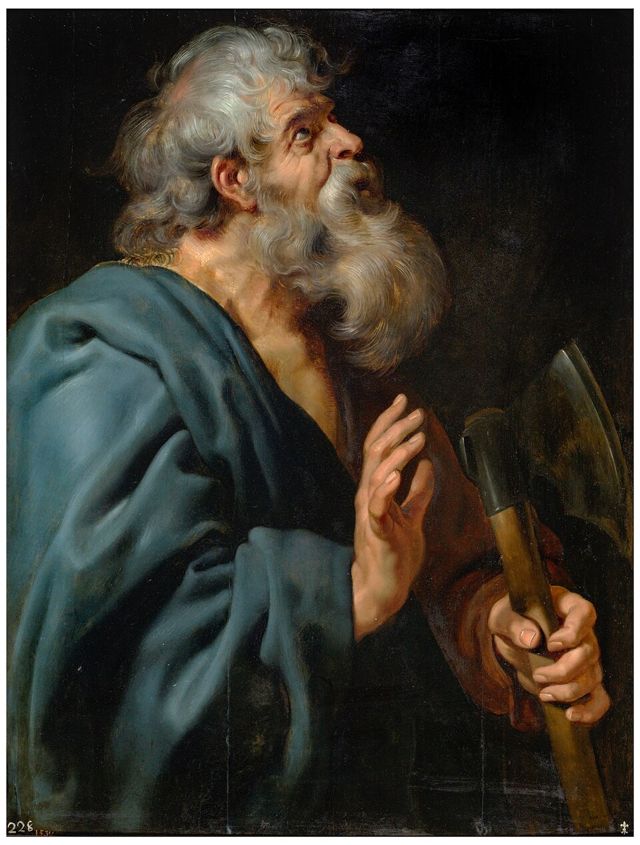
Faithfulness to Christ when it cost everything.
February 24
February 24
Martyr
Thin entry · the 1897 book gives only 71 words. We have not filled the gap with invented detail.
S. Sergius lived a retired, hermit life, near Cæsarea, in Cappadocia. When he heard of the breaking out of persecution, under the Emperors Diocletian and Maximian, his zeal led him to come into the city, and appear before Sapricius, the governor, and proclaim his abhorrence of the gods of Rome. The governor at once ordered him to execution.
Stay faithful when it costs you. This account is about holding firm under pressure.
Make time for silence. Solitude and withdrawal to pray shape this life.
Learn from the kind of life it was. Faithfulness to Christ when it cost everything.
S. Sergius lived a retired, hermit life, near Cæsarea, in Cappadocia [a region of central Turkey]. When he heard of the breaking out of persecution, under the Emperors Diocletian [Roman emperor 284–305, who began the ‘Great Persecution’ of Christians in 303] and Maximian [Diocletian’s co-emperor in the West, 286–305], his zeal led him to come into the city, and appear before Sapricius, the governor, and proclaim his abhorrence of the gods of Rome. The governor at once ordered him to execution.
His relics [the bodily remains of a saint, or objects they used, kept with honor] were translated to Ubeda, in the diocese of Taragona, in Spain.
Feast: February 24
One short email a day for nine days. The day's prayer, a line from St. Sergius's story, and a nudge to keep going.
From Sabine Baring-Gould, The Lives of the Saints, new edition in 16 vols. (London: John C. Nimmo, 1897), digitized text from Project Gutenberg. Public domain.
From Sabine Baring-Gould, The Lives of the Saints, new edition in 16 vols. (London: John C. Nimmo, 1897), digitized text from Project Gutenberg. Public domain in the United States. Reproduced unedited, except for short bracketed notes in grey that we added to explain names and terms (“S.” is the old abbreviation for Saint). Some history and judgments reflect 19th-century scholarship.