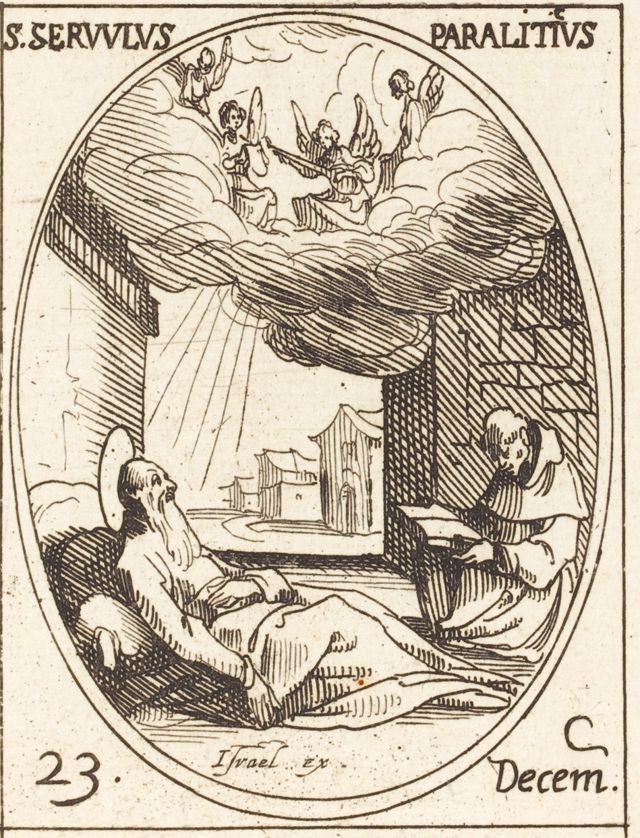
St. Servulus, G

Read the essentials →
December 22 · —

St. Servulus

St. Servulus, G

Traditional feast

December 22
1914 / pre-1969 calendar, per Baring-Gould (1897)

Current feast

December 23
Secondary source · Wikipedia

Represents

Feast

Their story

Adapted in modern English from Alban Butler's Lives of the Saints

St Gregory the Great tells the story of Servulus, a beggar paralysed from infancy who could not stand, sit up, lift his hand to his mouth, or turn over. His mother and brother carried him to the porch of St Clement's church in Rome, where he lived on alms. Whatever he could spare he gave to other poor people.

He asked visitors to read the Scriptures to him and learned them by heart, and he spent his time singing hymns of thanks. As he lay dying, about 590, he asked the poor and pilgrims around him to sing psalms. Then he suddenly cried, 'Silence; do you not hear the sweet praises sounding in heaven?' and died. He was buried in St Clement's. Gregory told the story in a sermon to his people as a rebuke to the healthy and comfortable.

Struggles & surrender

What they wrestled with, and how they gave it to God

  • Lifelong paralysis ·
    Paralysed from infancy, he could not sit up or lift his hand to his mouth, and lived by begging at St Clement's in Rome; St Gregory says he turned his suffering into prayer and thanksgiving.

Early life

The book says little or nothing about early life. This is how the account begins.

Thin entry · the 1897 book gives only 0 words. We have not filled the gap with invented detail.

What they represent

How they teach us to live

Drawn from themes in the original account

Keep their day. Remember them on December 22 with a short prayer, and ask for their help.

Read more

The full original · 0 words

Read Baring-Gould’s full account

Baring-Gould’s sources: Roman Martyrology. Usuardus, &c. Authority: — S. Gregory the Great, Dialog, lib. iv. c. 14, and Horn. 15, in Evangel.] Servulus was a beggar, and had been afflicted with the palsy from his infancy; so that he was never able to stand, sit upright, lift his hand to his mouth, nor turn himself from one side to another. His mother and brother carried him into the porch of S. Clement’s church at Rome, where he lived on the alms of those that passed by. Whatever he could spare from his own subsistence he distributed among other needy persons. He asked those who passed him on their way to church to read to him portions of the Scriptures, and these he learned by heart His joy of heart broke out in hymns, which he probably caught from the open door of the church, when the choir sang the praises of God. After some years spent in suffering, his feeble frame sank. As he was dying, he besought the poor and pilgrims to sing by his pallet. He lifted up his feeble voice in concert with theirs. Suddenly he arrested their song; “Hush!” said he, “I hear sweet music from heaven !” And he expired.

Feast days

Feast: December 23
Traditional: December 22

Nine days · Free

Pray the novena
with us.

One short email a day for nine days. The day's prayer, a line from St. Servulus's story, and a nudge to keep going.

Also on December 22
I

St. Ischyrion

December 22 · Martyr
F

St. Flavian

December 22 · Martyr
E

St. Ernan

December 22 · Feast
← All 1726 saints in the library
Sources & notes

Feast-day sources

Story sources

Sources

Credits

Image: St. Servulus of Rome.jpg · Jacques Callot · Public domain, via Wikimedia Commons

From Sabine Baring-Gould, The Lives of the Saints, new edition in 16 vols. (London: John C. Nimmo, 1897–98); text from the Internet Archive scan (OCR, lightly cleaned; errors possible). Public domain.

Image: Jacques Callot, Wikimedia Commons (Public domain)

From Sabine Baring-Gould, The Lives of the Saints, new edition in 16 vols. (London: John C. Nimmo, 1897–98); text from the Internet Archive scan (OCR, lightly cleaned; errors possible). Public domain in the United States. Reproduced unedited, except for short bracketed notes in grey that we added to explain names and terms (“S.” is the old abbreviation for Saint). Some history and judgments reflect 19th-century scholarship.