S

Trying to rule as a Christian, not just in name.

Read the essentials →
February 1 · King, Confessor

St. Sigebert

St. Sigebert

Trying to rule as a Christian, not just in name.

Traditional feast

February 1
1914 / pre-1969 calendar, per Baring-Gould (1897)

Current feast

February 1
Secondary source · Wikipedia

Represents

King
Confessor

Their story

Adapted in modern English from Alban Butler's Lives of the Saints · Baring-Gould original below · little is known

Sigebert II was the son of King Dagobert I. He was baptized at Orleans by St Amand, whom Dagobert recalled from banishment for that purpose. Blessed Pepin of Landen oversaw his education.

In 633, when he was three years old, his father made him King of Austrasia. On Dagobert's death in 638 he ruled Austrasia while his brother Clovis II ruled the rest of France, and the two lived in rare harmony. His only war was against the rebellious Thuringians.

He used his patrimony to relieve the poor and founded twelve monasteries, as well as churches and hospitals. He died on 1 February 656, aged twenty-five, in the eighteenth year of his reign.

Early life

Selected sentences from the original account, unaltered.

This royal saint was the son of Dagobert I., King of France. The young prince's education was entrusted to Pepin, mayor of the palace, who carried his charge into Aquitain, to his estates. But at the age of three, Sigebert was invested by his father with the kingdom of Austrasia, or Eastern France, including Provence, Switzerland, Bavaria, Swabia, Thuringia, Franconia, the Rhenish Palatinate, Alsace, Trèves, Lorraine, Champagne, Upper Picardy, and Auvergne.

What they represent

How they teach us to live

Drawn from themes in the original account

Share your faith, in words and by example. Preaching and conversion are central here.

Build up the community you belong to. This life was lived with and for a community.

Learn from the kind of life it was. Trying to rule as a Christian, not just in name.

Read more

The full original · 359 words

Read Baring-Gould’s full account

Baring-Gould’s sources: French Martyrology. Authorities:—His life by Sigebert of Gemblours, d. 1112, and mention by Gregory of Tours, and Flodoard.

This royal saint was the son of Dagobert I., King of France. The father for a long time refused to have his son baptized, but at length by the advice of S. Ouen and S. Eligius, then laymen in his court, he recalled S. Amand, bishop of Maestricht, whom he had banished for reproving his vices, and bade him baptize his son Sigebert. The young prince's education was entrusted to Pepin, mayor of the palace, who carried his charge into Aquitain, to his estates. But at the age of three, Sigebert was invested by his father with the kingdom of Austrasia, or Eastern France, including Provence, Switzerland, Bavaria, Swabia, Thuringia, Franconia, the Rhenish Palatinate, Alsace, Trèves, Lorraine, Champagne, Upper Picardy, and Auvergne.

Dagobert died in 638, and was succeeded by Clovis II., in the kingdom of Western France. Pepin of Landen, was mayor of the palace to Sigebert, and strove to train the young king in godliness and Christian virtues. By his justice and temperance, S. Sigebert rendered himself in his youth greatly beloved and respected by his subjects.

Pepin dying in 640, the king appointed Grimoald, mayor of the palace, in his father's room. The Thuringians revolting, Sigebert reduced them to their duty; and this is the only war in which he was engaged. His munificence in founding churches and monasteries, his justice in ruling, and the private virtues of his spotless life, made him to be regarded as a model of a saintly king. After a reign of eighteen years from the date of his father's death, he died at the age of twenty-five, and was buried in the abbey of S. Martin [St. Martin of Tours (d. 397), soldier turned bishop], near Metz, which he had built. His body was found incorrupt in 1063, and in 1170 it was enshrined in a silver case. When Charles V. laid siege to Metz, Francis of Lorraine, Duke of Guise, demolished all the monasteries and other buildings in the suburbs which could give harbour to the enemy, amongst others that of S. Martin. The relics [the bodily remains of a saint, or objects they used, kept with honor] of the saintly king were then removed to the collegiate church of Our Lady, at Nancy, where they repose in a magnificent shrine.
Feast days

Feast: February 1

Nine days · Free

Pray the novena
with us.

One short email a day for nine days. The day's prayer, a line from St. Sigebert's story, and a nudge to keep going.

Also on February 1
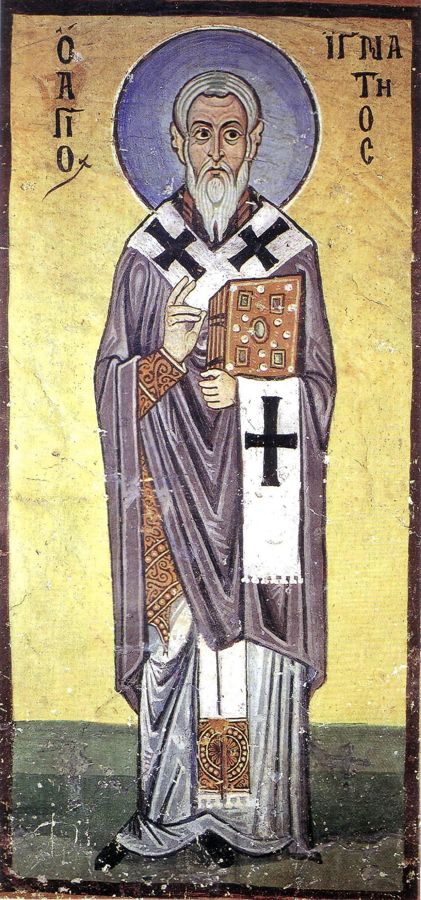
St. Ignatius

St. Ignatius

February 1 · Bishop, Martyr
P

Sts. Pionius and…

February 1 · Priest, Martyrs
E

St. Ephraem the Syrian

February 1 · Deacon, Confessor
← All 1726 saints in the library
Sources & notes

Feast-day sources

Story sources

Sources

Credits

From Sabine Baring-Gould, The Lives of the Saints, new edition in 16 vols. (London: John C. Nimmo, 1897), digitized text from Project Gutenberg. Public domain.

From Sabine Baring-Gould, The Lives of the Saints, new edition in 16 vols. (London: John C. Nimmo, 1897), digitized text from Project Gutenberg. Public domain in the United States. Reproduced unedited, except for short bracketed notes in grey that we added to explain names and terms (“S.” is the old abbreviation for Saint). Some history and judgments reflect 19th-century scholarship.