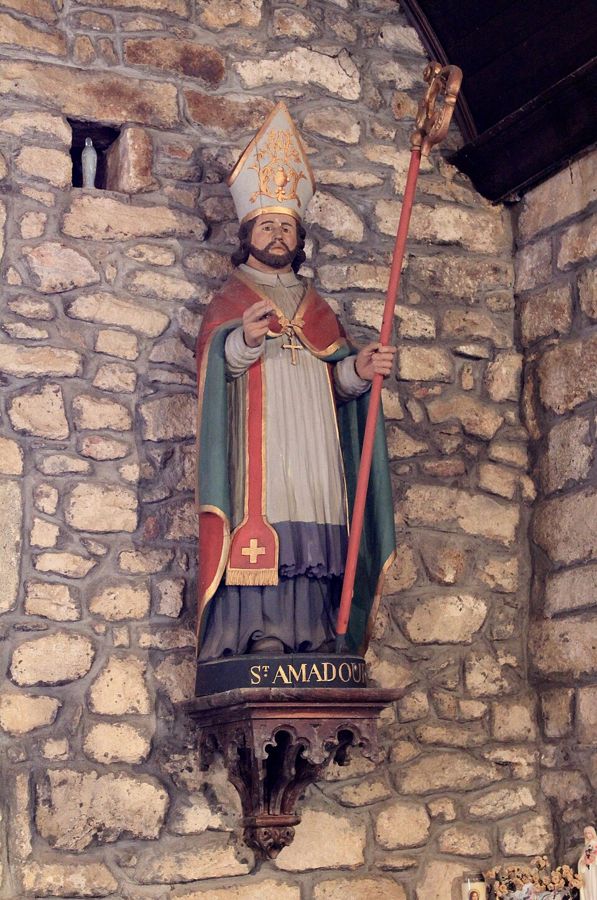
Baring-Gould’s sources: Roman and Gallican Martyrologies. Usuardus, Ado, Notker, Hrabanus. Authorities: — S. Gregory of Tours in his Hist. Francorum, cc. 5 and 6J S. Sigismund was the son of Gundebald, king of Burgundy. He was converted from Arianism by S. Avitus, bishop of Vienne, in 515. His father died in 516, and thereupon he ascended the throne. Sigismund was a munificent benefactor to the monastery of Agauuum or S. Maurice in the Valais, which he may be said to have founded, though religious men dwelt there before, yet it is probable that they inhabited the cave in the precipice [May i.
…above the town, which is still a hermitage. The stately tower of the abbey church in part dates from the foundation of S. Sigismund. S. A vitus preached at the dedication of the monastery.1 * * * But Sigismund, if imbued with strong religious feelings, was not without frantic outbursts of barbarian rage, in one of which he was guilty of a horrible crime, which embittered the rest of his life. His first wife was Astrogotha or Amalberga, the daughter of Theodoric the Goth, king of Italy, by whom he had a son named Sigeric. On her death, he married another wife, probably of inferior rank. The lad Sigeric bore his step-mother no warm love, and seeing her one day wearing the clothes of his own mother, burst forth into an angry exclamation of “Your mistress’s clothes do not become the back of her servant !” His step-mother never forgave this remark, and schemed his death. She gradually worked upon the feelings of her husband, awakening his fears of the power and ambition of Theodoric, and then pretending to discover a plot of the king of Italy to dethrone Sigismund and set up Sigeric in his place. The Burgundian king gave way to his ferocious passion, and in the blindness of his jealousy ordered the death of his son. A thong was slipped by two young men round the neck of Sigeric, as he slept, and the prince was strangled. No sooner was the crime committed, than the most agonizing remorse took possession of the king. He cast himself on the body of his son, and bathed the dead face with his tears. “Weep not for him, for he is at rest/' said an old courtier standing by; “but weep, sire, for thyself that by ill advice thou hast become a murderer of thy son.’7 The king 1 One cannot sufficiently deplore the barbarous way in which this venerable church has of late years been renovated, so that by the mean gim-crack tracery of the windows and wall-paper embellishments of the interior every token of dignity and religious gravity has been swept away. May i.] Sigismund ’ hastened to Agaunum, and remained in the monastery for some time fasting and weeping. He prayed in his sorrow that God would punish him in this world rather than in the | next. The storm that was to overwhelm him was already gathering. Clothildis, wife of Clovis I., king of the Franks [the Germanic people who ruled Gaul and gave France its name], was the daughter of Chilperic, king of Burgundy, who had been put to death, together with his wife and two sons, by Gundebald, the father of Sigismund. Consequently Clothildis not only desired to revenge the death of her father and brothers, but also laid claim to the kingdom of Burgundy. She, therefore, instigated her sons, Chlodomer, king of Orleans, Child ebert, king of Paris, and Clothaire, king of Soissons, against Sigismund, and gathering an army, they advanced against him, and his brother Gondomar fled. The Burgundian army was routed, and Sigismund endeavoured to find refuge at Agaunum; but was overtaken in a forest with his wife and her sons, and Chlodomer carried them back with him captives to Orleans. Gondomar collected the dispersed army of his brother and recovered Burgundy. Chlodomer in the ■ following year, 524, marched into Burgundy against Gondomar; but, before starting, flung Sigismund, his wife and her sons, into a well at Columelle, near Orleans, saying, “I am not going to leave my enemy behind my back.” As he advanced he called his halfbrother, Theodoric, King of Belgic Gaul [roughly modern France and Belgium], to his aid. Theodoric had married Suavigotha, the daughter of Sigismund, and though he pretended to be ready to assist Chlodomer, he resolved to revenge the death of his fatherin-law, and at the same time advance his own ambition. In a battle engaged with Gondomar, he went over to the enemy, and Chlodomer fell.
The body of S. Sigismund was taken to S. Maurice, and there buried. It was removed to the Cathedral of Prague by the Emperor Charles IV. Of this there is abundant historical evidence. But the head is preserved at Plock on the Vistula, in Poland, and the Poles assert that it was given by Wenceslas I., king of Bohemia, to Sigismnnd I., king of Poland, his brother. However, an entire body of S. Sigismund, the head alone excepted, is shown at Imola to this day; and the absence of the skull is accounted for by Charles IV., having taken it to Prague. This body is said to have been brought there, in 1146, by Rudolf the abbot, afterwards Bishop of Imola. But this statement is certainly inaccurate, for Rudolf was translated to Ravenna in xi 40. But another body, entire with the exception of the skull, exists and excites veneration at Monseve, near Barcelona; and Tamayus Salazar says that it was from this body that Charles IV. took the head to Prague. Other bodies are shown at Aquileia, in the Cathedral of Milan, and anciently at Cahors. There can be no question about the spuriousness of all these relics [the bodily remains of a saint, or objects they used, kept with honor] with the exception of those at Prague, whose genuineness is well established.