St. Stanislaus

Faithfulness to Christ when it cost everything.

Read the essentials →
May 7 · Bishop, Martyr

St. Stanislaus

St. Stanislaus

Faithfulness to Christ when it cost everything.

Traditional feast

May 7
1914 / pre-1969 calendar, per Baring-Gould (1897)

Current feast

April 11
Verified · General Roman Calendar

Represents

Bishop
Martyr

Their story

Adapted in modern English from the Catholic Encyclopedia (1913) · original text below

Stanislaus was born at Szczepanów, in the Diocese of Cracow, on 26 July 1030. No contemporary biography survives, and the life written at his canonization contains much legend. His parents, Belislaus and Bogna, were devout nobles who gave him a religious upbringing. After their deaths he gave his large inheritance to the poor.

Bishop Lambert Zula of Cracow ordained him priest and made him a parish priest, then canon, cathedral preacher and vicar-general. When Lambert died, Stanislaus was elected bishop, but accepted only at the explicit command of Pope Alexander II. He preached against vice among high and low alike.

King Boleslaw II, famous for his wars, had stained his name with cruelty and lust. He also quarrelled with the bishop over church land and over nobles he was treating cruelly. When pleas and warnings failed, Stanislaus excommunicated him and withdrew to the Chapel of St Michael outside Cracow. The king's guards dared not kill the bishop, so Boleslaw struck him down himself during Mass. He died on 8 May 1079. He was canonized (officially declared a saint by the pope) in 1253 and is patron of Poland and of Cracow.

Early life

Selected sentences from the original account, unaltered.

May 7.j S. Stanislaus. hi He was educated at Gnesen, and in Paris, and on the death of his parents, he resolved to devote his great wealth to the service of the Church.

What they represent

How they teach us to live

Drawn from themes in the original account

Stay faithful when it costs you. This account is about holding firm under pressure.

Learn from the kind of life it was. Faithfulness to Christ when it cost everything.

From the Catholic Encyclopedia

1913 · 423 words

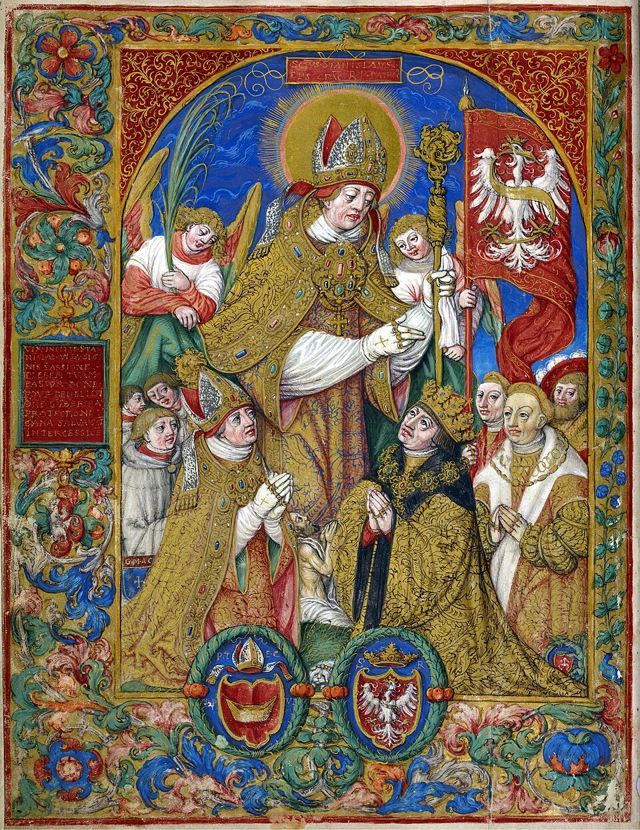
Bishop and martyr, born at Szczepanów (hence called Szczepanowski), in the Diocese of Cracow, 26 July, 1030; died at Cracow, 8 May, 1079; feast on May 7 in Roman Martyrology, but on 8 May in Cracow, which has a special feast of the translation [the solemn moving of a saint’s relics to a new shrine] of his relics [the bodily remains of a saint, or objects they used, kept with honor] on 27 September; patron of Poland and the city and Diocese of Cracow; invoked in battle. In pictures he is given the episcopal insignia and the sword. Larger paintings represent him in a court or kneeling before the altar and receiving the fatal blow. No contemporary biography of the saint is in existence. At the time of his canonization a life appeared written by a Dominican Vincent(?) (Acta SS.,May, II, 196) which contains much legendary matter. His parents, Belislaus and Bogna, pious and noble Catholics, gave him a religious education. He made his studies at Gnesen and Paris(?). After the death of his parents he distributed his ample inheritance among the poor. Lambert Zula, Bishop of Cracow, ordained him priest and made him pastor of Czembocz near Cracow, canon and preacher at the cathedral, and later, vicar-general. After the death of Lambert he was elected bishop, but accepted only on explicit command of Pope Alexander II. He worked with his wonted energy for his diocese, and inveighed against vices among high and low, regardless of consequences. Boleslaw II had become King of Poland. the renown he had gained by his successful wars he now sullied by atrocious cruelty and unbridled lust. Moreover the bishop had several serious disputes with the king about a piece of land belonging to the Church which was unjustly claimed by Boleslaw, and about some nobles, who had left their homes to ward off various evils threatening their families and who were in consequence cruelly treated by the king. Stanislaus spared neither tears nor prayers and admonitions to bring the king to lead a more Christian life. All being in vain, Boleslaw was excommunicated and the canons of the cathedral were instructed to discontinue the Divine Offices in case the king should attempt to enter. Stanislaus retired to the Chapel of St. Michael in a suburb of Cracow. The king was furious and followed the bishop with his guards, some of whom he sent to kill the saint. These dared not obey, so Boleslaw slew him during the Holy Sacrifice. The body was at first buried in the chapel, but in 1088 it was transferred to the cathedral by Bishop Lambert II. St. Stanislaus was canonized 1253 by Innocent IV at Assisi.

Read more

The full original · 939 words

Read Baring-Gould’s full account

Baring-Gould’s sources: Roman Martyrology. But the Prague Martyrology, those of Cologne, and Lubek, Greven, Molanns and Canisins, &c., on May 8th. The reason that the feast of S. Stanislaus was transferred back to the 7th, was so as not to obscure the feast of the Apparition of S. Michael. But May -8th, the day of his martyrdom, is that on which anciently the feast was celebrated. Authorities: — A life in the Polish History of John Longinus Dlugoss, canon of Cracow (d. 1480); 1 also a life written in 1252, and another life, ancient, but of uncertain date.] S. Stanislaus was bom on the 26th of July, 1030, at Sezepanow, near Bochnia, a town in Austrian Galicia, formerly part of the kingdom of Poland.

1 Longinus Dlugoss is not very trustworthy about dates; his account contains some strange mistakes in chronology. May 7.j S. Stanislaus. hi He was educated at Gnesen, and in Paris, and on the death of his parents, he resolved to devote his great wealth to the service of the Church. He was ordained by Lambert Zula, bishop of Cracow, who gave him a canonry in his cathedral. On the death of Lambert, in 1072, he was chosen to the bishopric of Cracow. At this time Boleslaus II. was King of Poland. This prince made himself abhorred by his subjects on account of his atrocious cruelty and unbridled lust. No one had courage to remonstrate against him, and at last, when he had carried off the beautiful wife of one of his nobles, Stanislaus boldly interfered, remonstrating, and threatening him with excommunication. A story is told of this period of his life, which must be received with caution, as we have nothing like contemporary evidence to substantiate it. The bishop had bought some land of a man named Peter, who was now dead, and had built on it a church. The king persuaded the heirs of Peter to reclaim the land. Stanislaus had not a receipt for the money, as the transaction had been conducted in good faith between him and the deceased, but he produced witnesses to prove that he had paid the money. The king, however, determined to judge the case, and he so browbeat the witnesses that they were afraid to speak the truth. The king was about to give judgment against the bishop, when Stanislaus suddenly exclaimed, “ Sire ! delay thy judgment three days, and the dead man shall himself speak." Then he went forth and spent three days and nights fasting and in prayer. And on the appointed day he went to the tomb of Peter, and bade it to be opened, and when they had discovered the dead man, “ Peter, arise !” exclaimed the bishop, touching him with his pastoral staff. Then the dead man, ghastly, with his mouldering grave clothes flapping about him, rose and followed the bishop between awestruck crowds to the court 1 12 Lives of the Samts. [May?.

of justice, where he stood in the place of witnesses, and gave his testimony, and then went back to his grave, and was stark as before.

At length the cruelty and profligacy of Boleslaus surpassed all bounds, and he rivalled the fiendish wickedness ot some of the old Roman emperors. Then the bishop again confronted him, and this time with the threat of excommunication. The king in a paroxysm of rage sent servants after him to murder him; but overawed by the sanctity of the prelate, they returned without having accomplished the deed. Boleslaus, blind with fury, himself rushed to chastise the daring prelate, and found him in the chapel of S. Michael at some distance from the walls of Cracow; he fell upon him with his sword, cut open his head, and in his brutal rage mutilated the face of the dying man. Then his attendants hacked the body and cast it into the field, where three eagles are said to have defended it from the wild dogs till some of the faithful found means to remove it secretly and bury it.1 Pope 1 The story of S. Stanislaus cannot be trusted in all its details. Longinus i Dlugoss not only makes chronological errors, but when he tells such stories as the following, the reader loses all confidence in his judgment, if not in his common sense. In 12^4 the body of S. Stanislaus was solemnly elevated in the cathedral to a new shrine. From Hungary came a pious family in a coach drawn by a horse, to be present at the ceremony. On the way, the horse fell down exhausted, and died. Thereupon the coachman descended and flayed the horse, hung the skin over his stick, and shouldering it, marched ahead. But the master sat down stubbornly on the bank and refused to proceed. His wife implored him to trust in the merits of S. Stanislaus, and go forward. But he declared his intention to Teturn. Then she had recourse to tears, and finally he gave way, she carrying the children, and he with the food of the party on his back. After they had gone some way, they heard the neighing of a horse behind them, and the wife looking back, exclaimed, “Here is our old horse coming after us at a trot, or I am very much mistaken.” “You fool/’ said the husband, “has not the horse been flayed? Look ! there is the driver carrying the skin on his stick.” But Io ! when he looked, the skin was gone, and the coachman could not account for the loss. So it was. By the merits of S. Stanislaus the horse had recovered its skin and its life, and the worthy family were able to harness it again in their waggon, and continue their journey, singing loud praises to the saint j and on their arrival at Cracow they offered a wax horse at his shrine.

Gregory VII. excommunicated the tyrant and all his accomplices in this sacrilegious act, placed a ban upon the kingdom, and released all his subjects from their allegiance to him. Boleslaus fled into Hungary where he died, according to some, by his own hand. S. Stanislaus was canonized by Innocent IV., in 1253.

The body of the saint is contained in a silver sarco^ phagus, borne by silver cherubim, in th$ cathedral of Cracow. Some portions also at Prague and Pilsen.
Feast days

Feast: April 11
Traditional: May 7

Nine days · Free

Pray the novena
with us.

One short email a day for nine days. The day's prayer, a line from St. Stanislaus's story, and a nudge to keep going.

Also on May 7
F

St. Flavia Domitilla

May 7 · Virgin, Martyr
D

St. Domitian of…

May 7 · Bishop
B

St. Benedict II.

May 7 · Feast
← All 1727 saints in the library
Sources & notes

Feast-day sources

Story sources

Sources

Credits

Image: Stanisław Samostrzelnik, Św Stanisław.jpg · Stanisław Samostrzelnik · Public domain, via Wikimedia Commons

From Sabine Baring-Gould, The Lives of the Saints, new edition in 16 vols. (London: John C. Nimmo, 1897–98); text from the Internet Archive scan (OCR, lightly cleaned; errors possible). Public domain.

Image: Stanisław Samostrzelnik, Wikimedia Commons (Public domain)

From “Catholic Encyclopedia (1913)/St. Stanislaus of Cracow,” The Catholic Encyclopedia (New York: Robert Appleton Company, 1907–1914), via Wikisource. Public domain. Matched by name and feast date; text unedited except for our bracketed notes in grey.

From Sabine Baring-Gould, The Lives of the Saints, new edition in 16 vols. (London: John C. Nimmo, 1897–98); text from the Internet Archive scan (OCR, lightly cleaned; errors possible). Public domain in the United States. Reproduced unedited, except for short bracketed notes in grey that we added to explain names and terms (“S.” is the old abbreviation for Saint). Some history and judgments reflect 19th-century scholarship.