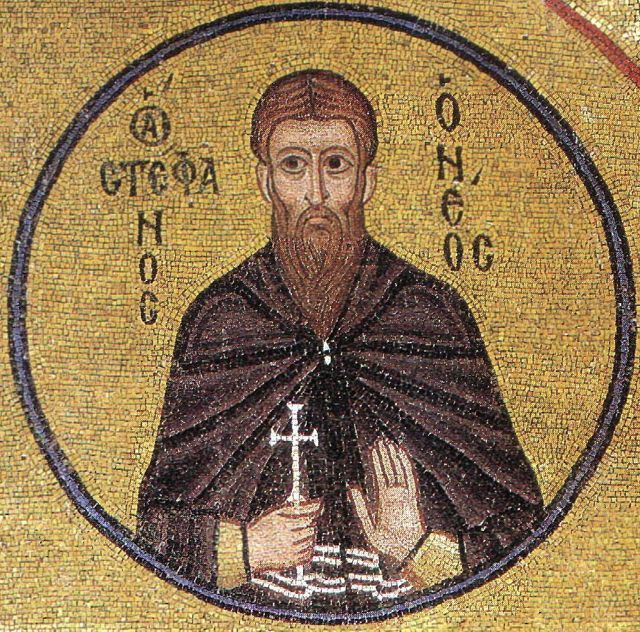
Baring-Gould’s sources: Roman Martyrology. Greek Menseas and Menologies on Oct. 20, 21, 28, and Nov. 28. Authority: — The Acts compiled forty-two years after his death by Stephen of Constantinople. Also Cedrenus and Theophanes.] S. Stephen, surnamed the Younger, was bom at Constantinople in 714, and dedicated to the religious life even before he was born. His parents were wealthy, but as they desired to concentrate their fortune in the hands of their elder children, so soon as Stephen’s mother gave promise of bearing another child, it was resolved to dispose of him in the most economical way possible, by obliging him to become a monk. He was delivered over in early youth to monastic teachers, and educated within the walls of a convent. At the age of sixteen he took the irrevocable vows in the monastery of S. Auxentius, near Chalcedon. The great advantage of this monastery in the eyes of his parents was its absolute poverty, and that it required no payment with those who entered or were put into it. The monastery consisted of little cells about the mountain, in which the religious lived like hermits. After the death of his father, Stephen put his mother and sister into a convent in Bithynia; he had another sister, a nun, in Constantinople.
Stephen wore only a sheepskin girded round his loins by an iron belt. A young widow, named Anne, placed herself under his direction, and took the veil in a nunnery at the foot of his mountain. He became abbot when aged thirty, but resigned the office in his forty-second year, and built himself a low cell, so cramped that he could neither lie nor stand in it, and into this he shut himself. In the iconoclastic persecution of Constantine Copronymus a council was held at Constantinople (a.d. 754) against images. Three hundred and thirty-eight bishops assembled, and knowing the objection entertained by the emperor against the veneration of images, obsequiously condemned it. As Stephen was greatly respected for his austerities, and the nakedness, dirt, and starvation in which he lived attracted a swarm of devotees, it was thought advisable to secure, if possible, his adhesion to the decree of the Council. Constantine sent a patrician named Callistus to sound him, but Stephen had made up his mind on the matter, and answered the overtures of the officers with such disdain, that Callistus returned baffled to the emperor. Constantine sent a body of soldiers to bring him from his cell. He lay down and refused to move, and they were obliged to enter the odorous and disgusting den and remove him by force. He was brought to the foot of Mount S. Auxentius, and was placed under a guard there till he could be tried. Various charges were raked up against him, as absurd as they were false — one, that he had criminally conversed with the widow Anne, was ridiculous. A hermit covered with vermin and plastered with filth was not likely to attract the affection of a passionate young woman. As she refused to confess what the emperor wished, she was scourged, imprisoned, and died shortly after of ill-usage. The emperor, seeking a new occasion to put Stephen to death, persuaded one of his courtiers called George Syncletus to draw him into a snare. Constantine had forbidden the monasteries to receive a novice. George went to Mount S. Auxentius, fell on his knees before S. Stephen, and begged to receive the monastic habit. The saint knew him to belong to the court, because he was shaved: the emperor having forbidden any at his court to wear beards. But the more S. Stephen urged the emperor’s prohibition, S. Stephen the Younger.
the more earnestly the impostor pressed him to admit him to the habit, pretending that both his temporal safety from the persecutors, and his eternal salvation depended upon it. Soon after he had received the habit he ran with it to the court, and the next day the emperor produced him in that garb in the amphitheatre before the people. Constantine inflamed them by a violent invective against the saint and the monks; then publicly tore the habit off his back, and the populace trampled upon it. The emperor immediately sent a body of armed men to Mount S. Auxentius. They dispersed the monks, and burnt down the monastery and church. They took S. Stephen from the place of his confinement, and carried him to the sea-side, striking him with clubs, taking him by the throat, tearing his legs in the thorns, and insulting him with opprobrious language. In the port of Chalcedon they put him on board of a small vessel, and carried him to a monastery at Chrysopolis, a small town not far from Constantinople, where Callistus and several iconoclast bishops, with a Secretary of State, and another officer, came to visit and examine him. They treated him at first with civility, and afterwards with harshness. He asked them how they could call that a General Council which was not accepted either by the Pope of Rome or the patriarchs of Alexandria, Antioch, and Jerusalem. The emperor, on learning the determination of the hermit, condemned him to be carried into banishment in the island of Proconnesus, in the Propontis. In that place he was joined by many of his monks, and his miracles increased the reputation of his sanctity. The tyrant, two years after, ordered him to be removed to a prison in Constantinople and loaded with irons. Some days after, the saint was carried before the emperor, and asked whether he believed that men trampled on Christ by trampling on his image. “ God forbid,” said the martyr. Then taking a piece of money in his hand, he asked what treatment he should meet with, were he to stamp insultingly on the image of the emperor? There was but one answer to this question. “ Is it then,” said the saint, “ so great a crime to outrage the representation of the earthly emperor, and none to cast into the fire the image of the King of Heaven ? ” The emperor ordered him to execution, and Stephen was led forth to death, but Constantine recalled the sentence at the last moment, and ordered him back to prison, and that he should be scourged. He was cruelly beaten and left half dead on the dungeon floor, bleeding and bruised. When the tyrant heard that he was still alive, he said, “ Will no one rid me of this monk ? ” Thereupon two monks, with some soldiers, entered the prison, carried off the wretched sufferer, and dragged him by the feet through the streets over the rough pavement, whilst some beat at him with sticks, or pelted him with stones. At last his brains were dashed out with a club. His body was torn to pieces by the ferocious mob.