Baring-Gould’s sources: Roman Martyrology. Authorities The Vita S. Stephani (major), written not long after the king’s death; the Vita minor, written after 1083, also by an anonymous writer. Another Life by Hartwig the Bishop (13th cent.), a compilation from the above. Chronicon Posoniense (a.d. 997 — 1203), the Chronicon Hungarorum mixtum (a.d. 1220), and other early Hungarian writers.] During the last decade of the ninth century the Magyars, a Tartar race from the shores of the Caspian, invaded and conquered Hungary. They marched under a chief, Arpad, who planted his banner on Mount Pannonius, the birthplace of S. Martin, and claimed for himself a district, of which Alba Regia, or Stuhlweissenburg, was the centre, and extended his domains as far as the Neusiedler Lake. Six other clans with their chiefs had invaded Hungary at the same time, and settled on other portions of the vast plain. They owed a rough capricious allegiance to Arpad. In 907 Arpad died, and was succeeded by his son Zoltan, who led the Magyars through the Alps against the Venetians. The progress of the Magyars westward was finally checked in the great battle of Augsburg, where they were defeated by the Emperor Otho the Great, as related in the life of S. Ulric (July 4th).
Geza, who became chief of the Magyars in 972, sur[Sept. a. rendered the province of Austria to Leopold, Duke of Suabia, and made peace with the emperor. Geza was a shrewd ruler. He saw that the Magyars contrasted unfavourably with the civilized nations that surrounded them. They were a wandering race, impatient of settled habits, and therefore impossible to civilize till brought to a different frame of mind. Geza was aware that the only influence that could alter the character of this nomad people was Christianity, and he invited Christian monks and priests to labour in Hungary for the conversion of his people. At the same time he encouraged the settlement of German colonies in his territories, hoping that the diligence and thrift of these foreigners would teach a lesson to the haughty, reckless Magyars.
Geza himself never, probably, was baptized; religion was with him a matter of politics more than of conscience. “ I am rich enough to serve any and all gods,” he said, contemptuously. But he caused his son to be brought up a Christian. Geza had married Sarolta, daughter of Gyula, Prince of Transylvania, a Christian. She is said to have had a dream, in which she saw the first martyr Stephen, who informed her that her son would convert his people to the faith of Christ, and should be called after him, Stephen. In due course of time a son was bom, named by his father, Vaik, and his education was entrusted to two Benedictine [monks following the Rule of St. Benedict] monks; but his baptism did not take place till he was sixteen years old, when he received the name of Istvan (Stephen). His father, fearing that the heathen Magyars would rebel against the changes which he foresaw his son would introduce, took the precaution to obtain from them oaths of allegiance to Stephen during his own lifetime.
Geza died in a.d. 977, and Stephen was only twenty years old when he became chief of the restless horde of S' Stephen. Hungarians, which it was his mission to scourge into submission and Christianity.
A general suspicion prevailed among the Magyars that the prince meant to use the foreigners whom his father had introduced and planted throughout the country, as means for gaining absolute mastery over his Magyar subjects. The Germans had built villages and walled towns, and occupied places of vantage within reach of one another, throwing a chain over the whole country; the Hungarian rambled freely over the wild plains, driving his cattle before him, or spending his time in hunting. The Germans, whom the politic Geza had introduced, looked to the prince as their support, for their prosperity depended on the maintenance of peace, and peace was abhorrent to the Magyars. Consequently the king could always fall back on the Germans when menaced by the turbulence of his own people. Stephen continued the good policy of his father. Where the suspicions of the people must be disarmed, and yet a stronghold be established to overawe them, he endowed a monastery, and walled it round like a fortress. Thence, in tranquil times the monks could disseminate lessons of peace and submission to authority and diligence, and thereinto in times of danger he could throw an armed force. The discontent and mistrust ripened daily, and finally broke out in open revolt. Kupa, Prince of Somagy, a grandson of Arpad, put himself at the head of a formidable body of insurgents, and Stephen was forced to take up arms in self-defence. Kupa proclaimed himself a champion of the ancient faith, but his religious zeal covered designs of private ambition. He saw no reason why he should not supplant Stephen, and become chief of the Magyars. To advance his scheme, he had asked in marriage Adelheid, Geza’s widow, but had been rejected. Religious zeal, ambition, and mortification urged him on; and round his banner rallied large swarms of discontented Hungarians. Stephen, on the other hand, was supported by the Magyars of his own clan or tribe, and by all the German colonists scattered throughout the country, shut in behind their walls, or issuing to harass and cut off the flying companies of the Magyars. Stephen pitched his camp on a plain near the river Gran, and sent messengers to Kupa, offering terms of peace. Meanwhile, to inspire his men with enthusiasm, he held a solemn festival, in the course of which he was invested, after the German fashion, with the baldric and sword of a knight. Thus armed, Stephen made a vow, in the presence of all the magnates, to devote a third of the spoils of the enemy to the abbey of S. Martin [St. Martin of Tours (d. 397), soldier turned bishop] on Mount Pannonius. Two consecrated banners blazing with the forms of S. Martin and S. George were borne before the army, that now broke up its camp and advanced to the relief of Veszprem, which was invested by the insurgents.
There a decisive battle was fought; Kupa flung himself at the head of a body of Magyar horsemen against the centre of the Christian host, but was unable to break the iron wall of mailed Germans. Kupa’s horse fell under him; before the prince could rise, his head was hacked off, and held aloft on the point of a spear. The bravest of the Magyars, now fighting with desperation, died in heaps on the spot under the battle-axes of the Germans, the rest threw down their arms and surrendered.
The victory was stained by no acts of cruelty. A third of the spoil went to endow the splendid monastery of S. Martin, called thenceforth the Abbey of the Holy Hill, which was subjected immediately to the apostolic throne. The body of Kupa was quartered and nailed to the gates of the four capitals, Raab, Veszprem, Gran, and Weissenburg in Transylvania. Then Stephen gave orders for the complete, unsparing extirpation of the ancient religion of his S. Stephen.
people. The altars were overthrown, and the priceless old heroic and mythologic poems, the heirlooms of the nation from remote ages, were ruthlessly destroyed. Stephen would not only Christianize but Germanize Hungary by force. Every Magyar found worshipping under the sacred oaks, by fountains, or before lichened rocks, was ordered to be put to death by drowning. These barbarous laws were inflicted on the whole trembling land, and the Magyar groaned under the iron despotism of a prince of his own race, who scourged him with the arm of an alien whom he abhorred. But it was not enough to forcibly extinguish paganism, the blank must be filled, and Stephen invited hosts of clergy to enter his realm and give a faith to the hearts he forbade to believe in their old religion. And to make it worth the while of clergy to come to this arduous field, he proceeded to richly endow the Church in Hungary. He founded an archbishopric at Kalocsa, and divided the land into ten dioceses. Stephen was resolved to give himself and his dynasty a firmer position than that of elected Vaivod of Hungary, he determined to constitute himself king in name as well as in fact, when he broke the power of his unruly nation. He therefore sent Anastasius, Abbot of Pecsvarad, whom he had nominated to the archbishopric of Kalocsa, on a mission to the Pope, to obtain from him a consecrated crown and sceptre.
Meanwhile, the same idea seems to have struck Duke Boleslas I. of Poland, who sent an embassy to Rome on the same mission. The Poles reached Rome before the Hungarians, and the Pope at once ordered the manufacture by a skilful goldsmith of a hemispherical crown, crossed by two arches, and surmounted by ball and cross. In front of the crown, over the brow, was an enamel figure of the Saviour set in pearls, and the border was adorned with precious stones and figures of the apostles.
Otho III. of Germany was then in Rome; it accorded with his wishes that Stephen, rather than Boleslas, should enjoy the title of king. He urged the prior claims of the Hungarian, about to be married to Gisela, sister of Henry of Bavaria; and Pope Sylvester, pretending that an angel had appeared to him in sleep, and forbidden him to give the crown to Boleslas, conferred it on Stephen. The enthusiastic eloquence of Anastasius, head of the Hungarian embassy, no doubt conduced largely to this favourable change of design. When he spoke to the Pope of the virtues of Stephen, and how he had converted his unbelieving people, stubborn against renouncing the religion of their ancestors for a new one of which they knew nothing but the name, of how he laboured with voice and arm in the mission field, persuading some, and compelling those who were deaf to persuasion, Sylvester exclaimed — “ I am called apostolic, but your prince is truly an apostle.” The title of Apostolic has ever since been borne by the Kings of Hungary. Sylvester confirmed all the ecclesiastical arrangements made by Stephen, and granted to him and his successors the right of regulating the affairs of the Hungarian Church. Then, further to insure its independence of other countries, he consecrated three bishops, Anastasius, Dominicus, a monk who accompanied the embassy from Hungary, and also the legate [an official representative sent by the pope] whom he intended to send to the Hungarian king. These, then, on their arrival, proceeded to the consecration of the other bishops appointed by Stephen to the ten dioceses into which he had divided the kingdom. The Pope gave the king a patriarchal cross of two cross-pieces, to be borne before him in battle. S. Stephen went to meet his ambassadors, on their return, listened standing to the Pope’s letter of greeting, and bent his knee whenever the name of Sylvester was pronounced as though it were the name of Jesus.
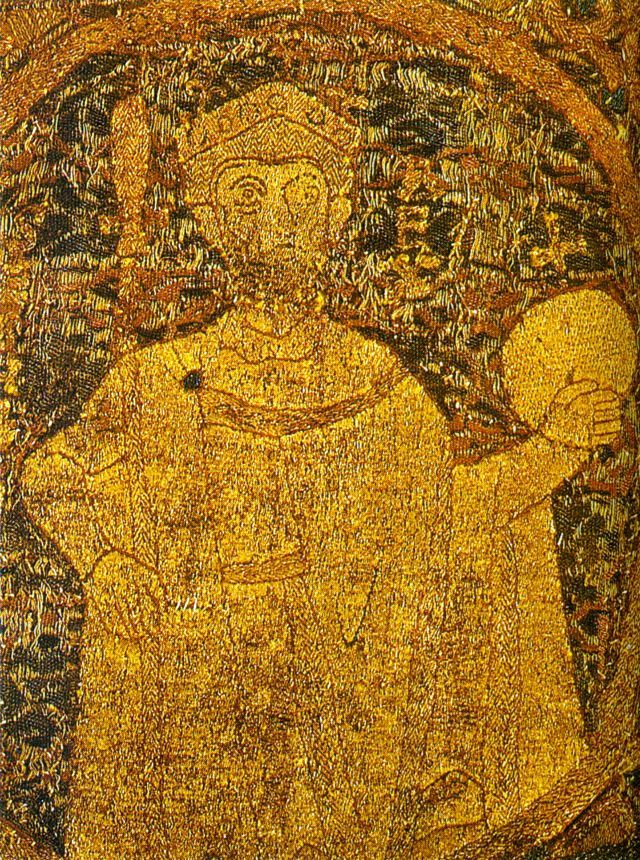
S. Stephen. The coronation of Stephen took place at Pressburg, in a.d. 1000. The ancient ceremony is observed to this day whenever an Emperor of Austria receives the crown of Hungary. The Archbishop of Kalocsa placed the gold crown given by the Pope on Stephen’s head, after which the king mounted his white horse, and rode to the summit of the mound in the market place of Pressburg, and there, after swearing to uphold the constitution, and respect the rights of the people, he waved his huge sword north, south, east, and west, to signify his determination to defend his country from all enemies, from whichever quarter they might arise. After the coronation the crown, sceptre, ball, shoes, and mantle were taken, first to Stuhlweissenburg, then to Veszprem, and lastly to the royal Castle of Pressburg, where they were guarded with the greatest care and reverence. Shortly after his coronation, Stephen celebrated his marriage to Gisela, sister of the Emperor, Henry the Second, to whom he had been betrothed for six years. We do not hear much of her, except that she was a good, quiet, colourless lady, with a special devotion to needlework. One monument of her industry still remains, in the blue satin mantle embroidered with figures of the Blessed Virgin Saints, which has been worn for centuries by every Hungarian king at his coronation.
But Stephen’s new title did not bring him rest or peace; he was the pioneer of civilization, and that a compulsory one. The Magyars had no wish for change in their habits, government, or religion. The use of Latin in the religious services of the Church proved a great obstacle to their acceptance of Christianity; for the Magyars were passionately attached to their native tongue, and regarded every attempt to supersede it as an attack on that nationality which every Magyar upheld as tenaciously and proudly then as he does at the present day.
[Sept. z. One of the places to which Kupa's quartered body had been sent was Weissenburg, capital of Transylvania. It arrived just as they were burying Gyula, Prince ot Transylvania, the father of Stephen’s mother. Gyula himself had been baptized and had embraced the faith of the Greek Church, but his son Gyula was an avowed Pagan. Kupa’s mutilated body announced that Transylvania was to submit to Christianity and the sovereign supremacy of the new king; and rather than do this Transylvania rose in arms, under the leadership of Gyula the younger. Stephen led his army in person, and his battle-cry was “God and the Blessed Virgin i” The battle ended in the complete rout of Gyula, who was taken along with his wife and children. Stephen flung the Prince into chains, and ordered that he should be kept imprisoned till he should consent to be baptized. The saintly king had a high opinion of the virtue of compulsion in making Christians. But Gyula grew grey and died in prison rather than accept a religion in which he could not believe.
With the spoils of the Transylvanian chiefs Stephen built a splendid church at Stuhlweissenburg, which he intended for the royal city. But there was no blessing on the treasure of Gyula, as the chronicle says, for the building was afterwards destroyed by fire. Stephen himself laid the foundation stone of the church, whose costly marble walls, alabaster altars, and gold and silver ornaments, made it one of the most magnificent edifices of the time.
Stephen now turned his attention especially to the political reorganization of his people. He did away with the old divisions into tribes, and divided Hungary into counties, each governed by its count, assisted by his palatine, and the orders of the Burg-graf, and the Hof-graf, were executed by a host of subordinate magistrates, stewards, and judges. The knights and nobles were made vassals of the crown; the people S. Stephen.
were not subjected to feudal bondage to the nobles, but were required to render them certain services; and throughout the country there were serfs who belonged to the crown. This system, which was found eminently serviceable for the civilization of Hungary, was thought by the Magyars in after times to have been directly inspired by heaven. In the year 1004 Otto, Doge of Venice, who had heard of the fame of Stephen, came in person to Hungary, to ask the hand of his sister Gisela. In the same year also, to the joy of the king and people, a son was born to Stephen, and named Imer or Emeric. The care of his education was entrusted to monks, who imbued him with religious principles, but fitted him rather for the cloister than for the duties of his station.
Meantime, Stephen was again obliged to engage in war to suppress a new revolt which broke out under Achtum, margrave of a district lying on the borders of Transylvania, between the Maro, Theiss, and the Danube. Achtum was a member of the Greek Church, and was disposed to acknowledge the Byzantine Emperor as his feudal lord, in place of Stephen, hoping thereby to obtain more independence. Stephen's army assembled at Kalocsa, and the king was on the point of crossing the Theiss when Sunnad, the chief officer of Achtum, came to him, having deserted the rebel chief. From this man Stephen obtained all the information he required relative to the extent of the revolt and the force of the enemy. Sunnad was rewarded by being elevated to the position of Count of Maros.
About the same time an attack of the Petschenegen Tartars was successfully repulsed. Shortly afterwards sixty of the richest families of the tribe came to Hungary with all their treasure, wishing to settle there; but on the boundary they were attacked and plundered by the Magyars. Stephen's displeasure was great when the news readied his ears. The robbers were, by his order, hanged in couples on the frontier, as a warning to the Magyars not to maltreat foreigners and would-be settlers amongst them.
S. Stephen is said by a public act to have placed all his dominions under the special patronage of the Virgin Mary. Finding that the morals of his subjects were not quite what they should be, he peremptorily ordered every man in his kingdom to be married, excepting only infants and ecclesiastics, and idolators, to the latter of whom marriage was strictly forbidden, lest they should propagate their obstiuctive and unbelieving prejudices by becoming fathers of families. Stephen was easy of access to people of all ranks, and listened to every one’s complaints without distinction. He was specially considerate to widows and orphans, and throughout the kingdom made provision for their support out of the royal funds.
He was accustomed daily to distribute large alms to swarms of beggars, who lived round the palace in penury, idleness, and dirt. One day that he was scattering his charities amongst this ragged crew, the swarm, in their jealousy of one another and eagerness to get close to the king, came to blows, and in the confusion S. Stephen was thrown down, and in their rage with one another, and in the general scuffle for the money, they belaboured him with their crutches and staves, pulled his hair and beard, tore his clothes, and one sturdy beggar made off with his purseThe stately Magyar magnates looked on, twirling their moustaches, with scorn and ridicule, till the pile of wriggling, screeching, fighting mendicants had dissolved, and exposed the battered person of the king beneath; then they lifted him up with ironical politeness. But the king esteemed himself happy in thus suffering, if we may believe his biographers, and raising his hands to heaven, he thus addressed the Blessed Virgin: <c See, O Queen of Heaven ! in what manner I am requited by these members of thy Son ! But, as they are His friends, I receive their ill-treatment with joy of heart.”
But the expression on the faces of his nobles who had viewed this indecent scene, convinced him that if he wished to retain their respect he must not again expose himself to such treatment; and after this he gave his charities through the hands of an almoner. He was particularly anxious to wash the dirty feet of poor men and cripples in public, but found the attempt dangerous. The haughty nobles were unable to appreciate the virtue of such an act, and before their sneers and suppressed laughter he was obliged to retreat, and perform the operation in private. He lost no time in vain amusements; but divided his day between the duties of religion and those which belonged to his station. To the former he regularly allotted many hours every day; and the latter he sanctified by doing all to the glory of God and the advancement of true religion.
Among the many benefactions of S. Stephen may be mentioned the monastery of SS. Peter and Paul built by him at Buda, a church of S. Stephen, a monastery for twelve canons erected by him at Rome on the Coelian hill, a hostel for Hungarian pilgrims on the Vatican hill, a hostel at Constantinople, and another, with church and convent dedicated to S. George, at Jerusalem, for the entertainment, at the king’s cost, of Hungarian pilgrims to the Holy Land.
While thus occupied in his own country, Stephen heard of the death of his brother-in-law, Henry II., Emperor of Germany, and of the election of Conrad II. to the imperial throne. The late Emperor had founded the bishopric of Bamberg, and endowed it with the greater part of his fSept. 2.
hereditary possessions. This was viewed with no favourable eye by his brothers, Bruno, Bishop of Augsburg, and Conrad II., who resolved on dividing and appropriating the estates Henry had given to the see; and Bruno proposed, as lie was without heir, to constitute Emeric, the son of S. Stephen, his successor in the share of the estate which fell to his lot; but S. Stephen refused to be a party to this scheme, and begged the bishop to persuade the Emperor to spare the bishopric. Shortly after, the Emperor Conrad sent the Bishop of Strasburg on a mission to the court of Constantinople; but S. Stephen refused to allow the prelate to pass through his domains, fearing lest the pomp of the German bishop should fill his newly-converted Hungarians with disgust.
The Emperor was aggrieved. Various other causes led to a rupture. The Bavarians and Hungarians had bickered over their borders. Complaining of incursions by the Bavarians, the Hungarians, at the command of S. Stephen, rose in arms to chastise them. This was an attack on the Empire, and Conrad at once marched to repel it (a.d. 1031). His army reached the Raab; but Henry, son of the Emperor Conrad, succeeded in negotiating terms of agreement, and Conrad withdrew the German army without striking a blow, but built the castle of Steyer to watch the frontier of the Hungarians, and left Count Ottocar in the fortress of Enns to protect the lands of the Empire against incursions.
Having thus secured peace, Stephen resolved to lay aside the principal cares of government, and entrust them to his son, then in his twenty-fourth year. The young prince Emeric was dearly loved by his father, and had obtained the respect, if not the affection, of the people by his virtues, whilst the clergy, who expected great things from his piety and gratitude, regarded him with the liveliest S. Stephen.
hopes. Great preparations were made for his coronation, which was to take place at Stuhlweissenburg, in the stately church erected by his father, when the messengers who had been sent to conduct him to the ceremony returned with news of his death. He died just six days before that appointed for his coronation, leaving behind him the reputation of a pure and blameless life.
“ God loved him, and therefore took him away early,” exclaimed the poor, heart-broken father when the news reached him. He never thoroughly recovered the shock which ruined the ambition of his life. He was obliged to look beyond his family for a successor, and was very doubtful whether he should find one who would carry out his policy.
Of the elder line of Arpad there lived Basil; of the younger, Andrew, and Bela Levente. But besides these, Stephen had a nephew of his own, named Peter, the son of his sister Giseia and the Doge of Venice. The Doge having been driven into exile, had died at Constantinople, and his wife and son had taken refuge with Stephen. Giseia was an intriguing woman; and fearing lest Stephen's choice might fall upon one of his cousins, plotted against them.
One night the king was roused from sleep by the fall of a dagger from the hand of an assassin, who had concealed himself in his room, and was approaching the bed to murder him.
“ If God be for me, who shall be against me calmly said the king. The murderer fell on his knees, and declared that he had been bribed to attempt the life of Stephen by the king's cousins, Andrew and Bela the wrestler. But there can be little doubt that the princes were innocent, and that the attempt at assassination was schemed by Giseia in order to prejudice the king against his cousins. The princes were [Sept. z.
arrested; but Stephen was so well satisfied of their innocence that he released them. The man who had entered his room, and dropped the dagger with sufficient noise to awaken him, Stephen good-humouredly forgave, seeing through the plot. But Gisela had succeeded already in taking the representative of the elder line, Duke Basil, and had blinded him, and poured molten lead into his ears. When Stephen heard the news, he burst into tears, and calling the other dukes to him, feebly advised them to fly Hungary, lest his ferocious sister should succeed in making away with them also. The latter part of Stephen's reign exhibits as remarkable weakness as the earlier part was distinguished by vigour. He fell under the sway of Gisela, adopted Peter, her son, as his heir, and announced his intention of leaving to him the crown of Hungary.
But the crown of Hungary is elective, not hereditary, and the magnates refused to recognise this right claimed by Stephen, and though Peter ascended the throne after the death of his uncle, he was speedily chased from it, and Samuel Aba, a Magyar noble who had married a sister of S. Stephen, was elected in his room.
While Stephen was engaged in building a cathedral at Buda, he was attacked by a fever, and felt that his end drew nigh. He assembled his magnates, gave them his last instructions, commended his kingdom to the patronage of the Blessed Virgin, and after having received the last sacraments expired on the Feast of the Assumption, the anniversary of his coronation, August 15th, 1038, at the age of sixty, after a reign of forty-one years.
Forty-five years after his death his body was exhumed and placed in a rich chapel in the great church at Buda. He was canonized by Benedict IX. Pope Innocent XI. in 1686 appointed his festival to be observed on the 2nd of Sepsept. 2 ] *£ Stephen.
tember, with an office for the whole Church, the Emperor Leopold having on that day recovered Buda out of the hands of the Turks. In Hungary, his chief festival is observed on the 20th of August, the day of the translation [the solemn moving of a saint’s relics to a new shrine] of his relics [the bodily remains of a saint, or objects they used, kept with honor].