St. Syncletica

A whole life given to God with an undivided heart.

Read the essentials →
January 5 · Virgin

St. Syncletica

St. Syncletica

A whole life given to God with an undivided heart.

Traditional feast

January 5
1914 / pre-1969 calendar, per Baring-Gould (1914)

Current feast

January 5 (also listed: January 6)
Secondary source · Wikipedia

Represents

Virgin

Their story

Adapted in modern English from Baring-Gould (1914) · original text below

Syncletica was born in Alexandria to wealthy parents of Macedonian descent. She was beautiful and had a large dowry, and many men wanted to marry her. She refused them all, because she wanted to belong to God alone. When her parents died she cared for her blind sister, and the two served God in prayer and almsgiving. To mark her break with the world, and to be rid of fortune-hunters, she cut off her hair and sold her estates.

She tried to keep her good works hidden, but she became known, and young women came to her for guidance. She did not want the role, but she could not turn them away, and her sayings were preserved. 'We all know how we can be saved, but we fail through our own carelessness,' she told them. They should love God and neighbour, guard their eyes, tongues and ears, and beware of slipping back. 'Obedience is better than asceticism, for asceticism may puff up, but obedience brings one down.' The test of true asceticism, she said, is moderation. But she also told them not to make excuses about their health to get out of fasting.

In her last three years she suffered with great patience from cancer of the mouth and a disease of the lungs. The cancer disfigured her face. To protect those nursing her, she allowed it to be treated with the mixture used for embalming the dead. She died at the age of eighty.

Early life

Selected sentences from the original account, unaltered.

The modest mind of a young girl shrank into itself, like a delicate flower that closes at the rude touch, and died to the world. Syncletica was born at Alexandria, of wealthy parents, of Macedonian extraction, who had settled there. On the death of her parents she devoted her attention to her blind sister; and together, they served God in prayer and almsgiving.

What they represent

How they teach us to live

Drawn from themes in the original account

Practise small acts of self-denial. The account dwells on fasting and penance; a skipped snack or a phone-free hour is a start.

Feed your mind with Scripture and good books. Learning and the Scriptures matter in this life.

Learn from the kind of life it was. A whole life given to God with an undivided heart.

Read more

The full original · 668 words

Read Baring-Gould’s full account

Baring-Gould’s sources: S. Syncletica is commemorated by the Westerns on the 5th Jan., and by the Easterns on the 4th Jan. Her life, written shortly after her death, has been attributed to S. Athanasius, but on insufficient grounds.

At a time when luxury was carried to extremities, and the body was pampered, and the lust of the flesh, the lust of the eye, and the pride of life, were the objects for which men and women lived, here and there the spirit of man throbbed with higher aspirations, and yearned to break away from the gilded round of wealthy frivolity, to live a truer life and breathe a purer air. Society was rotten to its core; decency was not observed in conversation; modesty was forgotten in dress, and all that could gratify the flesh, and excite passion, was studied as an art. In the midst of this hot, sickly atmosphere of evil, pure souls, like that of Syncletica, stifled. The modest mind of a young girl shrank into itself, like a delicate flower that closes at the rude touch, and died to the world. If she were a heathen, she bent her head, and sickened and faded. If she were a Christian, she found in the shadow of the Church, a fresh spot where she might bloom, fanned by the breezes of Paradise.

Syncletica was born at Alexandria, of wealthy parents, of Macedonian extraction, who had settled there. Being very beautiful and well-dowered, she was sought in marriage by many suitors; but declined all offers, for her girlish heart had awakened to a love truer and deeper than any human affection; the best of her love she gave to God, and she desired to be His, and His alone. On the death of her parents she devoted her attention to her blind sister; and together, they served God in prayer and almsgiving. In token of renunciation of the world, and to deliver herself from troublesome pursuit by fortune-hunters, she cut off her hair, and disposed of her estates, but she sought to avoid notice in all that she did, and to conceal her good deeds and self-sacrifices. Nevertheless, she became known, and young maidens and women resorted to her for advice, and to study her example. She was reluctant to be forced thus into a position which she dreaded; nevertheless, unable to refuse the girls and young women that assistance they so much needed, she gave them much instruction, which has been preserved to us in the record we have of her life, and her words abound in practical common sense. "Listen to me," she said to the maidens; "we all know how we can be saved, but we fail through our own carelessness. The first thing to be done, is to keep the commandment, 'Thou shalt love the Lord thy God with all thy heart, and thy neighbour as thyself; for in this consists all perfection.' These are few words, but there is plenty of matter in them. Then beware of retrogression. The corn in the Gospel brought forth; some an hundred-fold, some sixty-fold, and some thirty-fold. Beware lest, beginning at sixty, we fall back to thirty. Let those who are virgins take care of their eyes, and their tongue, and their ears, and keep them in modesty, not looking about them boldly, nor talking flippantly, nor listening to certain things that may be said. Obedience is better than asceticism, for asceticism may puff up, but obedience brings one down. There is an asceticism which is of the devil. How are we to distinguish right asceticism from that which is wrong? By its moderation. Have you begun fasting? Don't make pretexts to wriggle out of it on the score of health, for the lady who does not fast is just as much subject to maladies as she who does."

S. Syncletica died at the age of eighty, of cancer on the mouth, and consumption in the lungs, from which she suffered with great patience for three years. The cancer made horrible ravages in her face, and became so distressingly offensive, that to ward off infection from those who nursed her, she allowed it to be treated with the mixture which is used for embalming corpses.
Feast days

Feast: January 5

Nine days · Free

Pray the novena
with us.

One short email a day for nine days. The day's prayer, a line from St. Syncletica's story, and a nudge to keep going.

Also on January 5
St. Telesphorus, Pope

St. Telesphorus

January 5 · Martyr
M

The Martyrs in the…

January 5 · Feast
A

St. Apollinaris…

January 5 · Virgin
← All 1726 saints in the library
Sources & notes

Feast-day sources

Story sources

Sources

Credits

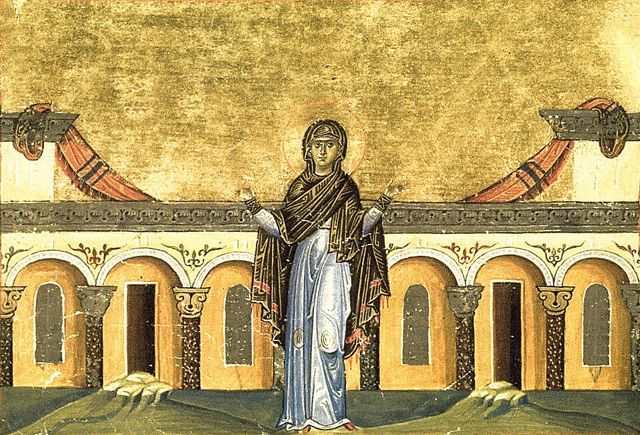
Image: Righteous Syncletica of Alexandria (Menologion of Basil II).jpg · Authors of Menologion of Basil II (circa 985 AC, Constantinople), Byzantine manuscript illuminators[1]: Pantoleon with G · Public domain, via Wikimedia Commons

From Sabine Baring-Gould, The Lives of the Saints, new and revised edition (Edinburgh: John Grant, 1914; first edition 1872). Public domain.

Image: Authors of Menologion of Basil II (circa 985 AC, Constantinople), Byzantine manuscript illuminators[1]: Pantoleon with G, Wikimedia Commons (Public domain)

From Sabine Baring-Gould, The Lives of the Saints, new and revised edition (Edinburgh: John Grant, 1914; first edition 1872). Public domain in the United States. Reproduced unedited, except for short bracketed notes in grey that we added to explain names and terms (“S.” is the old abbreviation for Saint). Some history and judgments reflect 19th-century scholarship.