St. Thalelæus

Leaving everything to pray, yet still drawing people who needed wisdom.

Read the essentials →
February 27 · Hermit

St. Thalelæus

St. Thalelæus

Leaving everything to pray, yet still drawing people who needed wisdom.

Traditional feast

February 27
1914 / pre-1969 calendar, per Baring-Gould (1897)

Current feast

February 27
Secondary source · Wikipedia

Represents

Hermit

Their story

Adapted in modern English from Baring-Gould (1897) · original text below · little is known

Theodoret (5th-century bishop and church historian), who met him, tells of Thalelæus, a hermit who built a hut beside a pagan shrine near Gabala. Despite terrifying noises and apparitions, and the efforts of the shrine's worshippers, he stayed and converted many of them.

He then shut himself in a cramped cage made of two wheels joined by bars, so low that his chin rested on his knees, and had lived in it ten years when Theodoret saw him. Theodoret spoke with many of his converts. Baring-Gould says this penance is not to be imitated, but that it served to impress the rough people of Syria.

Early life

The book says little or nothing about early life. This is how the account begins.

Thin entry · the 1897 book gives only 248 words. We have not filled the gap with invented detail.

"Not only have I heard of this man from others," says Theodoret, "but I saw him myself." Thalelæus erected for his habitation a small hut against an idol shrine, near Gabala, to which many people resorted, and where they offered sacrifice to devils. The evil spirits, enraged at his thus assaulting them in their sanctuary, endeavoured by hideous clamours and frightful apparitions, to scare the Christian hermit away; but every effort of demons and idolaters to drive him from this shrine proved ineffectual. Thalelæus succeeded in converting many who came as votaries to the temple, and persuaded them to bend their necks to the sweet yoke of Christ's law.

What they represent

How they teach us to live

Drawn from themes in the original account

Share your faith, in words and by example. Preaching and conversion are central here.

Practise small acts of self-denial. The account dwells on fasting and penance; a skipped snack or a phone-free hour is a start.

Make time for silence. Solitude and withdrawal to pray shape this life.

Learn from the kind of life it was. Leaving everything to pray, yet still drawing people who needed wisdom.
Read more

The full original · 248 words

Read Baring-Gould’s full account

Baring-Gould’s sources: Greek Menæa. No commemoration in Western Church. Authority:—Theodoret, Philothaeus, c. xxviii.

"Not only have I heard of this man from others," says Theodoret, "but I saw him myself." Thalelæus erected for his habitation a small hut against an idol shrine, near Gabala, to which many people resorted, and where they offered sacrifice to devils. The evil spirits, enraged at his thus assaulting them in their sanctuary, endeavoured by hideous clamours and frightful apparitions, to scare the Christian hermit away; but every effort of demons and idolaters to drive him from this shrine proved ineffectual. Thalelæus succeeded in converting many who came as votaries to the temple, and persuaded them to bend their necks to the sweet yoke of Christ's law. With many of these converts Theodoret conversed. After that Thalelæus had lived thus a while, he devised for himself a strange and horrible penance. He made two wheels, and then joined them by pieces of wood into a species of barrel, but open between the bars. He enclosed himself within this case, which was so low that his chin rested on his knees, and remained therein for many years. He had been ten years in it when Theodoret saw him. This frightful self-immolation is by no means to be regarded as deserving of imitation. But it was called forth by peculiar circumstances, and for a special purpose. The rude people of Syria could be impressed no other way. To win these souls from heathenism this phase of the ascetic life was evoked, it served its purpose, and passed away.

Feast days

Feast: February 27

Nine days · Free

Pray the novena
with us.

One short email a day for nine days. The day's prayer, a line from St. Thalelæus's story, and a nudge to keep going.

Also on February 27
Sts. Julian, Chronion and Besas

Sts. Julian

February 27 · Martyrs
G

St. Gelasius

February 27 · Martyr
St. Honorina

St. Honorina

February 27 · Virgin, Martyr
← All 1726 saints in the library
Sources & notes

Feast-day sources

Story sources

Sources

Credits

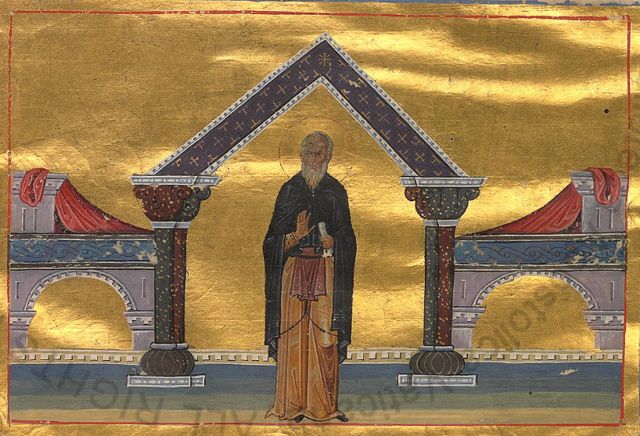
Image: Thalelæus, Menologion of Basil II.png · Authors of Menologion of Basil II (circa 985 AC, Constantinople), Byzantine manuscript illuminators[1]: Pantoleon with G · Public domain, via Wikimedia Commons

From Sabine Baring-Gould, The Lives of the Saints, new edition in 16 vols. (London: John C. Nimmo, 1897), digitized text from Project Gutenberg. Public domain.

Image: Authors of Menologion of Basil II (circa 985 AC, Constantinople), Byzantine manuscript illuminators[1]: Pantoleon with G, Wikimedia Commons (Public domain)

From Sabine Baring-Gould, The Lives of the Saints, new edition in 16 vols. (London: John C. Nimmo, 1897), digitized text from Project Gutenberg. Public domain in the United States. Reproduced unedited, except for short bracketed notes in grey that we added to explain names and terms (“S.” is the old abbreviation for Saint). Some history and judgments reflect 19th-century scholarship.