Baring-Gould’s sources: Roman Martyrology on Sept. 22, Augustinian on Sept. 18. Beatified by Paul V. in 1618, and canonized in 1658 by Alexander VII. Authorities: — A Life by John Magnatones, Bishop of Segorbe, his friend, d. 1571; another Life by Michael Salonio, a contemporary; the Acts of Canonization; Quivcdo of Villegas, Epitome a la historia d. Tomas de Villanueva, Madrid, S. Thomas was born at Fuentana in Castile, in 1488; but received his surname from Villanueva de los Infantes, a town where he had his education, situated about two miles from the place of his birth. His parents, Alphonso Tomas Garcias and Lucia Martinez, were also originally of Villanova. Their fortune was not one of affluence, but it was comfortable; and with their prudent frugality they were enabled liberally to assist the poor. Instead of selling that corn which was not necessary for the subsistence of their family, they made bread of it, which they bestowed on the necessitous. This charitable disposition was the most valuable part of their son’s inheritance, and proved one of the most distinguished virtues in his character during the whole course of his life. When but seven years old he studied every day by various little contrivances to obtain something which he might give to the poor, often depriving himself of part ot his meals for this purpose, and gathering together what scraps he could find at home, or whatever else his parents would allow him to give away: nor were they backward in approving his conduct on such occasions. An instance is recorded which shows how full of charity was the good mother of our saint. A beggar came one day to the door. She told the servants to give him some flour out of the bin. They told her it was empty. “ Then,” said she, “go into the store-room, and bring some thence.”
“ We cleared every particle thence this morning,” said they. “ Go, and look.” They came back, crying: “ See, see ! the bins are full !” And so it was. So the beggar was given abundance. The little Thomas grew up modest and gentle, with a singular abhorrence of falsehood of every sort, and a great love of prayer.
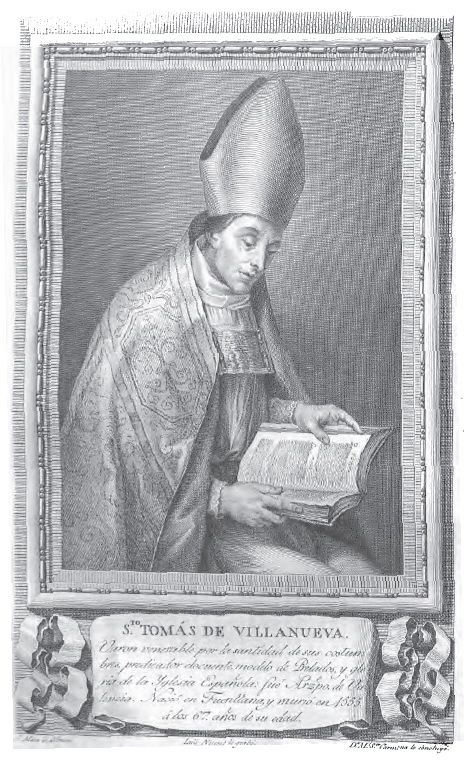
At the age of fifteen he was sent to the University of Alcala, which had been founded lately by Cardinal Ximenes; S. Thomas of Villanova.
and the cardinal, out of regard to his merit, gave him a place in the college of S. Ildefonso. After eleven years spent at Alcala, he was made professor of philosophy, and taught in the university, being then aged only twenty-six. This office he held for two years, and then moved to the University of Salamanca, to lecture there on philosophy. He taught for two more years, and then joined the order of the Augustinian [religious following the Rule of St. Augustine] hermits, 1518, in a house of the Society at Salamanca.
His behaviour in his novitiate was such as showed he had been long inured to austerities, to the renouncing his own will, and the exercises of holy contemplation. The simplicity of his behaviour charmed his fellow religious, and made them admire the manner in which he laid completely aside his own will and self-consciousness. Soon after the term of his novitiate was expired, he was promoted to priestly orders in 1520, and employed in preaching the word of God, and in administering the sacrament of penance. He acquitted himself in these functions with such dignity and success, that he was called the Apostle of Spain. He did not interrupt these employments, nor allow himself any relaxation in his monastic austerities whilst he taught divinity in the public school of the Augustinians at Salamanca. He was afterwards successively prior at Salamanca, Burgos, and Valladolid, was twice provincial of Andalusia, and once of Castile; and behaved himself in all these stations with a sweetness and zeal which gained the hearts of his religious brethren, so that he governed them rather by the example of his life than by the authority of his office. His charity made him accessible to all who wanted his assistance or advice, and the spiritual discernment with which he applied remedies to the maladies of souls was always remarkable. Heavenly succour the saint found in the close union of his soul with God. He fell into raptures at his prayers, especially at mass; and though he endeavoured to hide such favours, he was not able to do so; his face, after the holy sacrifice, shining like that of Moses, sometimes, it is asserted, with poetic exaggeration, dazzling the eyes of those that beheld him. The Emperor Charles V. is said to have been very fond. of hearing the saint preach, and when the archbishopric of Granada fell vacant (1544) he ordered S. Thomas to come to him at Toledo, and offered him the vacant dignity. S. Thomas refused it, and the see was given to Ferdinand de Guevara. At the same time the archbishopric of Valencia was vacated by Don George of Austria, uncle of the Emperor, who resigned the see that he might become Bishop of Liege. Charles, who was then in Flanders, thought it was in vain to offer it to S. Thomas of Villanova, so he determined that it should be given to some one else. But the secretary who made out the letter of recommendation to the chapter to elect, did not catch what the Emperor said in the haste of transacting business, and thought he had mentioned Thomas of Villanova, so he inserted his name in the letter, giving conge d’elire. When Charles V. came to sign it, he saw the mistake, and remarked on it.
“ I will correct it directly/' said the secretary. “ By no means/' answered the Emperor; “ I see in this the hand of God." So he signed the “placet," and it was sent into Spain.
S. Thomas, on hearing of his nomination, hasted to Philip, the Emperor's son, afterwards Philip II., and entreated him not to lay the burden on his shoulders. But all his entreaties were in vain, and he was commanded forthwith by his superiors in the Augustinian Order to obey.
Pope Paul III, sent the bull for his consecration, and j S. Thomas of Villanova. that ceremony was performed at Valladolid by Cardinal John of Tavera, Archbishop of Toledo. The saint set out very early next morning for Valencia. His mother, who had converted his house into a hospital for the use of the poor and sick, and resolved to spend the rest of her days in their service, entreated him to take Villanova in his way, that she might have the satisfaction of seeing him before she died. But the bishop refused. He would not diverge to the right hand nor to the left from the road to his diocese, being persuaded that his present vocation obliged him to postpone all other considerations to that of hastening to the flock committed to his care. He travelled on foot, in his monastic habit, which was very old, with no other hat than one he had worn ever since his profession, accompanied by one religious man of his Order and two servants. Upon his arrival at Valencia, he retired to a convent of his Order, where he spent several days in penance and prayer, that he might be enabled worthily to acquit himself of his charge. He took possession of his cathedral on the first day of the ensuing year, 1545; which he was prevailed upon to do with the usual ceremonies, amidst the acclamations of the people, but when he was led to the throne prepared for him in the church, he cast away the cushions and silk tapestry, fell upon his knees on the bare floor, and embraced the foot of the cross, pouring forth a flood of tears. The chapter, in consideration of his poverty, made him a present of four thousand ducats towards furnishing his house, which he accepted humbly and with thanks; but he immediately sent the money to the great hospital, with orders that it should be expended in repairing the house. The first thing he did after the public ceremonies were over, was to visit the prisons of his bishopric, and judging them too dark and inconvenient, he ordered them to be made more decent and commodious.
It is often said, that “ honours change manners /’ but our saint kept not only the same perfect humility of heart, but as much as possible the same exterior marks of contempt for worldly vanities. He went almost as meanly apparelled as before; and even wore for some years the habit which he had brought with him from his monastery 5 this he sometimes mended himself, as he had been wont to do in his convent. A canon surprising him one day in the fact, expressed his surprise that he should so meanly employ his time, when a tailor would do the work in half the time, and for a trifle. The servant of God said: “ I am still a member of my religious Order, which enjoins poverty. The trifle you speak of will serve for a poor beggar.5' The old ragged clothes which the Archbishop wore were a subject of irritation to the canons, who thought it unbecoming his dignity to be dressed like a pauper. In vain did they remonstrate. “I am vowed to poverty/5 was his invariable answer. The only concession they could wring out of him was that he should wear a silk instead of a dirty old woollen cap. He took his new bit of head gear, and showing it about, said, “ Behold my episcopal dignity, in order that I may be esteemed an archbishop, my worthy canons have forced me to wear this.”
S. Thomas was most bountiful towards his servants. His bishopric was worth eighteen thousand ducats per annum, two thousand of which were paid to Don George of Austria, as a pension reserved to him upon his resignation: twelve thousand the saint gave to the poor, not reserving one penny for the following year, and he allowed himself only four thousand to defray all the expenses of his family, repairs of his palace, &c. There came to his door every day about five hundred poor people, and each of them received bread and pottage, with a cup of wine and a piece of money. He took poor orphans under his care; and for the space of Thomas of Villanova.
eleven years that he was archbishop, not a poor maid was married who was not helped by his charity. He brought up all the foundling infants in his diocese with the tenderness of a mother; often visited them, and gave rewards to those nurses who were especially tender and diligent. To ^iis porters, to make them more diligent in finding children exposed by their parents, he gave a crown for every foundling they brought him. When, in 1550, a pirate had plundered a town in his diocese, near the sea-coast, the archbishop sent four thousand ducats, and cloth worth as much more, to furnish the inhabitants with necessaries, and j to ransom the captives.
Nor was he only the support of the poor himself, but he engaged the great lords, and all that were rich, to show their greatness and wealth, not in gorgeous dresses and festivities, but by becoming the fathers of their vassals, and by liberality to the necessitous. He exhorted them to be richer in mercy and charity than they were in earthly possessions. “ Answer me, O sinner,” he would say, “ what can you purchase with your money better, or more necessary, than the redemption of your sins ?” At other times he would say, “ If you desire that God should hear your prayers, hear the voice of the poor. If you desire that God should forestall your wants, forestall those of the indigent, without waiting for them to importune you; especially anticipate the necessities of those who are ashamed to beg. To make such as these ask an alms, is to make them buy it.”
The blessed man having been forewarned by a vision that he should die on the feast of the Nativity ot the Blessed Virgin, was taken ill of quinsy, attended with fever, on the 29th of August. He began his immediate preparation for his passage by a general confession of his faults, made with many tears. Then he received the last Sacraments of the Church with a devotion and resignation which moved those present to tears. And having commanded all the moneythen in his possession (which amounted to four thousand ducats) to be distributed among the poor in all the parishes of the city, he ordered all his goods to be given to the rector of his college, except the bed on which he lay. Being desirous to go naked out of the world, he gave this bed also to the jailer, for the use of prisoners, but borrowed it of him till such time as he should expire. Understanding that some money had been brought in for him, he caused it to be immediately sent to the poor, though it was then midnight. On the 8th of September in the morning, perceiving his strength fail, he caused the passion of our Lord according to S. John to be read to him, whilst he listened with his eyes fixed on a crucifix. Then he ordered mass to be said in his presence, and after the consecration, recited the psalm, In te, Do mine, speravi, 8zc., tears falling from his eyes; after the priest's communion he said, “ Into thy hands, O Lord, I commend my spirit and at the words he rendered his soul into the hands of God, in the sixty-seventh year of his age, 1555, after having been archbishop ten years. S. Linus,