T

A life spent serving ordinary people.

Read the essentials →
February 7 · Priest, Confessor

St. Tresan

St. Tresan

A life spent serving ordinary people.

Traditional feast

February 7
1914 / pre-1969 calendar, per Baring-Gould (1897)

Current feast

Not verified yet

Represents

Priest
Confessor

Their story

Adapted in modern English from Alban Butler's Lives of the Saints · Baring-Gould original below · little is known

Tresain (in Latin Tresanus) was an Irish priest who left his own country and preached with great zeal in France.

He died as curate of Mareuil on the Marne in the sixth century, and his relics were held in great veneration at Avenay in Champagne. Butler and Baring-Gould both place him in the sixth century.

Early life

The book says little or nothing about early life. This is how the account begins.

Tresan , with his six brothers and three sisters, left Ireland, their native place, and settled at Mareuil on the river Marne, in France, where Tresan hired himself as swineherd to a nobleman. He was wont to drive the pigs to the door of a little church dedicated to St. Martin, and to stand at the door and listen to the recitation of Matins, and assist at the holy Sacrifice of the Mass. By this means he became gradually so thoroughly acquainted with the divine office, that S. Remigius, hearing of him, and having evidence of his sanctity, ordained him priest.

What they represent

How they teach us to live

Drawn from themes in the original account

Pray a little every day. Prayer runs all through this account.

Learn from the kind of life it was. A life spent serving ordinary people.

Read more

The full original · 292 words

Read Baring-Gould’s full account

Baring-Gould’s sources: Gallican Martyrology. Authorities:—Mention by Flodoard in his Hist. Eccl. Remensis, lib. iv. c. 9; and a life from the Lections of the Avenay Breviary; a life given in Colgan; all late.

Tresan , with his six brothers and three sisters, left Ireland, their native place, and settled at Mareuil on the river Marne, in France, where Tresan hired himself as swineherd to a nobleman. He was wont to drive the pigs to the door of a little church dedicated to St. Martin, and to stand at the door and listen to the recitation of Matins [the night prayer of the Divine Office], and assist at the holy Sacrifice of the Mass. By this means he became gradually so thoroughly acquainted with the divine office, that S. Remigius [bishop of Reims who baptized Clovis, king of the Franks], hearing of him, and having evidence of his sanctity, ordained him priest. The legend is told of him that one day having celebrated Mass in this little Church of S. Martin [St. Martin of Tours (d. 397), soldier turned bishop], where he had learnt the holy offices, he returned to Mareuil, but being weary, he thrust his staff into the ground, and laid himself down and slept. And when he woke up, behold the staff had taken root and budded. Then he left it there, and it grew to become a great tree.

When he was dying, the Holy Eucharist was brought to him. He rose from his bed, and casting himself down on the ground, exclaimed, "Hail, most blessed hope, and most holy redemption! Hail, true flesh of Christ, to me precious above gold and topaz and all most goodly stones! Hail, most blessed blood of Christ, poured forth to ransom me, a sinner, and wash away my stains! Hail, Jesus Christ, defend me against the ancient enemy, that the prince of darkness secure me not! I pray thee, number me with thine elect." Then he received the holy Viaticum, and sighed, and his soul had fled.

Relics at Pont-aux-Dames, in Brie. In Art he is represented with a budding staff.
Feast days

Feast: February 7

Nine days · Free

Pray the novena
with us.

One short email a day for nine days. The day's prayer, a line from St. Tresan's story, and a nudge to keep going.

Also on February 7
C

St. Chrysolius

February 7 · Bishop, Martyr
A

St. Augulus

February 7 · Bishop, Martyr
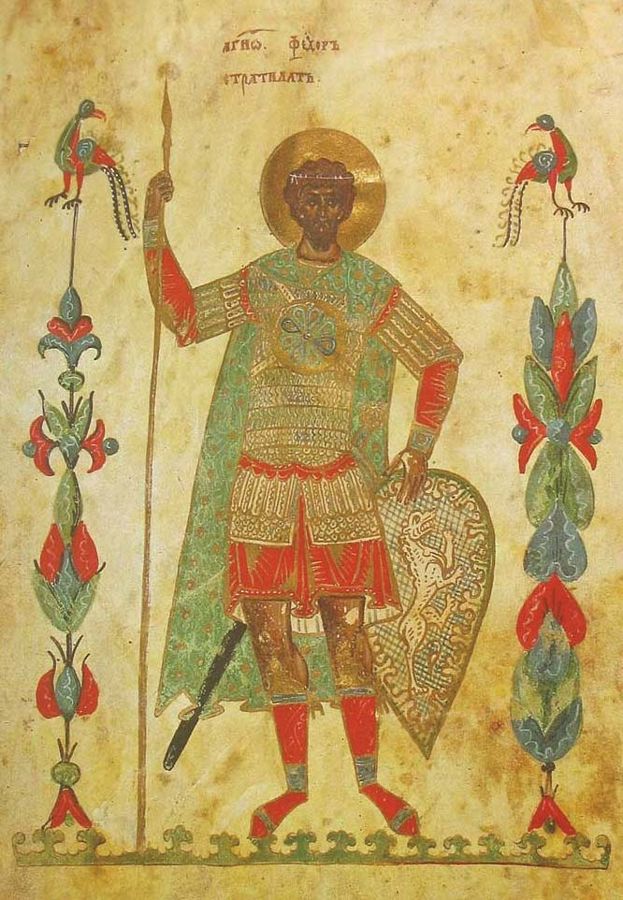
St. Theodore of Heraclea

St. Theodore of Heraclea

February 7 · Martyr
← All 1726 saints in the library
Sources & notes

Feast-day sources

Story sources

Sources

Credits

From Sabine Baring-Gould, The Lives of the Saints, new edition in 16 vols. (London: John C. Nimmo, 1897), digitized text from Project Gutenberg. Public domain.

From Sabine Baring-Gould, The Lives of the Saints, new edition in 16 vols. (London: John C. Nimmo, 1897), digitized text from Project Gutenberg. Public domain in the United States. Reproduced unedited, except for short bracketed notes in grey that we added to explain names and terms (“S.” is the old abbreviation for Saint). Some history and judgments reflect 19th-century scholarship.