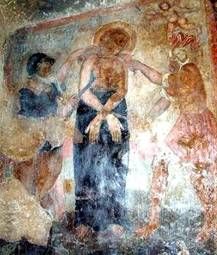
Baring-Gould’s sources: Venerated in the Maurienne. Authority: — A curious old legendary life in the archives of S. Jean de Maurienne.] In the reign of Gun tram, king of Burgundy, a pious woman named Tygris, in the long valley of Maurienne, situated amidst the Cottian Alps, was told by a pilgrim a strange story of the discovery of the relics of S. John the Baptist, and how one of his hands was preserved in Alexandria. Then the woman resolved to possess herself of these relics to enrich therewith her native valley. Accordingly she went to Rome and took ship to Alexandria, and found out the church of the Baptist, and asked in vain for some of the relics it contained. For two years did she remain, persisting in her petition. At the end of that time she was one day in the church alone, when she took the opportunity of no one being present, to possess herself of the thumb and one of the fingers of the Baptist Then she ran away. The sacrilege caused general excitement, [Jane a$.
Land she was pursued. But her woman’s wit proved a match for the Alexandrians. She made an incision under her breast and secreted the thumb and finger of the Baptist in the cavity for milk. She was asked where the relics [the bodily remains of a saint, or objects they used, kept with honor] were, and she protested that for her sins they had miraculously fled away. Her baggage, her clothes, were searched; no thumb and forefinger were to be found, and she was dismissed. She made her way to her native mountain valley, and gave the relics to the church there. In their honour Gunthram founded the cathedral of S. John, and they were solemnly enshrined. There they remain, and are to this day exhibited along with the arm of S. Tygris. It is popularly believed that the thumb and forefinger are the very ones which touched our Lord, when S. John baptized him. Tygris retired to a cell where she was sorely troubled by the chattering of sparrows, and therefore banned them. They departed, and we are told no sparrows are to this day seen at Tegle, where was her place of retreat She died on the morrow of S. John the Baptist’s Day.
S. iEMILIAN, B. OF NANTES [At Nantes on this day, but at Autun on the following day. The Bollandists [Jesuit scholars who since the 1600s have critically studied the lives of the saints] on June 26th, the Gallican M&rtyrologies on June 27th. Authority: — The lections of the church of Autun.J When the Saracens [medieval Christian name for Arab and Muslim peoples] invaded Gaul [roughly modern France and Belgium] in the 8th century, they laid siege to Autun, which held out heroically against them. At this time the church of Nantes was governed by Emilian, or Emiland, a man of noble Breton race, stately in appearance, and remarkable for his abilities. Hearing of the distress of Autun, the bishop gathered an army of Bretons, armed and disciplined them, and marched 5". Adalbert. to the relief of Autun. The Saracens met him at S. Ferreol, then at S. Pierre-L^ trier, and afterwards on the hill of Auxy, and were thrice defeated by him, and he pursued them to Conches; but the main army detached a large body of men to reinforce their routed outposts, and falling suddenly and unexpectedly upon the bishop and his army, routed them completely with the loss of nearly all his men. The bishop fell pierced with arrows, and was buried where he fell, which was at S. Jean de Luze, near Conches. In the nth century his bones was taken up and enshrined, and a church was built over them, which goes by his name, and still attracts pilgrims.